
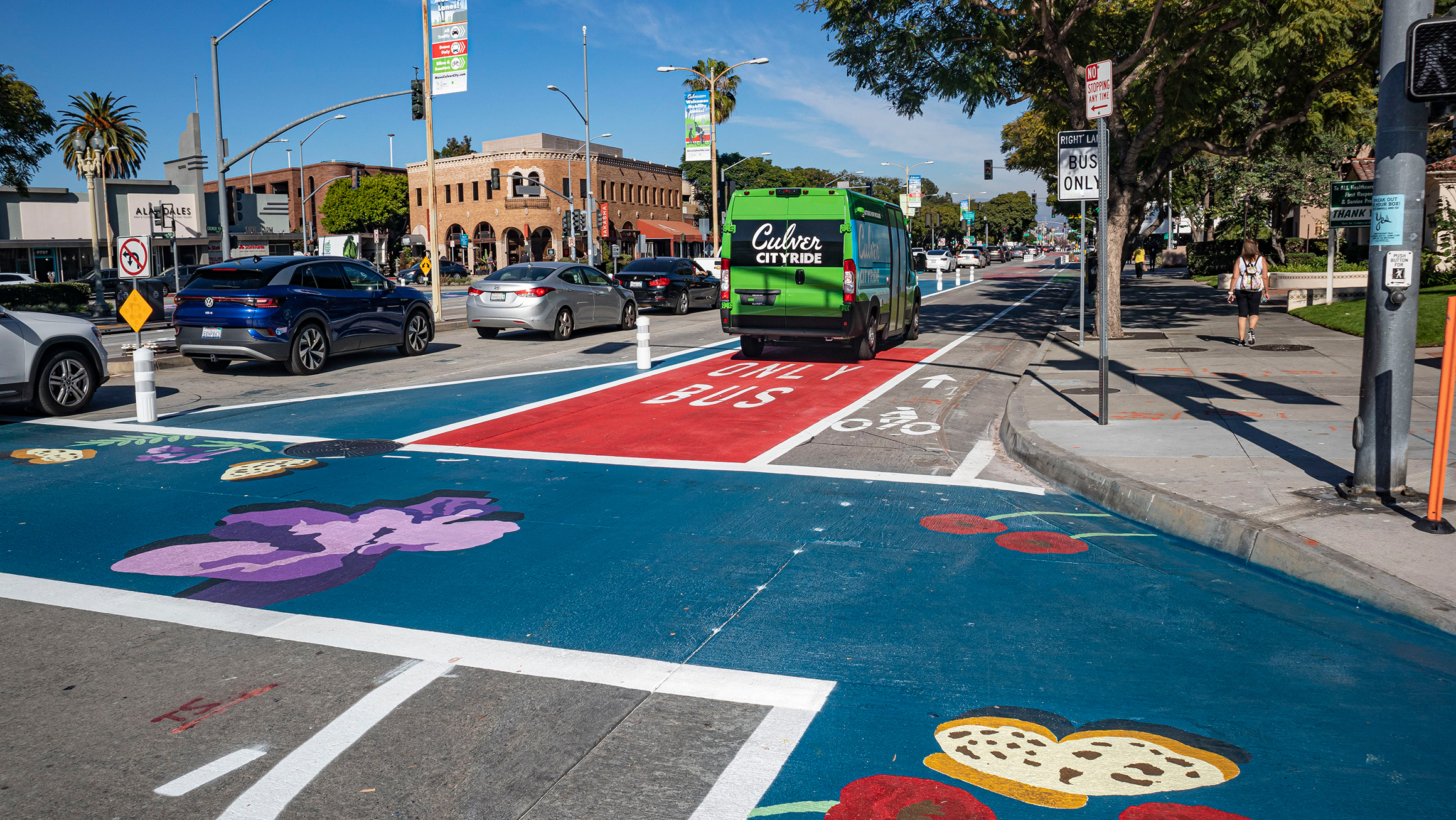
The 2021 Infrastructure Investment and Jobs Act (IIJA), commonly known as the Bipartisan Infrastructure Law, mobilized unprecedented levels of funding to rebuild the nation’s infrastructure. But it also marked a shift in the federal government’s approach to infrastructure investment—taking steps to ensure underserved communities benefited from those improvements.
The Biden administration explicitly promoted infrastructure as a means to advance equity and environmental justice and to reverse previous federal approaches that disproportionately led to harm and underinvestment for low-income communities and communities of color. Much of the law’s spending was subject to the Justice40 initiative, an executive order directing agencies to ensure that at least 40 percent of the benefits of certain infrastructure investments went to historically marginalized communities or those overburdened by environmental harms.
But the Trump administration revoked Justice40 in January 2025 and has reversed the federal government’s previous commitments to addressing historic inequities. Although IIJA funding will continue to be distributed through the end of fiscal year 2026, widespread federal funding cuts, freezes, and delays threaten project implementation for award recipients. With reauthorization scheduled for 2026, policymakers need to know whether and to what extent IIJA met its distributional goals and what lessons can be learned.
In new research, we find that federal agencies did increase investment to disadvantaged counties in terms of dollars spent, but these increases lagged overall funding increases for some agencies.
What has IIJA accomplished?
IIJA funded nearly 400 infrastructure programs, about half of which were subject to Justice40 commitments, at spending levels nearly twice as high as before the law was enacted.
To explore how this increased investment and the accompanying commitments to underserved communities may have shifted funding patterns, we looked at trends in federal spending across four key agencies since 2016. We acknowledge that the distribution of funds does not always equate to the distribution of program benefits, but because benefits are hard to define and differ for every program, we use funding as a proxy to understand which communities were best positioned to receive beneficial infrastructure.
For each agency, we compare the percentage change in overall obligated (or contractually promised) spending from 2016 levels with the percentage change in obligations directed to disadvantaged counties (based on the Biden administration’s definition that included measures of economic and environmental burden). If agencies effectively implemented Justice40 goals, we would expect similar, if not larger, increases in obligations for disadvantaged communities compared with the overall spending increases following IIJA.
As expected, we find that each agency’s total obligated assistance spending increased following IIJA’s passage. Total dollars distributed to disadvantaged communities also increased for all agencies, though the magnitude of the increase exceeded the pace of overall funding increases only at the US Department of Energy (DOE) and the Environmental Protection Agency. For the US Department of the Interior and the US Department of Transportation (DOT), changes in funding for disadvantaged communities lagged overall funding increases.
The DOE increased funding to disadvantaged counties most substantially, distributing $3.7 billion in 2025 compared with $80.7 million in 2016 (a more than 4,000 percent increase). The agency also had the most programs covered by Justice40, so it may have had more leverage to make significant changes.
For the DOT, the slower growth of funding for disadvantaged communities may be a consequence of several of its largest programs, such as the National Highway Performance Program and Surface Transportation Block Grant, not falling under Justice40. Further, decisionmaking for those programs was largely in the hands of states and local governments that may not have shared the federal government’s goals. For all agencies except the DOE, increases in funding levels seem to slow after an initial bump.
Our previous analysis has shown that significant shares of funding through some transportation, climate resilience, energy grid, and broadband programs supported by IIJA went to disadvantaged communities. Although some agencies fell short of Justice40 goals, many historically underserved communities did benefit from meaningful projects breaking ground in their communities. For example, the DOT’s Reconnecting Communities program provided a limited number of communities with funds to connect neighborhoods torn apart by highway construction. In addition, the Biden administration seems to have avoided the pitfall of distributing discretionary funds along partisan lines, ensuring communities across the country had a fair shot at funds and setting a strong example for future funding distribution.
But by some measures, IIJA may have fallen short of its environmental promises, instead reinforcing historic patterns and sending a quarter of transportation formula funding to highway expansion projects.
What challenges did agencies face when implementing IIJA?
The Biden administration’s infrastructure agenda represented a shift in approach that required a whole-of-government response, including agencies rethinking how to distribute infrastructure funding. Any change on this scale was likely to face challenges, but these challenges may hold lessons for future efforts.
For one, the US Government Accountability Office (GAO), which reviewed the implementation of Justice40, noted that agencies struggled to define and measure the benefits of their infrastructure programs. This work was complex and time consuming, given that programs each have their own goals, timelines, geographic scales, target populations, and statutory requirements. Further, benefits could be difficult to attribute and could take years to fully manifest. But agencies did take some steps—such as drafting annual equity plans, thinking critically about program benefits, conducting community engagement, and defining metrics and data needs—that have the potential for lasting improvement in distribution methods.
Second, federal agencies may have limited ability to shift funding patterns on their own. Formula programs typically distribute funds to states and localities, giving these governments decisionmaking power over how funds are spent within their jurisdictions. Although federal agencies can attempt to guide or influence these decisions, they must stay within existing laws and requirements. Discretionary programs, on the other hand, give federal agencies power to choose projects in priority areas from among qualified applicants. But many of the most disadvantaged communities may not have the capacity to submit complicated applications. Together, this means the extent to which funding distributions can shift to meet community needs is reliant on state and local agencies.
Finally, IIJA and Justice40 faced challenges getting the unprecedented levels of authorized funding out the door and to communities. A GAO report found that as of the end of 2024, agencies had only obligated (or promised by signed agreement) 47 percent of authorized funds for 2022–24 and paid 21 percent. More recently, the Trump administration has taken steps to reverse progress by canceling projects; stalling award decisions, review processes, and payments; and firing staff members who oversee programs, producing uncertainty for many communities waiting on funding. The administration rescinded Justice40 and rolled back commitments to equity, cutting off agencies’ efforts right as some were beginning to make progress.
Looking ahead
IIJA represented an unprecedented investment in our country’s infrastructure, both in scale and distribution patterns. Four years after its enactment, some agencies have shifted infrastructure investments to meet the needs of underserved communities. The DOE, for example, made progress in delivering increased funding to disadvantaged communities.
Ultimately, the federal government faced challenges in achieving its infrastructure and equity goals. Much of its burgeoning progress has been cut short or reversed by the Trump administration. Still, with IIJA expiring in 2026 and conversations around reauthorization ramping up, these efforts offer the following lessons for future federal infrastructure spending:
- Critically consider project benefits. IIJA and Justice40 pushed agencies to think through the benefits promised by the projects they oversaw, who those benefits support, and how they can be measured. Continued reflection can better position agencies to support communities and avoid the harms of previous infrastructure projects.
- Coordinate and collaborate with state and local governments. State and local governments are crucial for ensuring federal funding gets to the communities that need it most as they decide how to allocate formula dollars and submit applications for discretionary funding. Federal agencies should work with state and local governments to ensure funding priorities align and help equip communities to submit high-quality applications.
- Follow through on funding commitments. Canceling projects, delaying reviews and award processes, and shifting project requirements can disrupt infrastructure projects and put leveraged funding from other sources at risk while inflating project timelines and increasing construction costs.
As Congress deliberates reauthorizing IIJA, it should carefully consider these lessons and others we highlight in our companion article, The Reauthorization of Federal Transportation Programs Offers Policymakers an Opportunity to Improve Effectiveness, Environmental Sustainability, and Access.
Thank you to Christina Stacy and Elsa Falkenburger for providing detailed feedback on drafts of this article.
