
The federal government has been investing in community-level climate resilience and recovery since the mid-20th century. But as climate change has increased both the rate and severity of natural disasters, spending on resilience and mitigation has expanded and diversified, with an increased focus on investing in the most affected communities. In this summary, we investigate how federal climate-resilience programs distribute their funds.
Why This Matters
As climate change increases the risk of disasters, investment in climate resilience and mitigation is crucial to managing risk, protecting communities, and providing relief as crises emerge. Given the importance of these investments, shifts in investment distribution potentially threaten the long-term viability of communities, particularly low-income communities and communities of color, who are more likely to have suffered from historic underinvestment, and communities that face greater risk from natural disasters due to changing climatic conditions. Assessing the distribution of federal climate-resilience funds can provide policymakers with a framework for determining where further investment may be needed.
Key Takeaways
Our findings in this summary include the following:
- Federal climate-resilience programs provide more per capita funding to western states, particularly in the Great Plains and Southwest.
- Federal climate-resilience programs disproportionately invested in counties with higher environment-related bureaucratic capacity, suggesting that communities with fewer government staff may struggle to apply for and receive funds.
- Climate-resilience programs distributed 38 percent of funding to disadvantaged counties and 48 percent of funding to counties with low incomes.
- All climate programs tended to fund counties with lower levels of particulate matter pollution, suggesting that funding may not be targeting places with higher environmental burden.
Most midwestern and southern states received less than $10 per capita in fiscal years 2022 and 2023
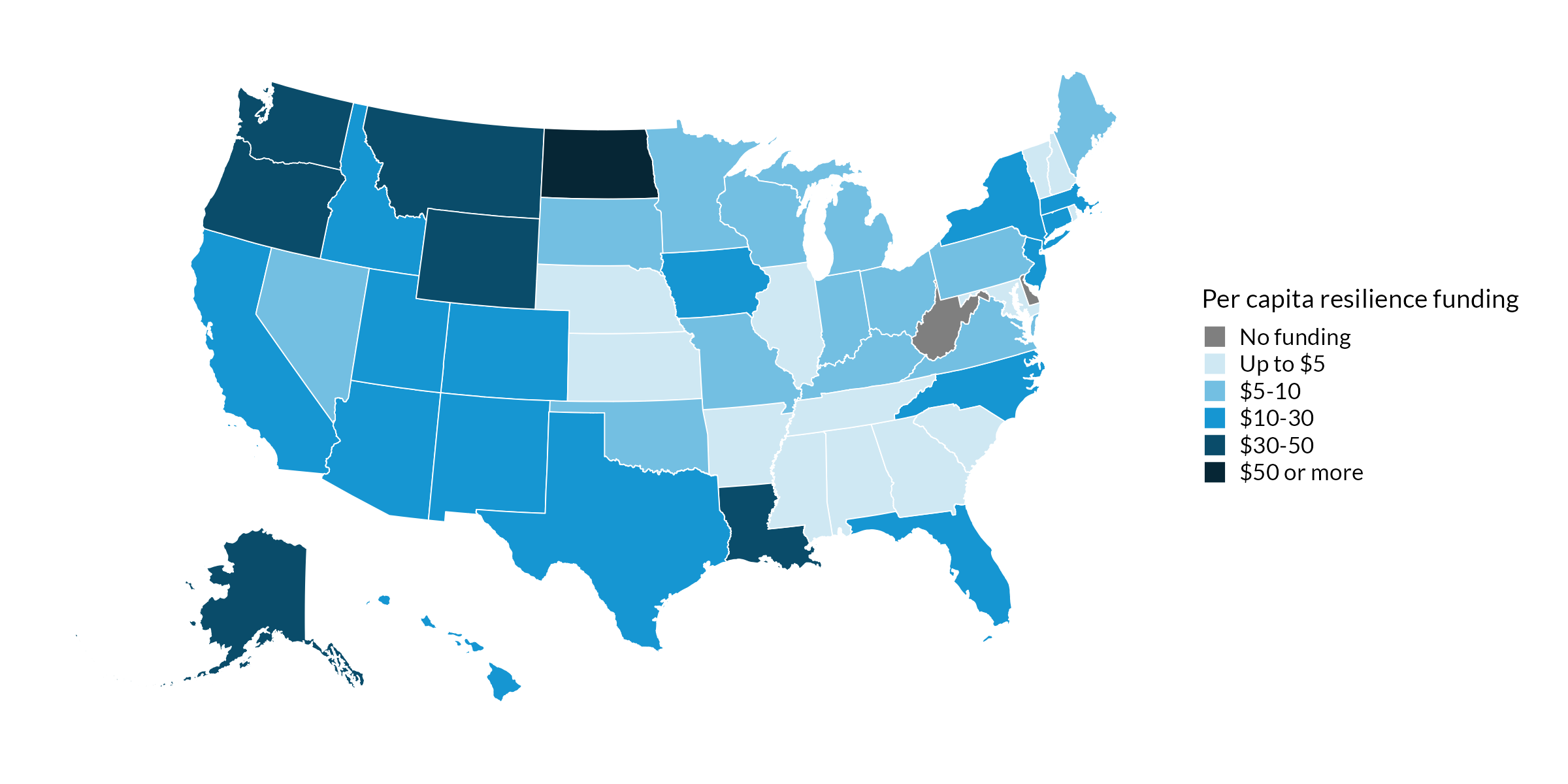
Source: Authors’ analysis of fiscal years 2022 and 2023 award announcements for six competitive resilience programs: Building Resilient Infrastructure and Communities; Urban and Community Forestry Grants; Flood Mitigation Assistance Grant Program; Community Wildfire Defense Program; Regional Conservation Partnership Program; and Climate-Ready Coasts.
How We Did It
We compiled fiscal years 2022 and 2023 data on awards from major climate-resilience programs that received funding through the 2021 Infrastructure Investments and Jobs Act or the 2022 Inflation Reduction Act, with a focus on programs addressing flood mitigation, infrastructure resilience, and wildfire preparedness and recovery. Our analysis is conducted at both the county and state geographical levels. For projects that spanned multiple counties, we listed all jurisdictions where the project was located and assumed funds were distributed evenly among them, then summed all county-level funding to the state level. We collected demographic data from the US Census Bureau 2016–20 five-year American Community Survey, particulate matter exposure data from the Environmental Protection Agency’s Environmental Justice Screening and Mapping Tool, water violation data from the Environmental Protection Agency’s Safe Drinking Water Information System, and environmental staff capacity data from the US Census Bureau’s Census of Governments. We explain our research process in greater detail in the methods appendix.
We conducted similar analyses of fiscal years 2022 and 2023 funding for broadband, energy grid, housing, and transportation programs. These findings are part of a larger effort to track the distribution of federal infrastructure investments (including housing).
