
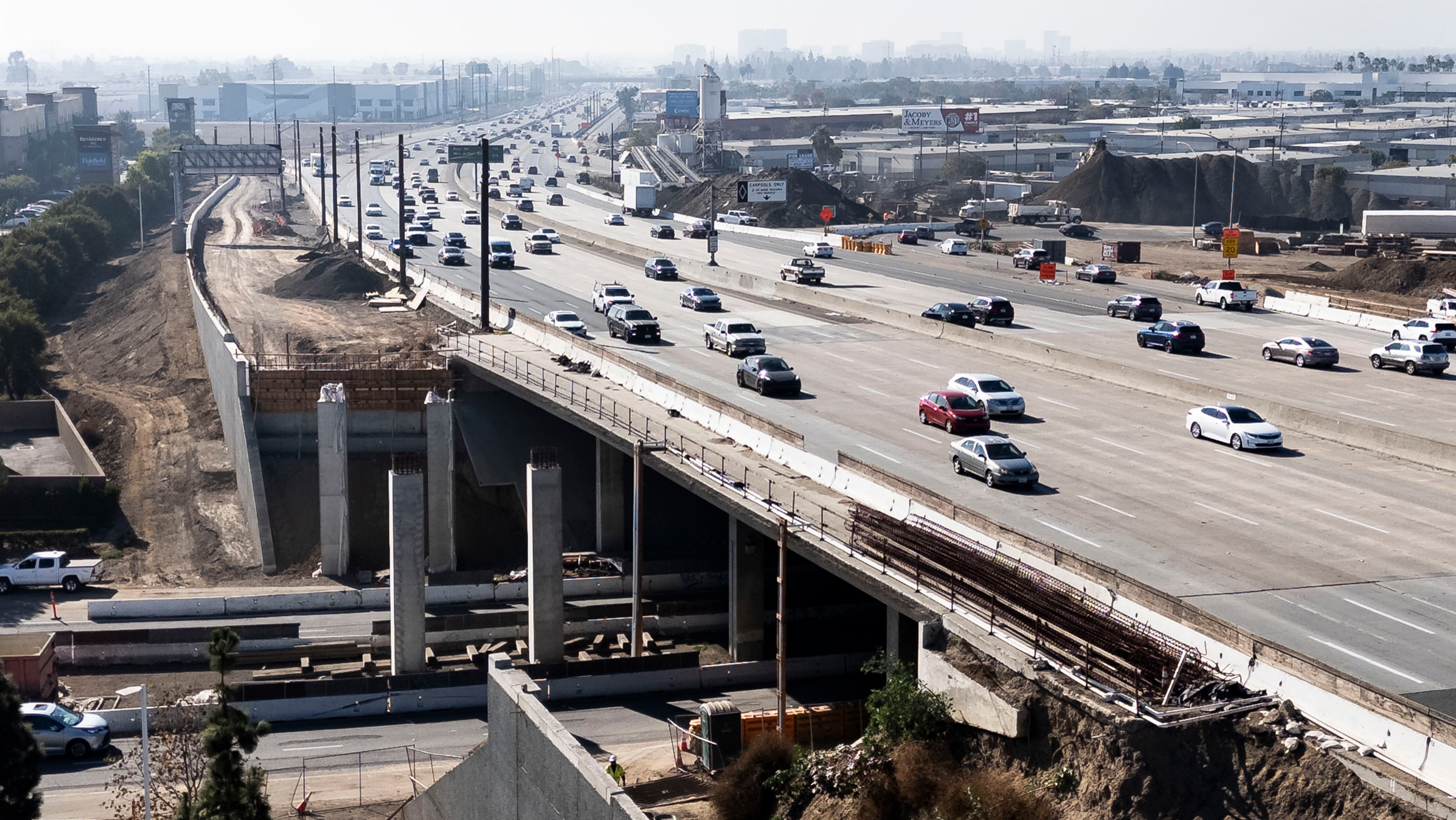
In November 2021, President Joe Biden signed into law the Infrastructure Investment and Jobs Act (IIJA), also known as the Bipartisan Infrastructure Law. The five-year legislation directed billions of dollars toward improvements for the nation’s infrastructure systems, including transportation, water, broadband, and energy.
This investment targeted the poor condition of the nation’s infrastructure, and Biden claimed that it would be “the most significant investment in roads and bridges in the past 70 years…the most significant investment in passenger rail in the past 50 years and in public transit ever.” Noting the law’s sustainability components, the president also argued that it would help the nation “withstand the devastating effects of the climate crisis.”
Four years later, has IIJA expanded investment in the nation’s transportation systems?
We find that the law has been associated with an overall increase in ground transportation capital investment compared with previous years, but that increase is concentrated among highway projects. Meanwhile, overall public transit capital spending has flatlined, and rail projects have experienced a net decline in spending. Additionally, we find evidence that high construction cost inflation has reduced the effects of the IIJA’s investments because the ability to build projects has been limited by faster-than-inflation increases in labor and materials costs.
Trends in US transportation spending since the 1950s
Federal funding represents about a quarter of US public infrastructure spending; states, local governments, and transportation agencies cover the rest. Still, federal legislation helps shape the nation’s infrastructure priorities because many federal grants require a “match” from other levels of government.
In the years preceding IIJA’s passage, inflation-adjusted overall transportation investment had increased, with highway and transit spending being 51 and 75 percent higher, respectively, in 2021 than 40 years before. Operations and maintenance spending had also increased steadily, while capital spending (e.g., new roads or transit lines) has varied over the years.
But the federal government’s share of overall infrastructure spending had generally declined before IIJA, especially on highway investment, as state and local governments have taken on larger roles. In 2020, the share of the federal budget spent on highways and transit was substantially lower than in the late 1970s. This shift can be partially attributed to increased federal expenditures on health care (which have risen even as grants to states and localities for other policy areas have fallen), though infrastructure spending as a share of the total economy has also declined. In 1970, governmental entities spent 1.93 percent of the gross domestic product on transportation infrastructure. In 2020, that share was just 1.65 percent.
Changes in transportation capital investment since IIJA’s passage
After decades of gradual increases in construction spending on transportation infrastructure, IIJA was associated with a more substantial uptick in investment than previous transportation legislation, including 2012’s Moving Ahead for Progress in the 21st Century Act and 2015’s Fixing America’s Surface Transportation Act.
We find that inflation-adjusted spending on highway and street projects increased substantially in the three years following the IIJA’s passage. The majority of these projects were likely centered on infrastructure for passenger cars and trucks, like highways. Projects focused on pedestrian, bike, and bus infrastructure account for a small share of the total, according to recent analysis.
Data since 2023, however, suggest that the large boost in highway and street spending may have been short lived, with a decline in inflation-adjusted spending over the past two years.
And spending on rail transit flatlined despite the law’s passage, with declines for projects managed by state and local governments. This drop may partially result from governments redirecting capital investments toward operational expenses following the COVID–19 pandemic, which led to a substantial decline in farebox revenues.
We did identify a large jump in direct federal spending on nonhighway transportation investments (e.g., railways), likely because of the law’s support for intercity rail, which predominately went to Amtrak, a federal agency. These increases occurred more quickly than those experienced after other recent infrastructure laws were enacted.
Construction cost inflation has diminished the value of IIJA’s increased spending
Although evidence shows that IIJA increased spending on transportation infrastructure nationwide, it is possible that this added spending has not resulted in additional infrastructure.
We compared construction spending with the Bureau of Labor Statistics’ Producer Price Index for government construction, which standardizes the costs of materials and services (e.g., labor) for government procurement over time. This index can show whether new spending has led to additional infrastructure.
Since IIJA went into effect, our comparisons indicate only a limited increase in additional highway and street infrastructure created overall. We also find suggestive evidence of a net decline in investment in passenger and freight rail transportation over the same period and see no evidence that overall spending on public transit capital investments (e.g., bus and rail) increased, when accounting for rapid increases in labor and materials costs.
Some of the trends we document here may reflect governments directing funding toward productivity-enhancing investments, such as better equipment, which would imply a more sustainable use of funds than these data show. Further, it often takes several years for projects to move from planning to ribbon cutting. We find that spending on bridges declined until 2023, when investments started picking up again. Transit projects may take more time to get going than roadways, meaning that increased funding from IIJA for bus and rail investments may not have kicked in yet.
Future research based on more detailed data, such as miles of roadway constructed, is necessary to confirm our findings.
Catalyzing future investment in the nation’s transportation infrastructure
IIJA promised a massive increase in the scale of investment in the nation’s transportation system. Evidence suggests that the law was associated with an uptick in spending on streets and highways, but it did not do much to increase production of public transportation lines.
This outcome suggests that, as others have found, states and localities primarily leveraged transportation funds from IIJA to expand highway construction rather than invest in transit. Further, the law’s effects on actual construction—how many roads or transit lines were built—were marginal at best. A few trends can explain this outcome.
First, declining productivity had already hamstrung transportation construction across the country. The cost to build a mile of metro subway in the US has increased to higher levels than in other countries, the cost to purchase a public bus is sometimes three times as expensive in the US as it is abroad, and the cost to build a mile of highway increased rapidly between the 1960s and 1980s. Despite more federal spending on transportation infrastructure, the actual value of that money may have declined in the current productivity environment. To build more efficiently, transportation agencies may need to explore more creative planning and construction processes.
Second, there simply was inadequate money available given inflationary trends. The increase in labor and materials costs during and after the COVID–19 pandemic was largely unanticipated at the time of the law’s writing and overwhelmed its spending increases.
Third, state and local governments may have reduced their own funding contributions even as federal support increased. Our data show this scaling back likely occurred with transit capital funding.
Finally, the COVID–19 pandemic may have produced labor and supply chain shortages that undermined the investment.
As federal policymakers in Congress consider reauthorizing the programs funded by IIJA over the next year, they must address these challenges. We recommend doing so by spending more effectively, focusing on projects that advance environmental sustainability, and ensuring that funds go to the communities that need them most. Learn more about reauthorization and our recommendations in our companion article, “Reauthorization of Federal Transportation Programs Offers Policymakers an Opportunity to Improve Effectiveness, Environmental Sustainability, and Access.”
Thank you to Adie Tomer, Benjamin Swedberg, and Philip Plotch for providing detailed feedback on drafts of this article.
