
Since the passage of the Infrastructure Investment and Jobs Act in 2021, the United States federal government has sought to significantly expand broadband coverage to millions of Americans, with a particular focus on rural and tribal areas. This effort has come in the form of grant programs managed by the US Department of Agriculture, the National Telecommunications and Information Administration, and the Federal Communications Commission. In this summary, we investigate how funding from these programs has been allocated, specifically looking at competitive programs that received funding from the Infrastructure Investment and Jobs Act, to understand if these investments have gone to the communities that need them.
Why This Matters
Internet access is essential to participating in modern life. Yet 45 million Americans lack access to high-speed broadband, which places them at a significant disadvantage. Without broadband, it is harder to find and apply for jobs, access online education and telehealth, and connect with family, friends, and communities—all of which can potentially exacerbate social and economic inequalities.
Key Takeaways
Broadband programs prioritized high-need communities, particularly in rural and tribal areas. In particular, we found the following:
- Some programs, such as the ReConnect and Tribal Broadband programs, distributed as much as 60 percent of their funding to disadvantaged counties and nearly 80 percent to counties with low incomes.
- Counties with lower shares of households with internet access and lower broadband speeds received more funding.
- Funding was heavily concentrated in counties with low population densities.
- Due to an emphasis on rural and tribal communities, broadband investments were generally concentrated in a few large states in the Great Plains and other parts of the West.
Per capita funding for competitive broadband programs, fiscal years 2022 and 2023
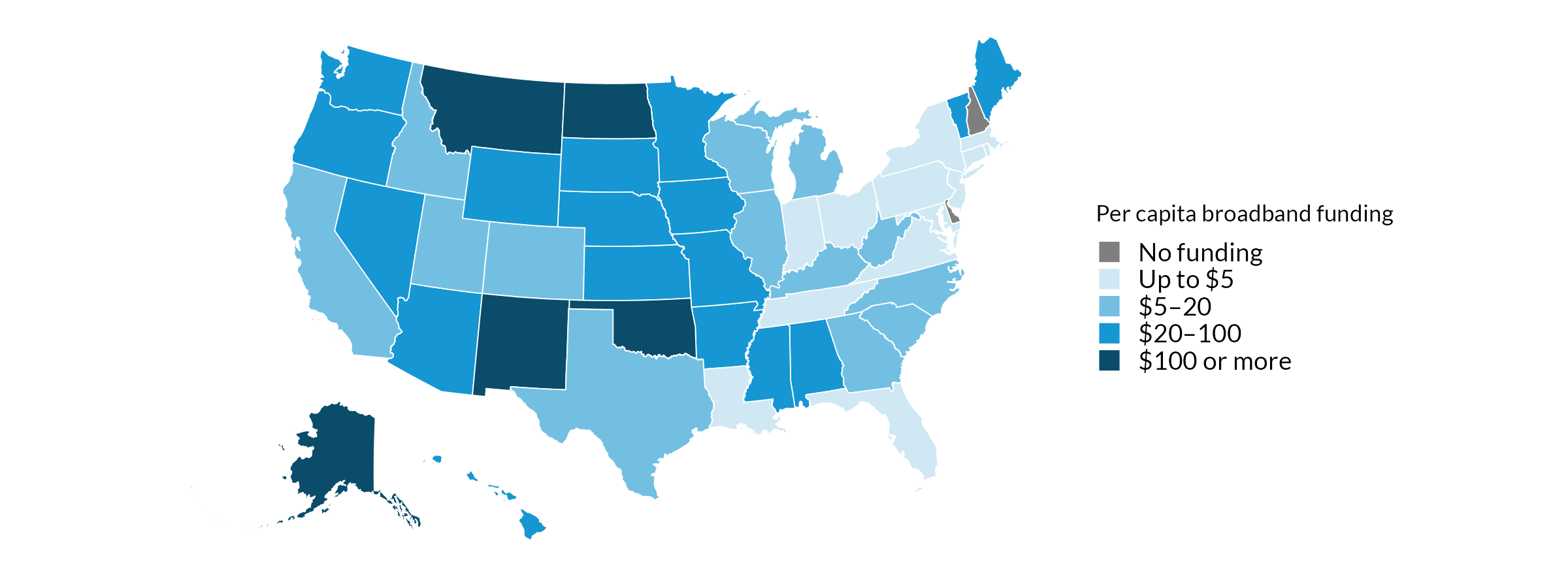
Source: Authors’ analysis of 2022 and 2023 program award announcements from four competitive energy programs: Affordable Connectivity Outreach Grant Program, Rural Development Broadband ReConnect Program, Tribal Broadband Connectivity Program, and Enabling Middle Mile Grant Program.
How We Did It
We compiled fiscal years 2022 and 2023 data on awards from major competitive broadband programs that received funding through the Infrastructure Investment and Jobs Act. We conducted our analysis at both the county and state geographical levels. For projects that spanned multiple counties, we listed all jurisdictions where the project was located and assumed funds were distributed evenly among them, then summed all county-level funding to the state level. We collected demographic and broadband-specific need-based indicators from the US Census Bureau 2016–20 five-year American Community Survey and the Federal Communications Commission Form 477. We outline our analysis in greater detail in our methods appendix.
We also conducted similar analyses of fiscal years 2022 and 2023 funding for energy grid, climate resilience, housing, and transportation programs. These findings are part of a larger effort to track the distribution of federal infrastructure investments (including housing).
