
2022 Impact Report
Evidence in Motion
Let Urban help ignite change in your community. Learn how you can connect with us, partner with us, and support work that delivers insights to improve people’s lives.
Urban Institute’s research moves.
It makes its way to community gatherings. To boardrooms and newsrooms. To city halls and the White House.
And when it reaches business executives, advocates, lawmakers, and community leaders driving change, Urban’s work inspires. It influences. And it informs decisions about the shape of programs, policies, and investments—all of which affect the quality of people’s lives and the opportunities available to them.
In 2022, a range of changemakers tapped Urban’s expertise to help strengthen their endeavors to advance racial and economic justice, bolster families’ financial security, and revitalize communities. In this look back at the year, we offer a snapshot of who relied on Urban’s research, data, and strategic advice and how our work helped move the needle toward a society where all people have a fair shot at achieving their version of success.
See how policymakers, practitioners, media, advocates, philanthropy, and corporations used Urban’s work in 2022.
Using Evidence-Informed Ideas to Support Working Families
Many working parents who qualify for food, medical, and child care assistance to help support their families do not receive the aid they need, in part because of cumbersome state benefit processes and requirements. In 2022, amid a renewed federal focus to improve parents’ experiences with safety net programs and advance equity by expanding their access to these supports, Urban experts curated lessons from our previous research on how states can streamline their processes with an equity focus. We packaged these evidence-informed tips into an easily digestible fact sheet designed to educate those in Congress and beyond. Five months later, inspired by the evidence-based strategies we provided, Senator Maggie Hassan (D-NH) introduced a bill cosponsored by Senator John Cornyn (R-TX) that provides grants to states to minimize administrative burdens on families seeking child care assistance. Such legislation holds great promise: if passed, it could smooth access to the critical supports many parents juggling work and child care need, reduce inequities in access, and help families create more stability as they raise their children and strive to advance in their careers.
Related 2022 Work
Report: Balancing at the Edge of the Cliff
Urban Wire post: A Safety Net of Income Supports Won’t End Financial Insecurity Alone. Addressing Wealth Gaps Is Just as Important.
Project: Student-Parent Families at the Center
Report: What Child Care Arrangements Do Parents Want during Nontraditional Hours?
Explore More: Child Care and Early Childhood Education / Families / Social Safety Net

Photo by FatCamera/Getty Images
Understanding the Health Coverage Implications of Unwinding COVID-19 Relief Legislation
Urban analyses helped spark debate among lawmakers over how best to address the expiration of a key policy that ensured millions of people had continuous health coverage during the COVID-19 public health emergency. In 2020, the Families First Coronavirus Response Act prevented state Medicaid agencies from disenrolling people during the emergency unless they requested it. Urban’s analyses were the first to show that this policy was a main driver of historic increases in Medicaid enrollment. We later showed that an estimated 18 million people were likely to lose Medicaid coverage after the continuous coverage requirement expired. Urban’s projections were widely covered in national and state media and helped prompt advocates, state Medicaid agencies, and federal policymakers to focus on mitigating coverage losses.
Ultimately, Congress passed legislation in December 2022 that permitted states to unwind continuous coverage and resume regular Medicaid renewals in April 2023. Lawmakers also enacted several provisions to help people maintain their health insurance. Among other changes, the legislation permanently extended a policy that allows states to provide a full year of postpartum Medicaid or Children’s Health Insurance Program (CHIP) coverage. Leading up to the passage of federal legislation, Urban research identified access gaps and health and financial burdens experienced by uninsured new mothers. Our experts also estimated that providing 12 months of postpartum Medicaid or CHIP coverage in all states would make 123,000 uninsured new mothers newly eligible annually. These findings were cited by key governmental and nongovernmental stakeholders, including members of Congress [PDF] and the Medicaid and CHIP Payment and Access Commission [PDF] as the legislation was debated.
Leaning into Data to Target Student Debt Relief
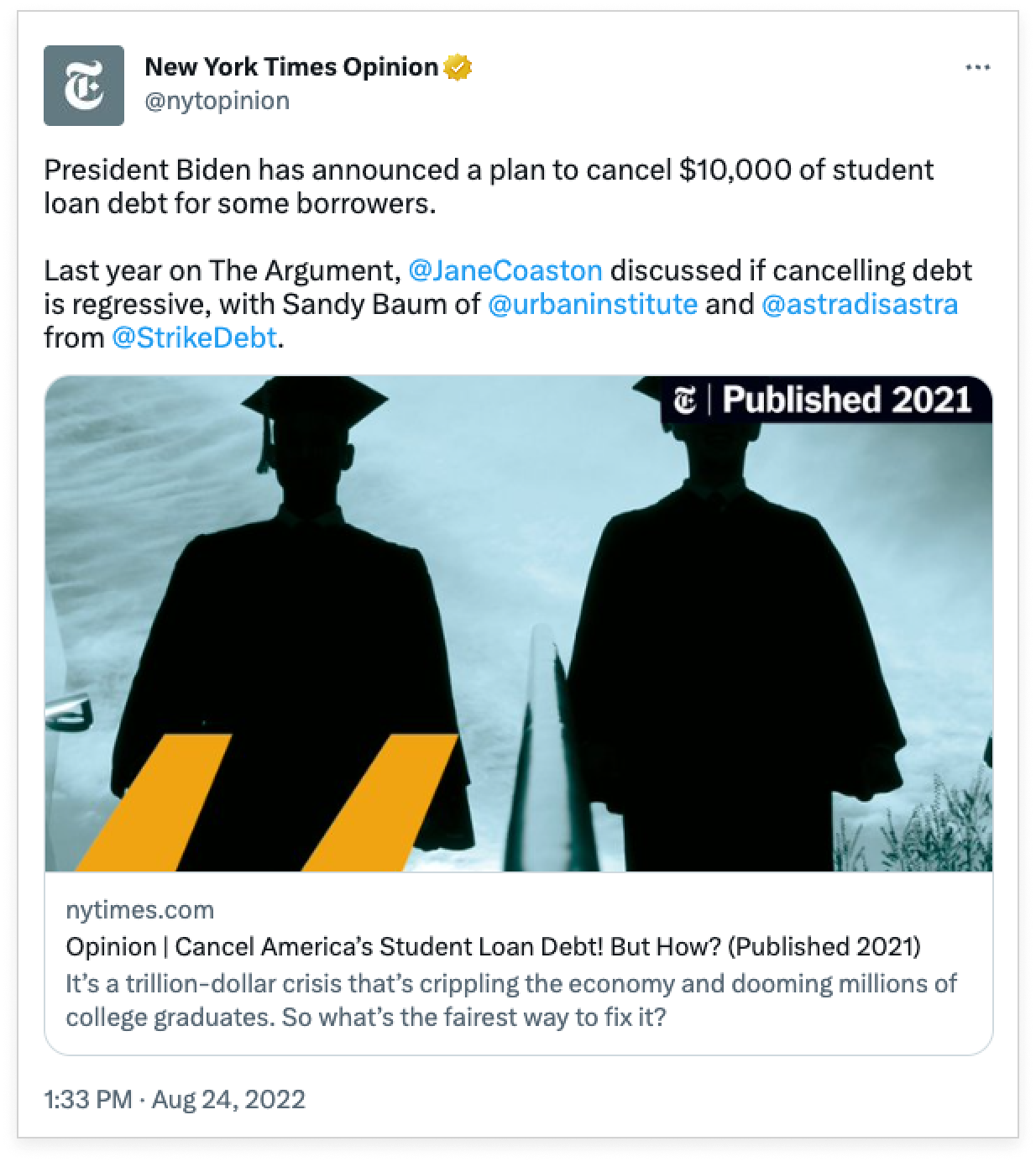
Urban researchers have long analyzed education policies, including those related to student loan forgiveness. In 2021, an Urban researcher offered an analysis on Urban Wire that introduced the idea of basing student loan debt forgiveness on Pell grant receipt. Then, last year, as the Biden administration struggled to realize the president’s campaign pledge to provide broad student debt relief, Urban researchers offered our analysis to help inform the process. President Biden’s fall 2022 announcement of $10,000 in debt relief for many borrowers featured the unexpected addition of another $10,000 in forgiveness for Pell grant recipients, modeled on Urban’s proposal. The White House announcement cited Urban’s analysis showing that targeting aid to Pell grant recipients would increase reach to Black and Latinx borrowers, whose families tend to be less wealthy than their white counterparts and face higher debt burdens. The debt relief approach our experts proposed not only relieves borrowers’ financial burden, it also holds promise in narrowing our country’s yawning racial wealth gap.
Related 2022 Work
Data tool: Who Should Pay? Designing a More Equitable Income-Driven Repayment Plan
Report: Understanding Racial and Ethnic Differences in the College Experience
Report: Federal Undergraduate Loan Limits and Inflation
Data tool: Degrees of Value: How Policymakers Can Design a High-Quality College Accountability System
Article: How Student Loan Debt Affects the Racial Homeownership Gap
Explore More: Education / Paying for College / Racial Equity in Education
PRACTITIONERS

Photo by Maura Friedman for the Urban Institute
Spotlighting Research to Expand Strategies that Reduce Homelessness
Urban helped design and evaluate Denver’s Supportive Housing Social Impact Bond (SIB) initiative to increase housing stability and decrease jail stays among people experiencing chronic homelessness—and interacting frequently with the criminal legal and emergency health systems. One of the first such programs in the country, the Denver SIB combined a permanent housing subsidy with intensive services, such as connections to mental health counseling, to help people stay housed. Urban’s five-year evaluation found that the supportive model had powerful effects on reducing homelessness, arrests, jail days, and emergency department visits.
Our findings inspired Denver to establish a new line item in the city budget to continue the SIB program. And in 2022, our work led to a Treasury Department grant that supports a major expansion of supportive housing for people at the intersection of homelessness, the criminal legal system, and emergency health care in Denver. Since its inception, this ongoing work has created at least 450 supportive housing units for people experiencing chronic homelessness in Denver County. Urban is now helping Colorado evaluate a statewide expansion of supportive housing based on the Denver SIB. And at least four other communities, including Hamilton County, Tennessee, are seeking our strategic guidance as they consider innovative solutions to chronic homelessness.
Related 2022 Work
Story: Policing Doesn’t End Homelessness. Supportive Housing Does.
Brief: Evaluation of the Homes for the Homeless Fund
Urban Wire post: Five Ways to Better Serve Women Experiencing Homelessness
Story: ‘A Jolt of Energy’ to San Francisco’s Homelessness Response System: What the Chronic Homelessness Initiative Shows about Philanthropy’s Role in Addressing Complex Social Issues
Explore More: Homelessness
MEDIA
Relying on Medical Debt Data to Inform News Investigation
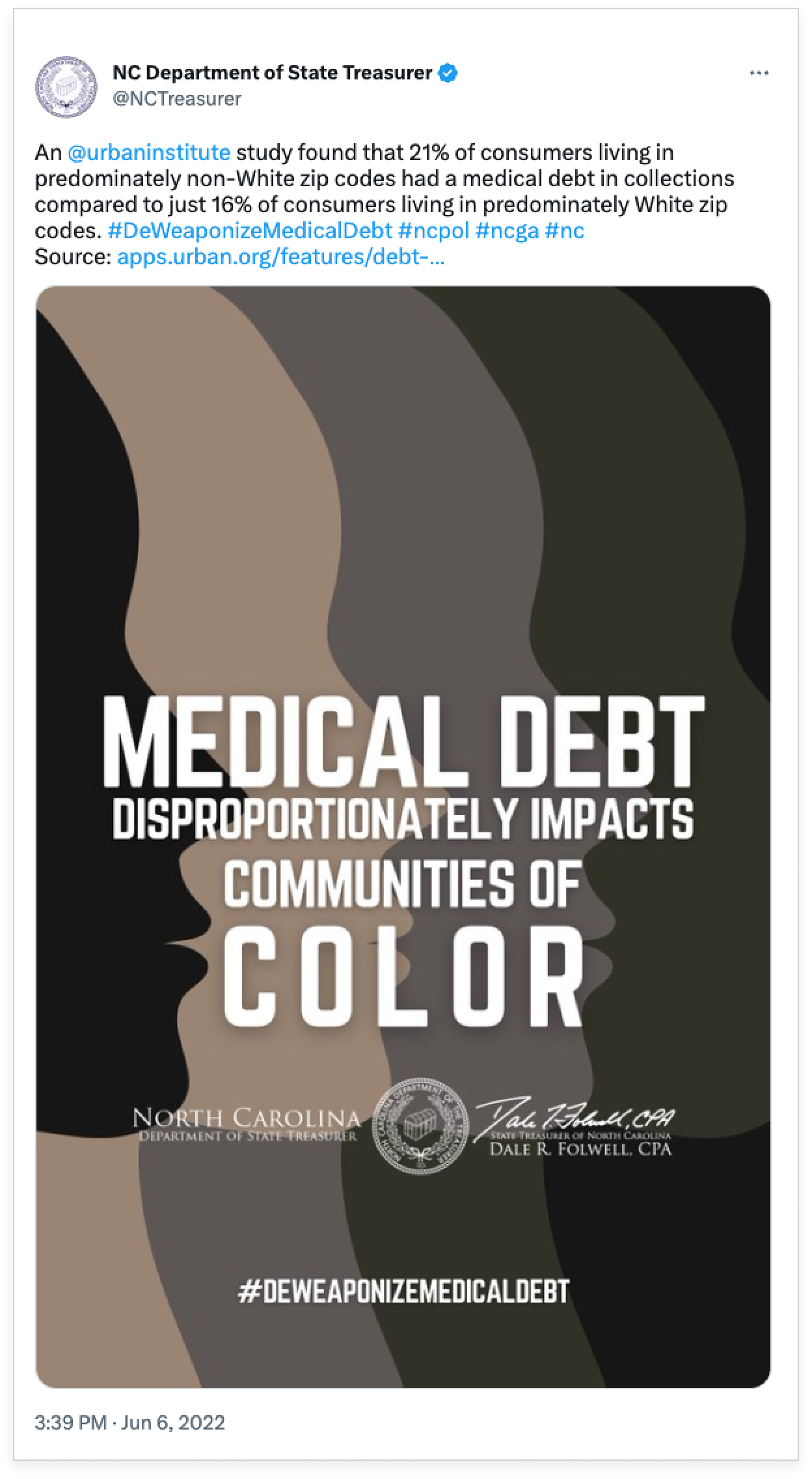
An investigation by Charlotte, North Carolina’s WBTV News as well as a study by the National Academy for State Health Policy and the North Carolina State Health Plan relied on Urban data about medical debt and credit health during the COVID-19 pandemic to help show that tax-exempt hospitals in North Carolina were improperly charging patients who qualified for free medical care—and the implications of these medical bills for families. Following the local news station’s report, North Carolina State Representative Ed Goodwin sponsored the Medical Debt De-Weaponization Act [PDF], a bipartisan bill to reduce burdensome medical debt and protect patients from unfair practices. The bill requires hospitals to screen for charity care, mandates free coverage for patients with incomes at or below 200 percent of the federal poverty level, and prevents hospitals from foreclosing on patients’ homes or garnishing their wages.
Related 2022 Work
Brief: Which County Characteristics Predict Medical Debt?
Report: An Evaluation of THRIVE East of the River: Findings from a Guaranteed Income Pilot during the COVID-19 Pandemic
Fact sheet: What Can Policymakers Do to Help Young Adults Cope with Debt?
Event: Baby Bonds in Context: A Systems Approach to Closing the Racial Wealth Gap
Story: Changing a Life: Exploring How Barriers and Social Interventions Influence Mobility and Inequality
Explore More: Wealth and Financial Well-Being / Family Credit and Debt
Sharing Tax Analyses to Educate the Public
Urban-Brookings Tax Policy Center’s (TPC’s) analyses of the Inflation Reduction Act of 2022 (IRA) were fundamental in shaping the national dialogue on the potential implications of the law. Major media outlets cited our analyses that demonstrated how the law would affect corporations, Internal Revenue Service funding, and people’s tax burdens based on their income levels. Among the media that used our findings to help the public understand the law’s impact were the Washington Post, National Public Radio’s Planet Money, and New York Times columnist Paul Krugman. White House economic advisor Jared Bernstein also leaned on TPC’s analyses during a live Fox News interview about the IRA.
ADVOCATES
Using Evidence to Narrow the Racial Homeownership Gap
Foundational research by Urban is informing how a Living Cities initiative called the Closing the Gaps Network is working to narrow racial and income disparities in homeownership and entrepreneurship in six cities, as well as how the National Fair Housing Alliance, a Washington, DC, civil rights organization, carries out its Keys Unlock Dreams Initiative to expand homeownership and generational wealth in 10 cities, including Atlanta, Columbus, Detroit, and Memphis. Many neighborhoods in these and other cities are unequally resourced; some are rich with amenities, while others, particularly those with more residents of color, are not. And finding an affordable home—often a first step to building wealth—is increasingly out of reach.
In 2022, Urban’s research findings provided housing advocates, consumers, and policymakers evidence-based guidance as they seek to shape local housing policies and close the racial homeownership and wealth gaps in their communities. We also delivered an easy-to-share video series that advocates can use to explain how national housing trends are rooted in local challenges and to advocate for solutions. When in the hands of these diverse changemakers, Urban’s evidence-informed insights are contributing to making homeownership a reality for potentially millions of people, especially Black and Latinx families who have been left behind by historical racist policies such as redlining and racial covenants.
Related 2022 Work
Report: A Landscape Scan of Homeownership for Households of Color
Urban Wire post: What Will It Take to Help Latina Moms Hold onto Homeownership Gains?
Brief: The GSEs’ Equitable Housing Finance Plans: Strengths and Missed Opportunities
Article: How Student Loan Debt Affects the Racial Homeownership Gap
Explore More: Racial Homeownership Gap
Developing an Approach to Measure Equity in Policymaking
In partnership with Oakland, California’s PolicyLink, a national research and action institute advancing racial and economic equity, Urban developed a groundbreaking framework for measuring whether federal legislation promotes or impedes equity in terms of race, gender, geography, and other dimensions. The measurement framework is part of Urban and PolicyLink’s multiyear Equity Scoring Initiative, which aims to help legislators systematically assess how a proposed bill might benefit or harm all people and communities. Measuring such progress is top of mind in this new era of racial reckoning and equity accountability, fueled in part by the executive order on advancing racial equity President Biden issued on his first day in office. Urban’s data-driven equity scoring system provides the groundwork for the legislative branch to consider embedding equity assessment in its policymaking process. In 2022, we also illustrated how equity analysis could be applied to an expanded child tax credit and the Family and Medical Insurance Leave Act so policymakers could score these policies. This work represents the first of several such analyses Urban experts will provide as part of the initiative, which a cornerstone effort of PolicyLink’s racial equity governing agenda to build racially equitable governments and institutions. Analyzing data to understand the differential consequences of policy decisions could, over time, ameliorate the effects of systemic and structural inequities. Emerging evidence shows equitable policies can create cascading benefits for all people and places—especially communities of color.
PHILANTHROPY
Designing Strategies to Boost Upward Mobility
Urban first collaborated with the Bill & Melinda Gates Foundation in 2015 to explore what it would take to dramatically increase mobility from poverty. Initially, Urban hosted the Gates-funded US Partnership on Mobility from Poverty and worked with experts across the country to define the conditions that can help propel people out of poverty and how to measure that progress. And as part of Urban’s Boosting Upward Mobility initiative, we provided eight counties with funding and technical assistance to better understand and advance upward mobility in their communities. In 2022, those counties developed action plans informed by Urban’s framework for lifting residents out of poverty and advancing racial equity, bringing to bear local partnerships and resources, including state and local pandemic recovery funds. The tools and technical assistance Urban provided is helping spur the systemic change necessary for residents to achieve economic success, have autonomy over their lives, and feel valued in their communities.
Measuring Rural Communities’ Strengths to Shape Programs
New York-based Heron Foundation, which focuses on improving economic opportunity for people and places through enterprise investments, turned to Urban in 2022 to develop a framework for collecting data on and measuring communities’ resources—such as their financial, civic, and natural infrastructure—to help the foundation best align its programs with its investment philosophy. Urban’s data gathering and analysis are under way in several rural communities of Alabama along with rural counties across 25 states. Urban’s partnership with Heron builds upon our Reenvisioning Rural America typology of the strengths of rural communities, our tracking of capital flows into cities and neighborhoods, and our report on the efforts of the Partners for Rural Transformation, six community development financial institutions working toward a reimagined future for rural America and the people who call it home. Our work with Heron Foundation could spur additional capital investments in rural communities to help strengthen families and community wealth and well-being.
Related 2022 Work
Urban Wire post: Three Ways Congress Can Ensure a Little-Known CHIPS Act Program Benefits Rural Communities
Event: Building Rural and Native Communities’ Resilience to Disasters
Brief: Defining “Rural” for the Study on Human Services Programs in Rural Contexts
Story: Revitalizing a Tribal Economy through Cultural Connection
Explore More: Rural People and Places

Photo by Rhiannon Newman for the Urban Institute
CORPORATIONS
Drawing on Financial Data to Boost Black Homeownership
Corporations across the US sought Urban’s 50-plus years of expertise in housing issues to advise them on how best to target investments and incubate innovations to increase homeownership and housing affordability, particularly among Black households. In 2022, we collaborated with the Federal Home Loan Bank of San Francisco, a cooperatively owned wholesale bank, to develop evidence on using alternative financial data—such as people’s rental payment history—to better assess a borrower’s credit risk and mortgage performance. Our experts also provided analyses on policy efforts to mitigate the effects of student loan debt on mortgage lending and homeownership. On both topics, Urban offered practical guidance for member financial institutions of FHLBank San Francisco to pilot evidence-informed solutions we identified through our research. While such guidance is no silver bullet, it’s a promising step toward ensuring more Black families become homeowners and, ultimately, closing the racial homeownership gap.
Applying Innovative Insights to Invest in Housing Affordability
As part of JPMorgan Chase’s broader investment in affordable housing and closing the racial wealth gap, the firm partners with Urban to identify, test, and scale promising solutions to improve housing stability and affordability for Black, Latinx, and other households of color through the Housing Innovation program. In 2022, JPMorgan Chase selected a new cohort of grantee organizations who will carry out and evaluate innovations to increase climate-friendly affordable housing in Buffalo, New York; Inland Valley, California; Rio Grande Valley, Texas; Washington, DC; and across the state of Florida. They join 11 other housing innovation grantees Urban supports to achieve their goals, measure their impact, and learn from one another. To inform the broader housing field, Urban is also conducting research and hosting events that elevate challenges and lessons learned from the grantees’ work to support policymakers and practitioners in addressing the nation’s housing crisis. The evidence Urban provides, along with grantees’ insights, is shaping JPMorgan Chase’s philanthropic and firmwide strategy to better support renters and homeowners of color across the country.
Related 2022 Work
Report: Guaranteed Income as a Mechanism for Promoting Housing Stability
Report: Building a Housing Justice Framework
Urban Wire post: How Two-Generation Programs Can Advance Housing Stability
Report: The Role of Manufactured Housing in Increasing the Supply of Affordable Housing
Story: Cracking the Zoning Code: Understanding Local Land-Use Regulations and How They Can Advance Affordability and Equity
Explore More: Housing Affordability / Housing Stability / Housing Finance

Photo by Alexander Spatari/Getty Images
