
The United States is already short somewhere between 2 million and 4.7 million homes, while high financing, land, and labor costs constrain new construction. At the same time, data centers are booming: Capacity across eight major US markets grew 36 percent in 2025, and more than 1,500 facilities were in development nationwide by early 2026. As both industries compete for capital, land, and skilled workers, an important question has emerged: Are data centers worsening the housing shortage?
So far, the answer seems to depend largely on where data centers are built and on local market conditions. Evidence of a nationwide effect remains limited, but local effects can be significant, though more research is needed to estimate the causal impact. Here we examine the evidence on data centers’ effects on housing affordability and what questions remain so state and local policymakers can make informed decisions.
Capital: Do data centers crowd out housing investment?
Data center investment is surging. Federal Reserve estimates suggest US data center investment could reach a $370 billion annualized rate by the second quarter of 2026. Hyperscalers rely mainly on retained earnings and corporate bonds. Third-party developers use equity, construction loans, private credit, leases, and securitization.
Homebuilders also rely on bank construction and development loans, creating some overlap in financing channels. Data center construction loans can count toward the same bank concentration measures as residential construction loans, and banks that face capital or risk constraints may have to balance lending across sectors. Competition is most likely when the same lenders finance both housing and data centers.
Some banks have reportedly faced concentration constraints on large data center deals, encouraging reliance on private placements and private credit. Bloomberg reports that AI-related borrowing could raise costs for other corporate borrowers. These are plausible channels of competition, but they do not demonstrate that data center financing has displaced housing investment.
To date, no study has quantified whether data center financing has diverted capital from housing. Future research could test this by examining whether lenders and investors with greater exposure to data center financing reduce housing credit or charge more for it, accounting for broader changes in credit markets and interest rates.
Land: Do data centers displace housing development?
Data centers and housing do not always compete for the same land. Data centers require large parcels near power, fiber, and cooling infrastructure, which differs from residential development needs. Meanwhile, the location of proposed facilities is shifting: Pew Research Center finds 87 percent of operating data centers are in urban areas, and 67 percent of those planned, under construction, or land banked are in rural areas. About 39 percent of proposed facilities are in counties without an existing data center, and three-quarters are in the South and Midwest.Because these projects are in development, their effects on housing remain uncertain
Competition becomes direct when land intended for housing is acquired for a data center. For example, in Northern Virginia, an early hub for data center development, an 189-acre site entitled for 516 homes was sold for roughly $700 million to Amazon, which sought to rezone it for a data center campus. This illustrates a specific trade-off, rather than a national pattern. Zoning can separate the two uses, but it does not eliminate competition over future land use. Local governments may face choices between preserving sites for housing and allowing a use that offers substantial tax revenue.
Future research could track parcels intended for housing that are redirected to data centers, changes in developable-land prices, and the effect on housing production. Comparisons should account for preexisting housing demand, infrastructure availability, and zoning restrictions.
Labor: Do data centers draw workers away from housing construction?
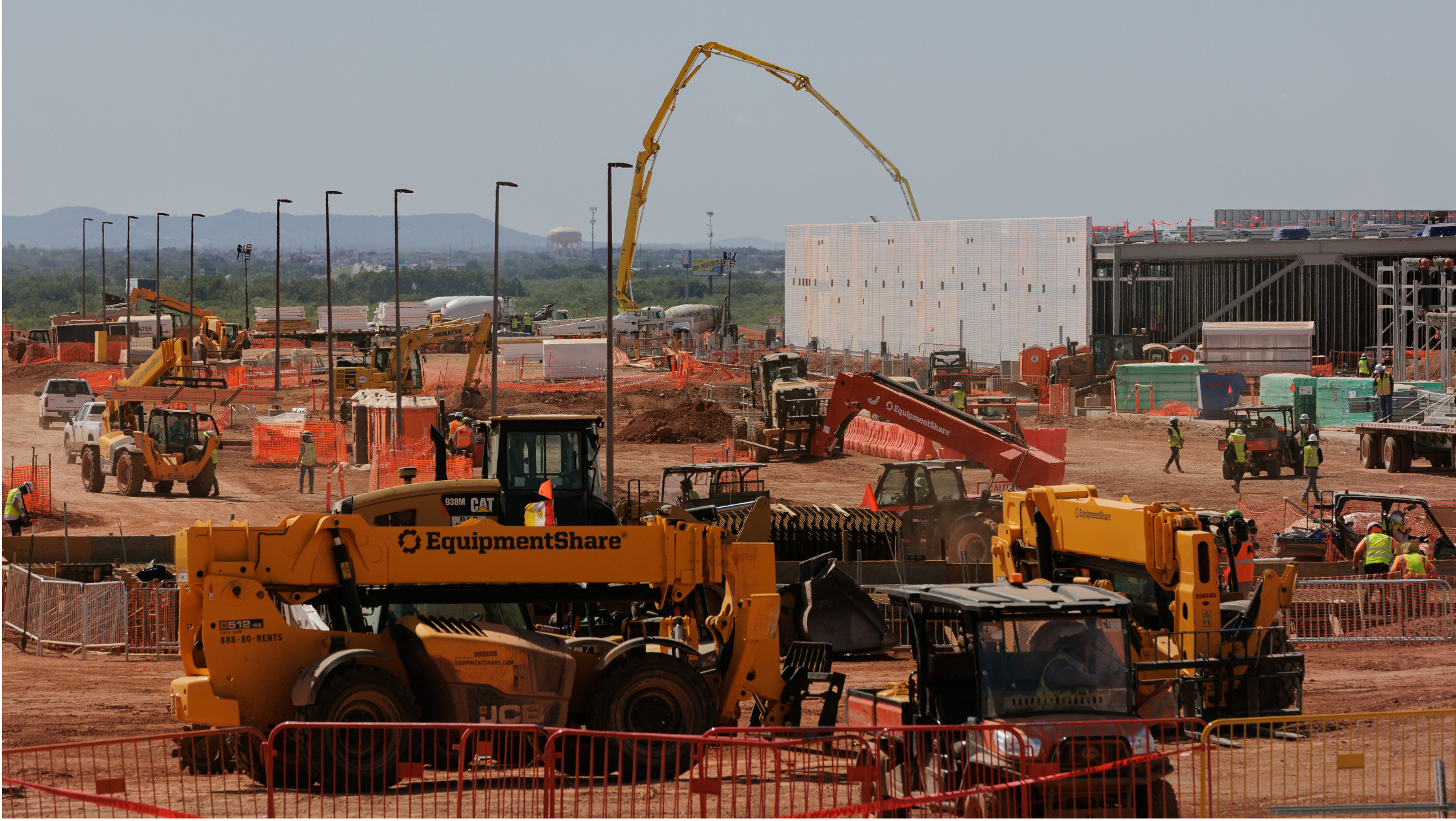
Data centers and housing construction rely on many of the same skilled trades, like electricians, equipment operators, pipefitters, and heating, ventilation, and air conditioning technicians. In Abilene, Texas, a homebuilder experienced two-month delays after workers left his electrical subcontractor for higher-paying data center jobs. The US Bureau of Labor Statistics projects about 72,700 electrician openings annually across the economy in 2025–35, including replacement needs; that figure does not measure data center demand alone.
Most of the competition occurs during the construction phase. The Joint Legislative Audit and Review Commission reports (PDF) industry estimates of about 1,500 workers on-site at peak construction, compared with roughly 50 full-time workers, including contractors, at a typical 250,000-square-foot operating facility. Demand may ease when a project finishes, but successive projects and multiyear campus expansions could sustain competition for workers.
It remains unclear how widespread these delays are, how much they raise housing costs, and whether the pressure subsides after data center construction peaks. Research could compare wages and vacancies in shared trades across counties with and without active data center construction and track housing timelines and costs before, during, and after nearby projects. Research could also examine where workers come from, as many new facilities are in small communities with limited local labor capacity, and how incoming workers affect local housing demand, housing costs, and the broader local economy.
What does the evidence show so far, and what action is needed now?
The evidence on the effects of data centers on home values remains mixed. Because many data centers are currently built in strong technology and employment markets, it is hard to determine whether higher home price growth is related to data centers. And real estate agents are divided on whether data centers have affected nearby home values.
Community concerns also extend beyond housing supply to noise, water use, and electricity costs, which could lower nearby home values. As resident opposition grows, Urban Institute researchers have recommended updating zoning and permitting to better account for facilities’ unique effects. A growing number of localities have responded by pausing new data center approvals, including a six-month moratorium in Louisville, Kentucky, and a one-year moratorium in Groton, Connecticut. In Virginia, Loudoun County’s board voted in September to draft a pause of up to 12 months, with a final vote expected in late October.
Although AI development may generate significant economic benefits, its effects remain untested. How broadly they will be shared remains uncertain. Given these uncertainties, state and local policymakers should assess data center proposals alongside housing needs, available land, infrastructure, and workforce capacity limitations. Whether and to what extent data centers compete with housing for land, workers, and financing—and how this affects housing production and costs—should be carefully examined, alongside their broader benefits and costs to communities.
Policymakers should also establish clear planning and negotiation processes, with mechanisms for accountability before projects are approved. Working through key questions before projects break ground, such as whether zoning codes address data centers specifically, whether developers will pay for the water and power infrastructure their facilities require, and how postconstruction jobs and wages will be tracked, can help preserve the benefits of innovation without shifting avoidable costs to communities.
