

Last month, the US Department of Labor released new data showing 714,050 active registered apprentices across the country. While this represents an increase of nearly 14,000 over the previous year, it marks a slowdown from the pace that drove a 77 percent increase in participation over the past decade.
It also falls short of the pace needed to reach President Trump’s goal of 1 million active apprentices. Pursuing such unparalleled growth could require sacrificing quality for quantity, risking the standards that have long defined registered apprenticeships.
We’ve already seen evidence that the administration—and other national and state apprenticeship leaders—may be willing to make this trade-off. A recent circular from the Office of Apprenticeship walks back the expectation that Registered Apprenticeship programs include at least one year of on-the-job training and similarly softens length requirements for academic instruction.
Forthcoming analysis by our colleagues shows that over the past decade, state apprenticeship systems typically experienced growth in the number of apprentices along with growth in apprentice job quality and wages. States’ policymakers can learn from each other as they pursue ambitious growth targets. When designing state-level plans or promoting new innovations such as youth apprenticeship programs, they should integrate targeted strategies to uphold quality standards.
Apprenticeship growth does not require sacrificing quality
The apprenticeship system’s growth so far has preserved apprenticeships’ hallmark features of quality and rigor that are critical to their strong outcomes. We recommend that policymakers pursue growth while preserving the high-quality nature of Registered Apprenticeship programs that lead to widespread benefits:
- Yield higher earnings. Registered apprentices’ mean quarterly earnings are $3,230 to $4,693 (PDF) more than their peers receiving standard federally funded employment services or who are enrolled in community college, respectively.
- Create career pathways. Programs offer participants the opportunity to gain paid work experience, mentorship and classroom instruction, and a nationally recognized and transferable credential.
- Develop a strong future workforce. Programs produce skilled workers who help employers meet their business needs.
- Create stronger communities. Apprenticeships contribute to economic development, generate tax gains, and reduce social service costs.
How to create quality apprenticeships
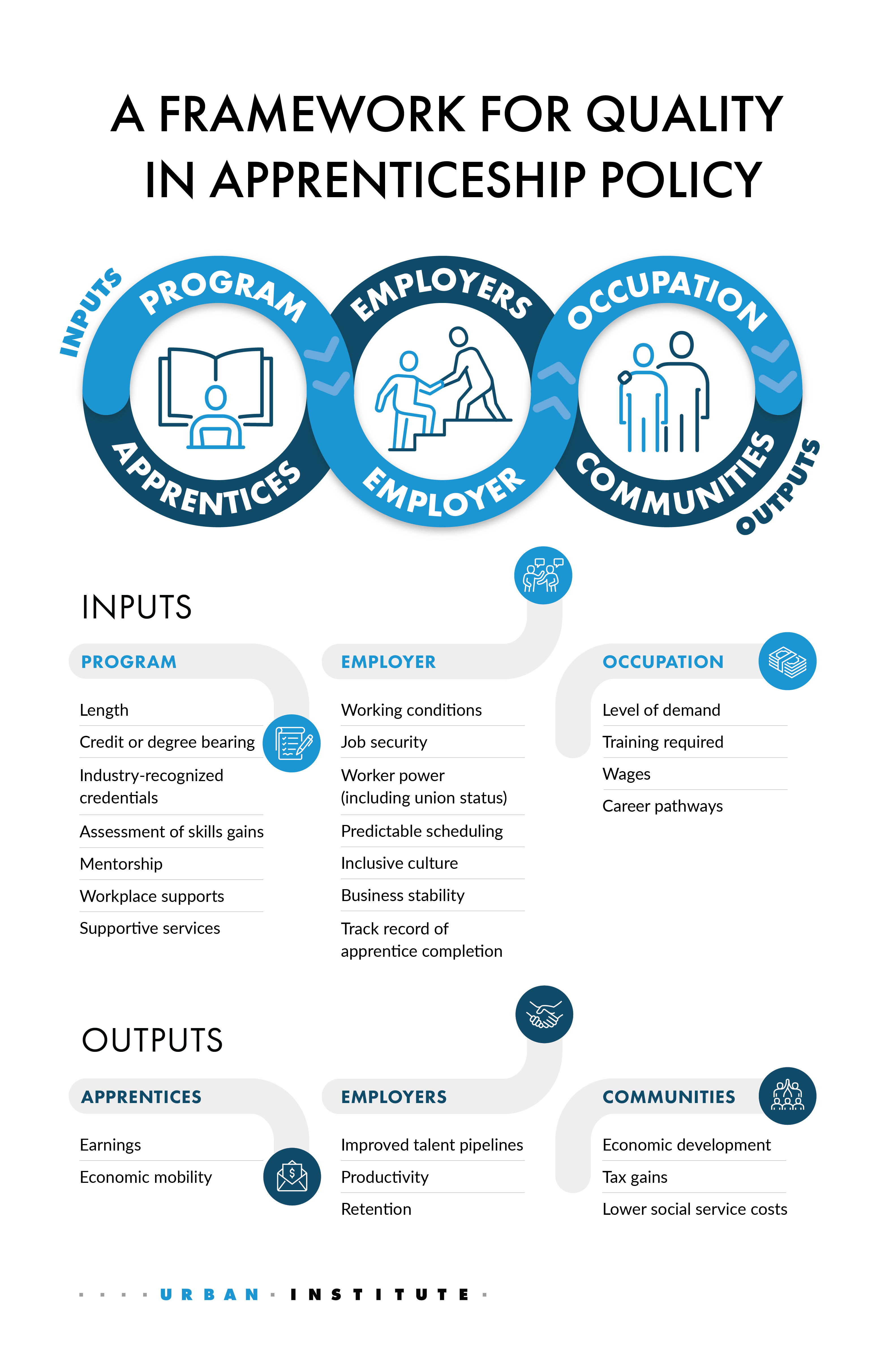
We offer a framework for legislative and regulatory policy, codified state apprenticeship agency practices and procedures, and executive action that promotes program quality in two ways: by creating accountability for priority outcomes or by influencing the factors leading to those outcomes.
Outcome-focused policy gives apprenticeship providers flexibility to use their judgment about how to deliver an effective program, while input-focused policies can incentivize, require, or otherwise shape the program, employer, and occupational characteristics that policymakers expect to lead to desired outcomes.
How states are already prioritizing apprenticeship quality
Many states have already adopted policies that demonstrate how to build quality into apprenticeship registration, implementation, and accountability processes.
Policies that embed quality into program design and delivery
- New York requires all related instruction providers to be approved (PDF) by the State Education Department or a local education agency, which vets both the provider and the proposed method of instruction for the apprenticeship program. This provides an opportunity for the state to ensure the related instruction is sufficiently rigorous and effectively delivered for apprentices.
- California amended its labor code in 2019 to add two members and a subcommittee within the Interagency Advisory Committee on Apprenticeship to focus on increasing apprenticeship opportunities for individuals with disabilities. Their focus (PDF) includes making it easier for people with disabilities to participate.
Policies to promote employer quality
- Colorado prohibits apprenticeship program registration or granting awards to employers that have violated wage or labor laws. Their rules and guidance (PDF) have established an enforcement mechanism of allowing a worksite analysis to address potential ongoing violations before registration, when adding new employers to a group program, and during compliance visits for established programs.
Policies to deliver apprenticeship in high-quality occupations
- Alabama’s Committee on Credentialing and Career Pathways, established legislatively, developed five criteria (PDF) for establishing in-demand occupations that include not only projected openings but also wage and credential requirements. The Alabama Office of Apprenticeship has aligned its program approvals and resources with these criteria to focus on occupations most likely to deliver high-quality program and career opportunities.
- Montana, Rhode Island, and Washington passed legislation to allow apprenticeship as a pathway to licensure in target occupations, primarily in health care, while the Tennessee State Board of Education adjusted its licensing policy to facilitate apprenticeships in education. These policies facilitate the expansion of apprenticeship programs in high-skilled occupations for which apprenticeships don’t exist because of -restrictive licensing requirements.
Policies that add accountability for program outcomes
- The Alabama Office of Apprenticeship issued guidance that all apprentices must earn at least $13.50 an hour after completing their first program year, consistent with a broader Alabama Department of Commerce policy to target state services and funding to support living wage jobs. Similarly, Idaho requires (PDF) that employers receiving apprenticeship incentive payments provide starting wages of at least $12 per hour, with preferences for apprenticeships paying above the average wage for their county.
- Washington state considers outcomes beyond the apprenticeship program as part of the initial program registration, including considerations of nonwage benefits for apprentices, as well as long-term access to a living wage and career advancement opportunities.
As members of Congress return to their districts during this August recess, states’ leaders have an opportunity to work with them to foster program quality amid apprenticeship expansion. States’ policymakers can highlight what they’re already able to achieve, as well as strategies they could adopt with federal action. Federal policymakers should apply these lessons as they pursue both targeted goals, such as aligning apprenticeship with educational systems, and the broader effort to modernize and improve the national legislation governing the Registered Apprenticeship system.
