
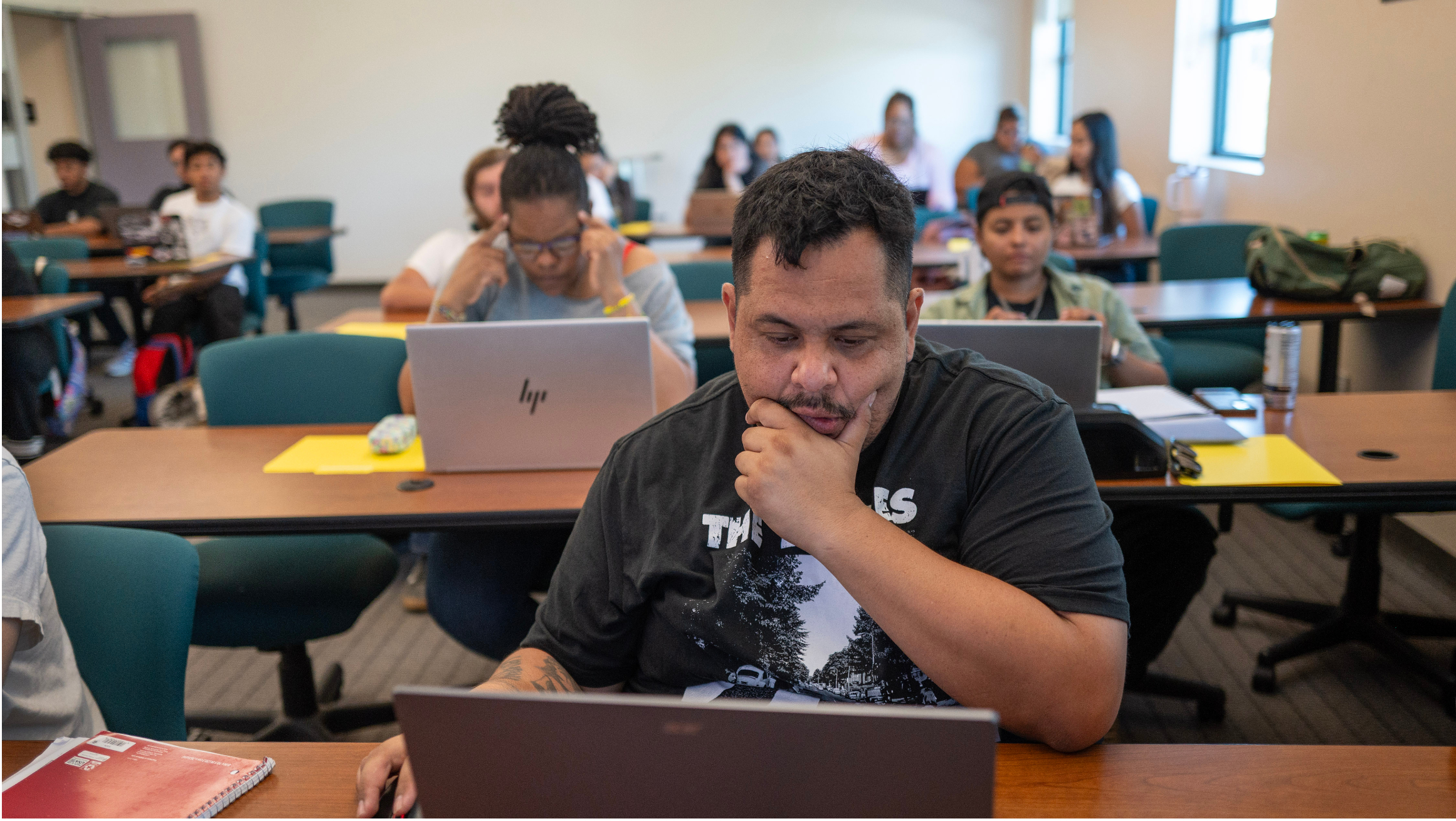
Today, three in five college students do not have enough to eat or a safe place to live, and millions lack access to essentials like health care, child care, transportation, course materials, and technology. These challenges affect students at all types of colleges and they persist over time. One-third of students who experience food insecurity and homelessness in their first year of higher education are no longer enrolled two years later, and among those who remain, four in ten students who experience food insecurity in their first year continue to experience it two years later. But few students receive public benefits or campus supports.
When students leave college without completing a degree, they often carry high debt, limiting their opportunities for workforce development and intergenerational mobility.
In response, colleges have increasingly invested in supports like food pantries and emergency aid programs. Though these services are critical, eliminating student basic needs insecurity altogether requires broader policy solutions to stop these hardships before they happen.
Several states have led the way in pursuing structural solutions, and many are learning from each other to reduce the likelihood students experience basic needs insecurity in the first place.
To better support this work, the Urban Institute launched the College Student Basic Needs Network–Great Lakes (CSBN-GL) in 2024 with support from the Joyce Foundation, ECMC Foundation, and Kresge Foundation and in partnership with The Hope Center for Student Basic Needs. The initiative brings together policymakers, higher education leaders, nonprofits, workforce partners, and students from Illinois, Indiana, Michigan, Minnesota, Ohio, and Wisconsin to advance state policy solutions to student basic needs insecurity. The Student Basic Needs Coalition facilitates student participation.
The initiative grew out of a June 2024 convening in Chicago that brought the stakeholders together and was informed by a regional landscape scan conducted by the Urban Institute. It found most states had made meaningful investments in basic needs support, but they lacked opportunities to learn from each other and coordinate around shared goals.
Through quarterly convenings, technical assistance, research, student engagement, and regional policy tracking, Urban and the Hope Center help the CSBN-GL better understand the scope of the challenges and develop effective solutions.
The Hope Center for Student Basic Needs at Temple University is a key partner, bringing regional and national expertise and experience to support state teams. The Hope Center uses its background in state partnerships and policy to contribute to curriculum development and delivery, provide individualized state support, and guide regional basic needs policy tracking. For example, The Hope Center has assisted partners in Michigan and Minnesota to sustain the momentum of their respective state’s basic needs task forces and working groups, guided other partner states in launching similar efforts, and identified opportunities for partners to scale up promising institution-level practices through targeted state investment.
Now, two years in, the initiative is generating important insights that could be useful to other states and regions seeking to address student basic needs gaps:
- Partnerships are essential. State higher education leaders recognize the value of partnering with state agencies, nonprofits, and colleges to design and support solutions to student basic needs challenges. In the Great Lakes network, decisionmaking-level representatives of these organizations have formed state delegations that have had problem-identification and problem-solving discussions that have led to new joint efforts. A Michigan participant shared, “I think we have shifted the philosophy and tone around what we expect higher ed institutions to do.… How do we leverage and lift up the work that’s being done in the community—not saying to an institution, ‘You should create something.’ Now I think we are thinking of this more holistically as a community, and I think philosophically that has been the biggest shift. We can do so much more together than apart as entities.”
- Cross-sector trust takes time—and pays off. Partnerships built through protected cross-sector conversations over two years of convenings are enabling coordination that wouldn’t otherwise exist. Three states—Illinois, Ohio, and Wisconsin—are launching new basic needs task forces. A Wisconsin team member shared, “Being part of the larger group has really made us be deliberate about how we can work together as a state to advance issues as a state or as a statewide group instead of in our silos.”
- States can help each other keep basic needs on the policy agenda. In a changing federal and state policy environment, state higher education and workforce leaders are looking for cost-effective strategies to sustain investments in student success—a critical component of workforce and economic development. They can learn from each other in these efforts through virtual and in-person workshops and idea exchanges that are built on lasting relationships that build trust and candor. A Minnesota state team member reflected, “Many states are grappling with similar challenges. There is just value in being in the same space, building knowledge and relationships.”
- Data informs strategy. States are using data from surveys and administrative sources to identify effective solutions, build support for investments, and measure results. Urban and The Hope Center are supporting states’ data needs to help inform that work, including modeling the effects of changes to food, health care, and child care assistance policies on student use and outcomes. A team member from Indiana reflected, “We have to get out of our heads that everyone should already know why this is important—and really demonstrate that it has an impact. It isn’t just raising money to feel good. Here are measurable results. Here’s what we’re doing to get there.”
From learning to action
Each state team has received a $40,000 action grant, cofunded by the three philanthropic project sponsors, to advance a statewide initiative, and states are translating their learnings into action. Three have launched new basic needs task forces, two have hosted highly attended statewide convenings, and three are conducting landscape scans to use evidence to develop promising strategies and partnership opportunities. States are also exploring state legislation to ensure policy consistency across leadership shifts and developing cross-agency and cross-sector partnerships.
Michigan just received a $5 million federal grant to enhance campus basic needs navigation and hubs, help eligible students access and maintain public benefits, and provide professional development while building institutional capacity. Other states are using lessons from the initiative to make similar cases for dedicated investments and policy changes.
Interest in this work extends beyond the Great Lakes region. In February 2026, Urban convened partners in the Deep South to explore whether a similar regional model could support state-level collaboration on student basic needs. Participants expressed strong appetite, and now, a regional delegation is exploring next steps informed by the Great Lakes network.
This growing interest signals that the model has broader applicability. Other regions may similarly benefit from strategic cross-state learning, particularly in this era of rapid policy change. To learn more about this work, contact the Urban Institute team at [email protected] or the leaders, Theresa Anderson ([email protected]) and Ryan Kelsey ([email protected]). For information about how The Hope Center for Student Basic Needs supports states in advancing solutions for student basic needs insecurity, contact Sara Abelson ([email protected]). For more on the Student Basic Needs Coalition, contact Paige Swanstein ([email protected]).
