
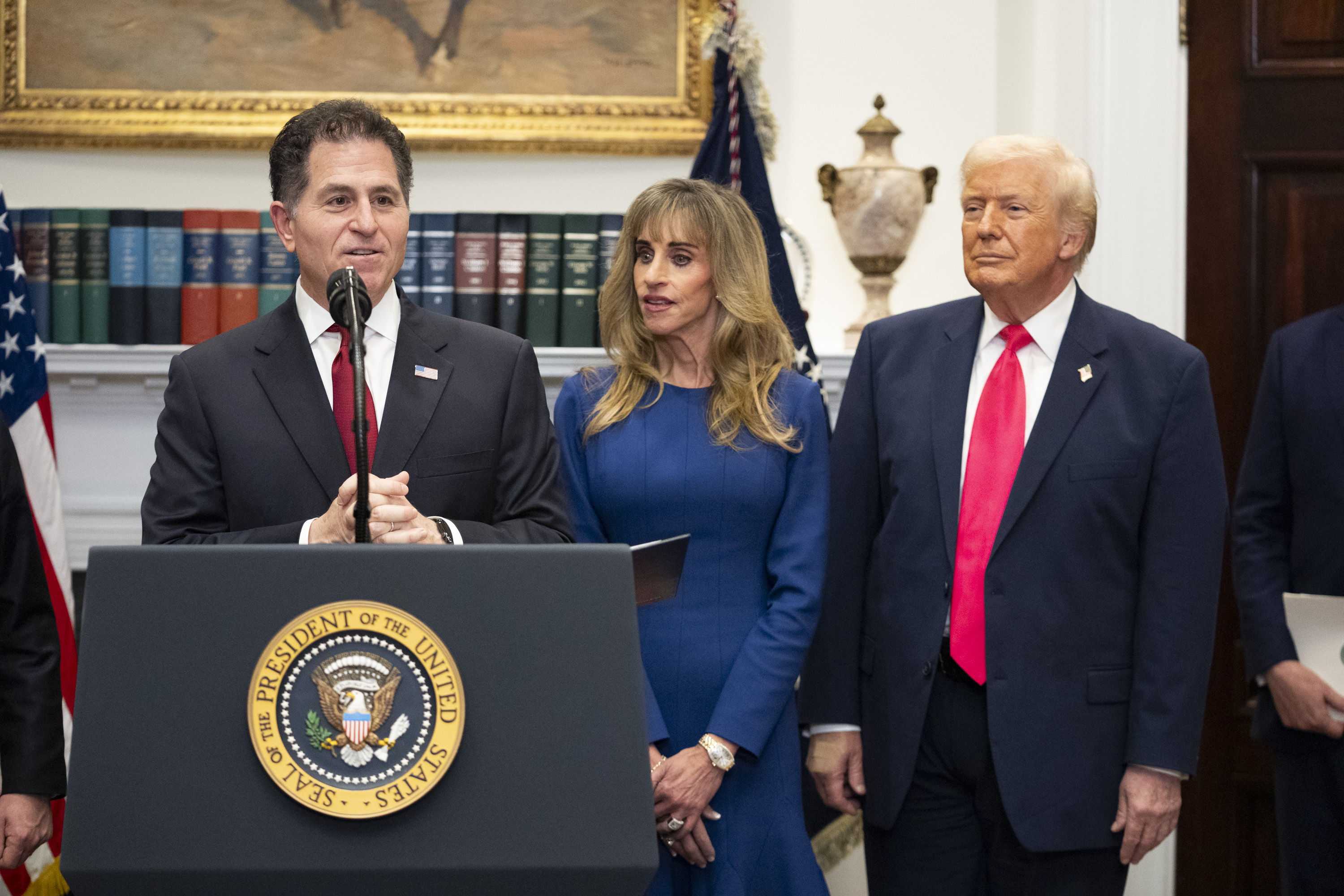
In early December, Michael Dell announced he and his wife Susan would pledge $6.25 billion toward Trump accounts for children in low-income zip codes. Established through the One Big Beautiful Bill Act, Trump accounts are intended to build long-term financial security for millions of children. During the announcement, Dell invoked the root of his business success—bypassing retail electronic outlets to sell computers to the public: “When I started a company 41 years ago, we created the direct model,” Dell told The New York Times. “This is sort of the direct model philanthropy.”
In this respect, the Dells’ pledge is the latest—and largest—illustration of the popularity of direct cash giving over the past decade. It’s a trend seen among both public agencies and private donors, and across the ideological spectrum. The approach is epitomized by the charity GiveDirectly, which has raised more than $1 billion to deliver cash to some of the world’s poorest people, including some of the neediest Americans.
The bipartisan attraction of direct cash giving is unmistakable: For many on the left, cash reduces gatekeeping and stigma; for many on the right, it minimizes bureaucracy and empowers individual agency.
Philanthropic leanness and nonprofit disintermediation—cutting out the institutional middle-man—have been central to the case that the Dells, Trump administration officials, and others have made to encourage other philanthropists and corporations to make contributions to Trump accounts. After Ray Dalio, the hedge fund founder, and his wife pledged to provide $250 to the Trump accounts of 300,000 children in Connecticut (a total gift of approximately $75 million), philanthropist John Arnold wrote on X, “Many ultra-wealthy Americans are philanthropically inclined, do not want a large foundation staff, do want to give while living, and haven’t been inspired by existing nonprofits. This American version of ‘GiveDirectly’ could be an ideal solution.”
The introduction of Trump accounts could accelerate nonprofit disintermediation. Yet, the growing interest in the accounts also highlights the existing—and inspiring—ecosystem of nonprofits that has developed and advanced cash benefits and wealth building through demonstration, learning, and scaling.
The paradox of privatization and public administration
The paradox between Trump accounts potentially bypassing nonprofit intermediaries and elevating the importance of nonprofits on which the wealth building field relies is reflected in how the Dells’ pledge could be interpreted as both advancing privatization—shifting responsibility for social protection from public systems to private donors and individual markets—and as a vote of confidence for public institutions.
When the Trump accounts were announced, some wondered whether individualized capital accounts could replace parts of the social safety net. Treasury Secretary Scott Bessent called them a “backdoor for privatizing Social Security,” before clarifying that they are an additive benefit, meant to supplement guaranteed payments rather than replace them. Yet, implementing Trump accounts will require competent government administration and perhaps even increased government bureaucracy.
One way this paradox between private initiative and public administration has been resolved historically was through demonstration projects. Beginning in the early 20th century, major foundations (often funded by Rockefeller and later Ford) supported local and state pilots, tested design and implementation, and then—if the approach proved out—invited public systems to scale the model.
A more recent example is the Nurse‑Family Partnership (PDF): Philanthropies underwrote longitudinal experiments in home visiting for first-time mothers; rigorous evaluation validated impacts; and, over time, states and the federal government institutionalized the model through public financing. That playbook—risk capital, measurement, iteration, handoff to public agencies—remains one of philanthropy’s most consequential legacies.
How early wealth-building programs have benefited from evaluation and implementation underwriting
Long before federal Trump accounts were proposed, children’s savings account pilots proliferated in places like Oklahoma, Maine, and San Francisco. There, philanthropy underwrote evaluation on design choices (e.g., automatic enrollment, matched savings, default investment choices) and program implementation (e.g., beneficiary tracking, financial education integration).
Those experiments surfaced crucial lessons about takeup, scaling, and administration—informing emerging federal principles for early wealth building and sharpening policy choices about eligibility, governance, and consumer protections. These implementation lessons were especially important as baby bonds pilots launched in states like Connecticut and cities like Atlanta, Georgia, and St. Louis, Missouri, in the past 10 years. In short: We learned how accounts work in real communities, which features can close gaps, and which frictions derail impact—before scaling such programs.
Trump accounts bring a new set of features and new questions, which nonprofits and philanthropy can help address. Under the One Big Beautiful Bill Act, accounts are created for eligible people under 18, with annual contribution limits (generally $5,000 for children under 18, indexed from 2028) and special tax treatment. The federal pilot includes a one‑time $1,000 seed for children born in 2025 to 2028, with the option to convert the account to a traditional IRA at adulthood.
These are powerful levers—but they also raise issues of equity, administrative complexity, market exposure, and consumer protection, especially for families with limited liquidity or volatile income.
This is precisely where philanthropy’s demonstration and learning role remains essential. If megagifts flood these newly minted accounts, robust design guardrails can help ensure capital translates into mobility—and philanthropy can help provide them.
- Targeting and automatic enrollment. Pilots taught us that automatic enrollment and simple defaults matter. Philanthropic partners can cofund refinements that keep administrative burdens low and participation high for families with low incomes.
- Consumer protection and credit health. Wealth accounts exist in a landscape of diminishing affordability; high APR credit; the growth of buy now, pay later programs; and proposed changes to medical-debt reporting. Pairing accounts with credit-building supports and coaching could reduce premature and penalized withdrawals that could lead to regressive outcomes.
- Integration with public benefits. Benefits cliffs remain an issue. Philanthropic demonstration can test benefit-friendly designs (e.g., disregards, safe harbors) that prevent early savings from triggering losses elsewhere and produce evidence to inform federal rulemaking.
- Data, evaluation, and feedback loops. Philanthropy can sustain independent evaluation, open-data standards, and participant voice so programs learn and adapt rather than simply scale.
If we reduce philanthropy’s role to providing direct cash alone, we risk bypassing nonprofits that have built the infrastructure to deliver coaching, financial access, safeguards, and trusted relationships—the mediation that turns dollars into durable gains. Conversely, if we dismiss direct giving, we miss a chance to destigmatize help, accelerate capital, and democratize choice.
Doing both is the more compelling path: Direct giving as support for family balance sheets and savings, and philanthropy’s demonstration learning model to refine design, prove impact, and embed programs in public systems so they last beyond the news cycle and the next donor’s preference. That’s how we move from headline generosity to institutional change—from disbursements today to wealth-building architecture that endures.
