
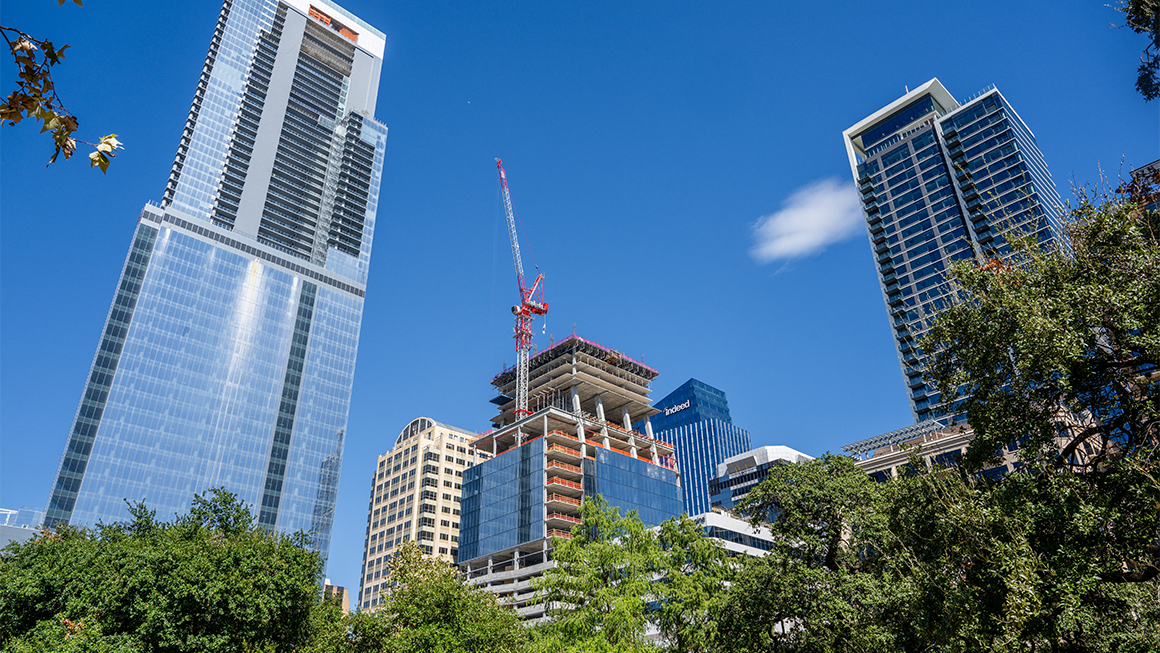
During the 2010s, the United States constructed fewer new housing units than in any decade since the 1970s, despite the country’s population growing by more than 50 percent. This lack of construction is partly contributing to the nation’s rising housing costs.
Faced with these failures, many cities and states have sought to encourage building more homes by reforming their land-use policies. Thus far in the 2020s, those changes, combined with the broader economic environment, have resulted in a higher rate of construction. But not every city has grown similarly.
In new analysis, I find that large metropolitan areas in Texas have accounted for a vastly disproportionate share of new housing since 2000. Each of Texas’s four main metropolitan areas has increased their housing supply by more than 12 percent through 2025. That growth has been largely concentrated in exurban areas far from existing neighborhoods because of the availability of low-cost land.
In contrast, metropolitan areas like Los Angeles have had slower growth rates, but new construction has disproportionately occurred in already developed, high-density neighborhoods. This type of construction is a more efficient use of public infrastructure investment and has fewer negative environmental consequences.
Which metropolitan areas have added the most housing?
To understand where housing is being built, I used the US Census Bureau’s Address Count Listing Files, which were last fully updated in November 2025 and have been available since 2020. These data provide a useful measure of housing at the block level and offer the best-available insight into where new housing is being built nationwide. Unlike the more frequently used American Community Survey or Building Permits Survey, these address data are up to date, provide information at small geographies, and do not have large margins of error.
Overall, the housing supply within metropolitan areas grew by almost 9 million units between 2020 and 2025, a 6.6 percent increase from 2020.
This overall growth in supply was powered by the four large Texas metropolitan areas—Dallas, Houston, Austin, and San Antonio—each of which added at least 160,000 housing units. Combined, those regions accounted for 13.3 percent of national housing supply growth. Other fast-growing large metropolitan areas include Phoenix, Charlotte, Orlando, Nashville, Jacksonville, and Raleigh, all of which had growth rates greater than 10 percent.
However, the nation’s three most populous metropolitan areas—New York, Los Angeles, and Chicago—built new units at a much slower pace, with housing supply growth rates of less than 4 percent.
Large Texas Metropolitan Areas Led the Nation in Housing Supply Growth from 2020 to 2025
Sources: Author analysis of US Census Bureau Address Count Listing Files, 2020 and 2025, at the tract and CBSA level (2020 geographies).
Note: CBSA = US Census–defined core based statistical area (names simplified), equivalent to a metropolitan area.
When examining all metropolitan areas, not just those with large populations, those that added the most housing supply were largely in the Southeast and Southwest. Jefferson, Georgia, a small community between Atlanta and Athens; The Villages, Florida, a retirement community; Provo, Utah; Myrtle Beach, South Carolina; Granbury, Texas; and St. George, Utah, all had housing supply growth rates above 20 percent.
Where are metropolitan areas building new housing?
Changes in housing supply aren’t evenly distributed within regions, either. In metropolitan areas like New York, Chicago, and San Francisco, new housing supply is disproportionately located in neighborhoods with existing high housing density. The typical housing unit added between 2020 and 2025 in these cities was in a census tract that already had at least 7,000 housing units per square mile. Yet in Dallas, Houston, and Phoenix, the typical unit was added in tracts with roughly 1,000 units per square mile—meaning a much larger share was added in areas previously occupied by natural or agricultural uses.
Despite the slower overall rate of growth in the first group of cities, these areas have done a better job of accommodating new housing in neighborhoods where people currently live. The median already developed tract in the New York, Chicago, or San Francisco regions added housing at a faster rate than did already developed tracts in the Dallas, Houston, or Phoenix regions.
Housing Supply Growth Was Most Densely Concentrated in the New York, Honolulu, and Chicago Metropolitan Areas
Source: Author analysis of US Census Bureau Address Count Listing Files, 2020 and 2025, at the tract and CBSA level (2020 geographies).
Notes: CBSA = US Census–defined core based statistical area (names simplified), equivalent to a metropolitan area. Weighted neighborhood density calculation focuses on the census tract where the average additional housing unit was added and does not include data for tracts that lost housing units during the study period. Already developed tracts are those that had a housing density of at least 2,000 units per square mile in 2020; lightly developed tracts are those with a housing density of fewer than 500 units per square mile in 2020.
In part, a lack of alternative options has driven this discrepancy. In 2020, the first group of cities—New York, Chicago, and San Francisco—was already more densely developed, thereby encouraging new units to be built in those neighborhoods. Still, even in New York, the rate of housing growth in already developed areas lagged that of low-density areas predominantly occupied by farms and natural areas. Among large metropolitan areas, only Los Angeles and Seattle had higher housing growth rates in already developed areas than in neighborhoods without much existing housing.
What these trends tell us about the nation’s housing supply growth
The concentration of housing growth in the Southeast and Southwest reinforces trends in the nation’s shifting population, which is far less concentrated in the Northeast or Midwest than it was several decades ago. In 1970, 14.4 percent of the nation’s population lived in Illinois or New York, for example; as of 2024, less than 10 percent does.
The context within metropolitan areas, however, tells a more nuanced story. Generally, slow-growing metropolitan areas like New York and Chicago are adding housing more quickly to already developed neighborhoods than fast-growing regions like Dallas or Phoenix.
These data suggest that overall housing supply trends are, to a large degree, a product of construction on areas occupied by farms or natural uses. The nation’s population is disproportionately moving into those areas as well. The metropolitan areas that have greenfield land available to develop (either because of geography or regulations) can build more housing, as this type of development is often cheaper because of lower-cost land and few challenges to building, such as greater ease transporting materials. However, it’s also associated with damage to local ecosystems, increased emissions, and greater transportation costs.
The other drawback of greenfield-based development: People largely don’t live in those areas already, increasing the cost of providing additional infrastructure, such as sewers or roads, to serve new homes. Many of the fastest-growing metropolitan areas are struggling to add homes in existing neighborhoods, and regions like New York aren’t adding enough units in those areas to keep up with demand. From this perspective, all metropolitan areas could benefit from land-use policy changes designed to encourage additional housing supply, such as substantial upzonings of key neighborhoods and policies like urban growth boundaries, which are designed to limit the harms of low-density development.
