
Housing affordability is declining in the United States, and one explanation is that housing supply has failed to match demand for new homes. There is some debate about whether this shortage is universal or applicable to just a subset of the nation’s population. Some research suggests that certain communities, including many neighborhoods, cities, and states with relatively high populations of liberal residents and high housing values—often areas on the nation’s coasts—have more restrictive housing policies while others, including areas in the Sunbelt, are attracting more housing construction. A growing movement of activists are encouraging the more restrictive states and localities to alter their land-use regulations to encourage more construction.
Yet more evidence is necessary to understand the relationships between geography, resident demographics, politics, and housing-supply growth in recent decades. In this research, I explore how housing supply changed in cities, counties, and metropolitan areas between 2000 and 2020.
Key Takeaways
I show that additional housing supply was disproportionately located in sparsely developed greenfield areas in higher-income, ideologically conservative locales, typically in the Sunbelt and in states with Republican-led legislatures. Relatively conservative metropolitan areas, like Houston and Phoenix, for example, experienced much faster housing-supply growth than relatively liberal metropolitan areas like New York and Seattle.
Percent increase in housing units, 2000 to 2020 in large US metropolitan areas and their center cities
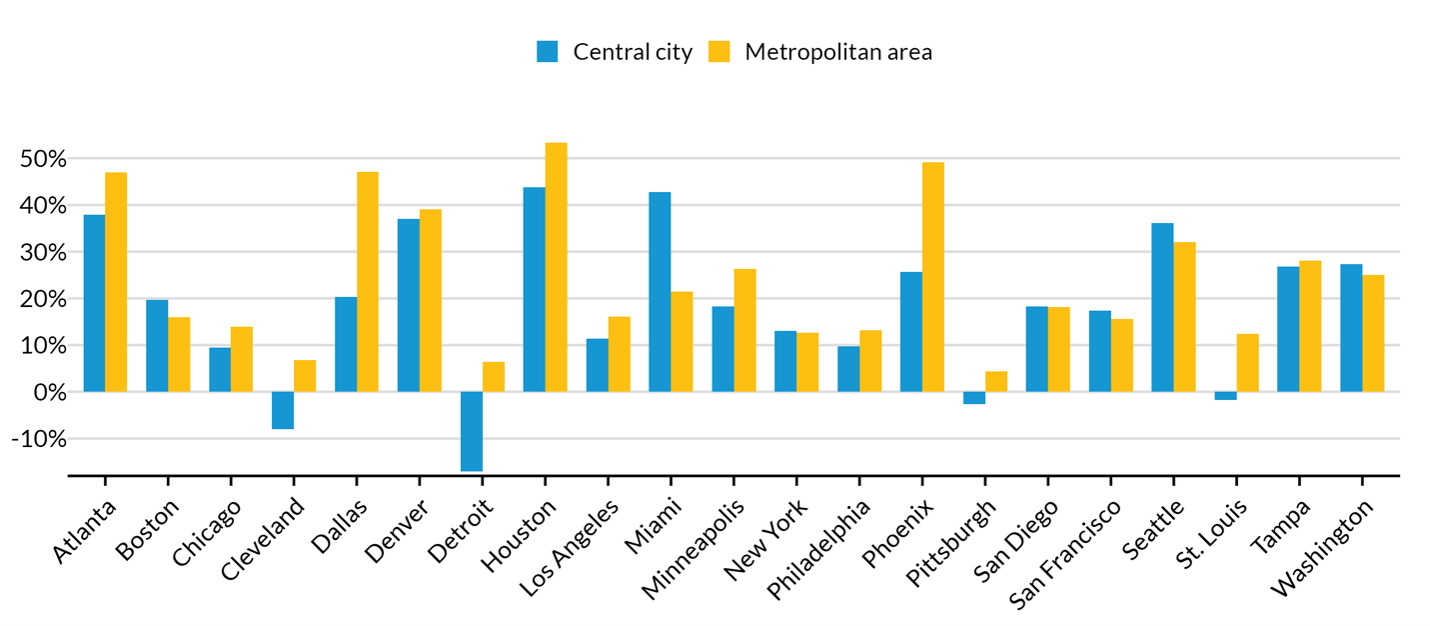
Source: Source: Author analysis of US Census data, 2000 and 2020.
Infill area growth was slower but—in contrast to the overall trend—more likely to be located in liberal cities, counties, and metropolitan areas outside the Sunbelt. The average density in tracts that added new housing units was higher liberal cities and counties and lower in conservative ones. As a result, people in many liberal areas live near more new housing than those in conservative areas.
Average tract density in 2000 for each unit added between 2000 and 2020, large US metropolitan areas and their center cities
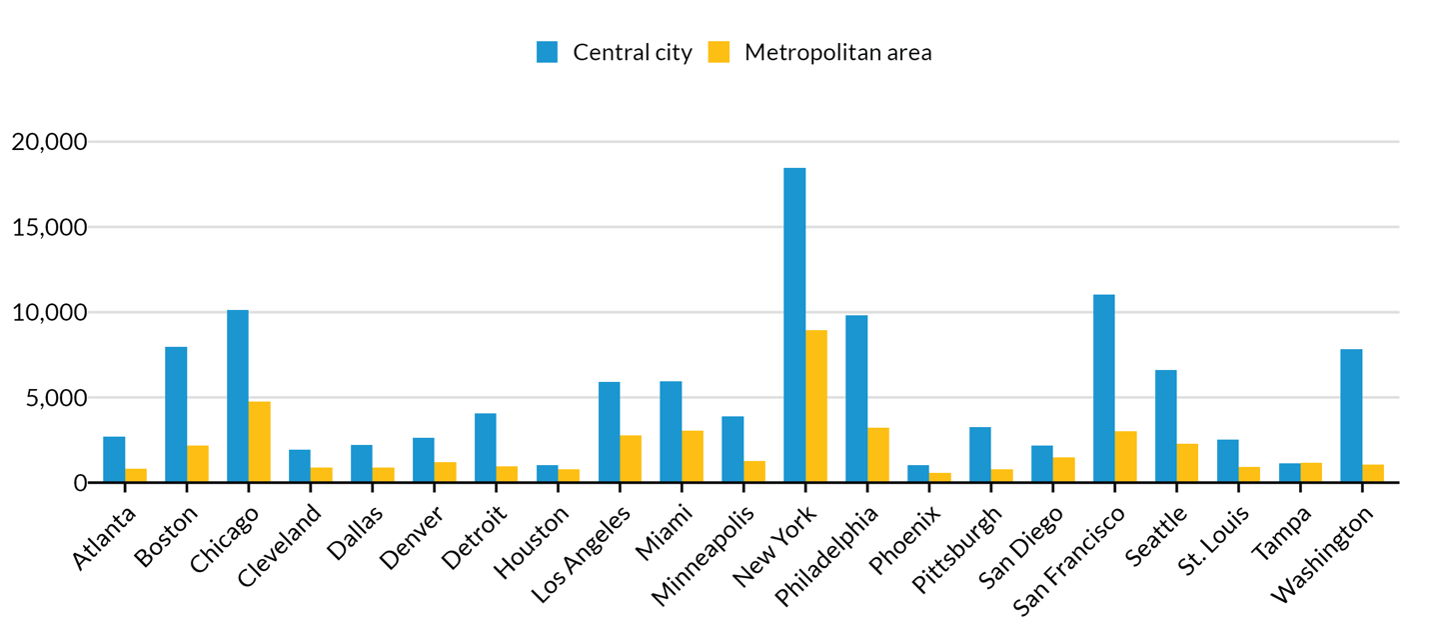
Source: Author analysis of US Census data, 2000 and 2020.
These findings confirm and belie conventional wisdom, producing a nuanced picture that highlights how prior development informs outcomes.
Why This Matters
What lessons can a nation without adequate housing supply take away from these findings? On the one hand, conservative resident ideology and Republican control at the city and state level have been associated with more housing overall. This suggests that differences in city- and state-level rules related to housing development—particularly on greenfield land—may play out along ideological and partisan lines, perhaps on issues like environmental review and zoning policy.
On the other hand, my finding that liberal cities and counties add the same amount of—and in some cases more—new housing supply on infill land than conservative cities and counties may run counter to expectations. This could mean that liberal cities have local land-use regimes, encompassing the full regulatory process, that overall enable more new housing in infill locations than do conservative cities. At the same time, the higher exposure to new construction by residents in many liberal areas may encourage those jurisdictions to promote slow and tedious public input processes—and may explain why new projects therein often face vociferous opposition, despite the stated preference of many liberals for more housing.
How We Did It
I examined housing supply changes among cities, counties, and metropolitan areas from 2000 and 2020 using publicly available data produced by the US Census Bureau. Using panel regressions, I tested the relationships between geography, resident demographics, politics, and housing-supply growth.
