
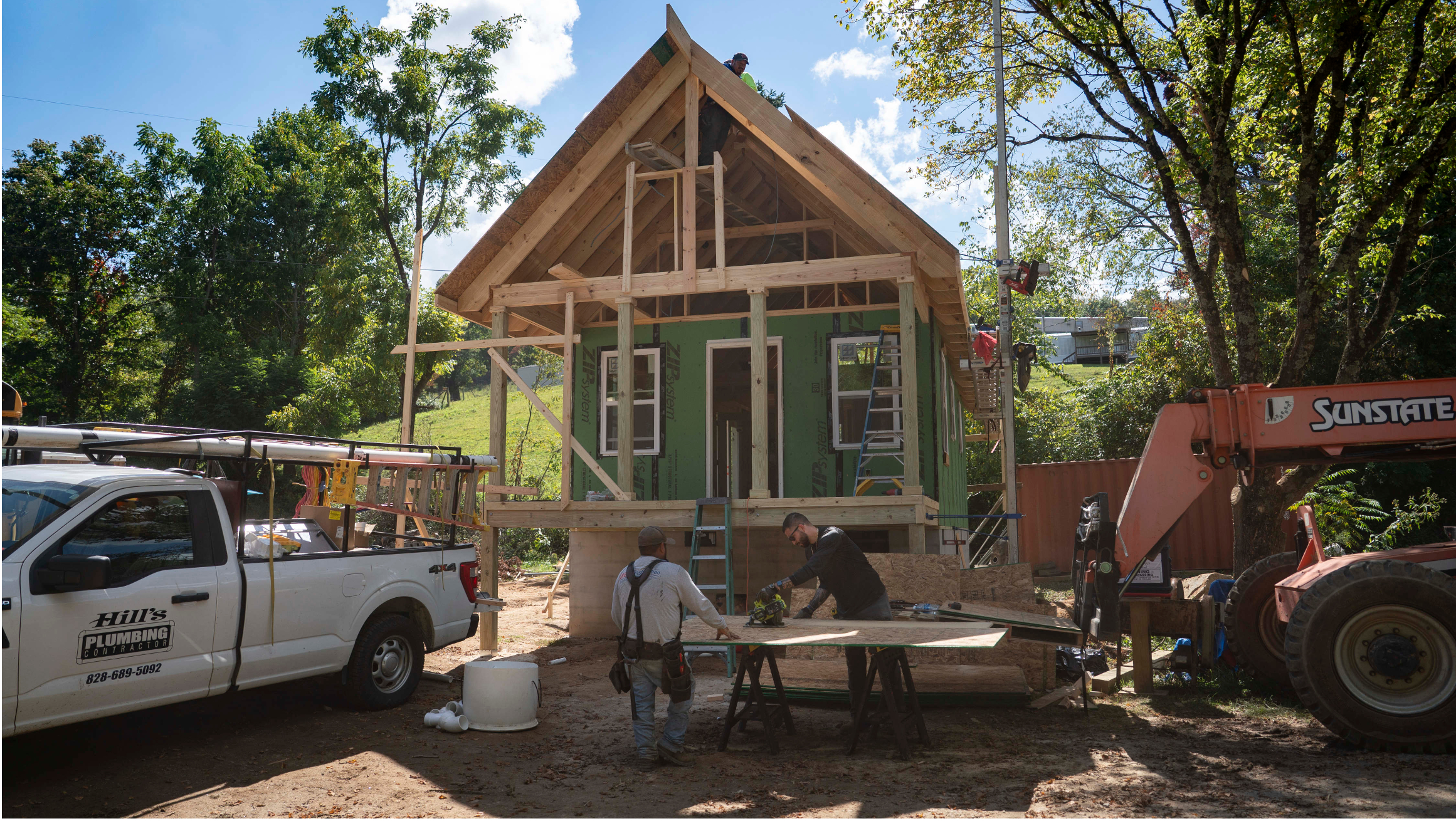
Damaged homes, lost belongings, interrupted services, and weeks or months of uncertainty. This is the reality many survivors faced when Hurricane Helene struck two years ago. But our interviews with 20 households who weathered the storm revealed that recovery didn’t look the same for everyone.
Survivors who entered the storm with insurance, savings, and manageable debt were generally better able to absorb unexpected costs while waiting for assistance. In contrast, households with low savings and high debt before the storm often exhausted their resources quickly.
To help make people and communities more resilient to disasters like Helene, we share financial insights and recommendations from Helene survivors.
1. Insurance is critical for recovery, but it can be slow and insufficient
Some Helene survivors received substantial insurance payouts that helped cover repairs and temporary housing, while others received little or nothing, despite significant damage to their homes. Survivors described claim delays, coverage limitations, and exclusions, including flood damage that was not covered by traditional homeowner’s or renter’s insurance.
Even when coverage was available, navigating claims often required extensive documentation and repeated follow-up during an already stressful recovery. As a result, many households relied on savings, loans, or additional debt to fill gaps while waiting for assistance.
“The insurance company has made sure that I kept a roof over my head whether in the hotels or in this apartment. But the help has been very, very slow, which has caused this snowball effect of debt and other things.”—Survivor in Georgia
2. Savings help households weather the gap between resources and needs
Many survivors described savings as the resource that helped them cover immediate expenses while waiting for insurance payments, Federal Emergency Management Agency (FEMA) assistance, or other support. One survivor in Florida relied on savings alongside insurance payments, a Small Business Administration loan, and volunteer labor to repair his home. He emphasized personal savings as a recovery strategy and recommended everyone set aside savings “in case this happens again.”
“I had just a little bit of savings. That helped me get through. And without that, I really don’t know what I would have done.”—Survivor in South Carolina
At the same time, survivors emphasized that savings are not a complete solution. Even households that entered the storm with financial reserves often found those resources depleted as recovery stretched on. One North Carolina survivor described rebuilding using savings, FEMA assistance, church donations, insurance payments, and volunteer support, but he eventually exhausted his financial cushion: “You've went through your savings. There’s no more little shots of help coming in.”
For households without savings, recovery was even more difficult. Without cash reserves, survivors often relied on FEMA assistance, community and church support, loans, debt, or family members to meet basic needs while waiting for longer-term recovery resources.
“I’ve never had a savings account. I don't have enough money left over from month to month to put anything in it.”—Survivor in Georgia
3. Debt made recovery harder and left some survivors further behind
Several survivors entered Hurricane Helene already carrying credit card debt, medical debt, or low credit scores, limiting their ability to absorb new expenses. One survivor described struggling with credit card debt before the storm, while another said medical debt had damaged her credit score and made it difficult to access additional financial products. But for many households, recovery created new debt. One Virginia survivor took out a loan to extend a hotel stay after being displaced, later explaining: “That’s kind of why I’ve got a delinquent loan currently…. I had to do a loan to pay for more of a [hotel] stay [after the hurricane].”
Others accumulated debt as recovery dragged on. One South Carolina family maxed out a credit card while trying to cover housing costs and later saw the account go to collections, damaging their credit score. A North Carolina household relied on payday loans after the disaster because they could no longer qualify for a loan through their bank and were still struggling to make loan and credit card payments nearly two years later.
“There was a period there where [credit card debt] was a little hard to pay off…. I just hated paying that interest on it. It just killed you.”—Survivor in Florida
What survivors say would strengthen financial resilience before the next disaster
We asked Hurricane Helene survivors for their recommendations for financial institutions, governments, community organizations, and communities preparing for future disasters. Their insights show that disaster preparedness is not only about emergency kits and strong infrastructure—it’s also about financial resilience.
Insurance providers and regulators should ensure claims are promptly paid. The survivors we spoke with called for insurance that is affordable, simpler to navigate, and paid out on a timeline that matches the pace of recovery. State insurance regulators could simplify documentation requirements and hold insurers responsible for quickly paying claims. Because slow payouts force households to cover costs with savings, loans, or credit cards, faster claims processing can prevent families from facing long-term financial stress because of insured losses.
Financial institutions can help households build and protect their financial well-being. Banks, credit unions, and other financial service providers can help households grow their emergency savings and manage their debt before a disaster. Many survivors called for financial relief measures from financial institutions after disasters as well, such as loan forbearance, deferred payments, waived overdraft fees, and reduced interest charges. Several survivors also suggested that financial institutions could provide customers with access to dedicated financial counselors to help them navigate the recovery process, recognizing that financial stress and trauma can make it difficult to evaluate options and plan.
“I would start [recovery efforts] with financial advisors…. It’s not reasonable to expect a person going through that level of trauma to make good decisions, and it’s certainly not reasonable to expect someone with literally no financial literacy or education to do the same.”—Survivor in Georgia
Governments and community organizations can improve outreach and navigation support. Many survivors said they did not know where to turn for help or struggled to understand what assistance was available. Participants called for year-round disaster education, centralized resource hubs, and more-proactive outreach before and after disasters. They also wanted individualized support after disasters to help households understand eligibility requirements, complete applications, and connect with the resources most relevant to their circumstances.
Local leaders can help households strengthen financial preparedness. Local leaders, including local government agencies, emergency management offices, community-based organizations, and nonprofit service providers, can use tools such as the Financial Health and Wealth Dashboard and Debt in America to better understand financial vulnerability and resilience in their communities. These tools can also help them identify opportunities to strengthen preparedness before the next disaster.
Together, these insights and recommendations can reinforce households’ financial foundations before the next disaster and help all households recover more quickly from future disasters.
