

Many local leaders are seeking to attract young families to their communities in the hopes that they’ll become long-term residents and contribute to economic growth. But to do so, leaders need to understand affordability in their area, which is a key driver of where families choose to live. While rising costs have dominated national conversations about affordability, recent Urban Institute analyses point to earnings as the difference maker in whether a community is affordable.
In this analysis, we use Urban’s Upward Mobility Data Dashboard to examine how the cost of living and wages have changed across US counties over time. We focus on how single parents working full-time experience affordability in their communities, because this family unit sets a meaningful bar for job quality: a community is truly affordable when a single parent can cover their family’s basic needs on one paycheck. Our findings underscore the importance of quality jobs in making communities affordable for families raising children.
The cost of living grew faster than pay in half of US counties in recent years
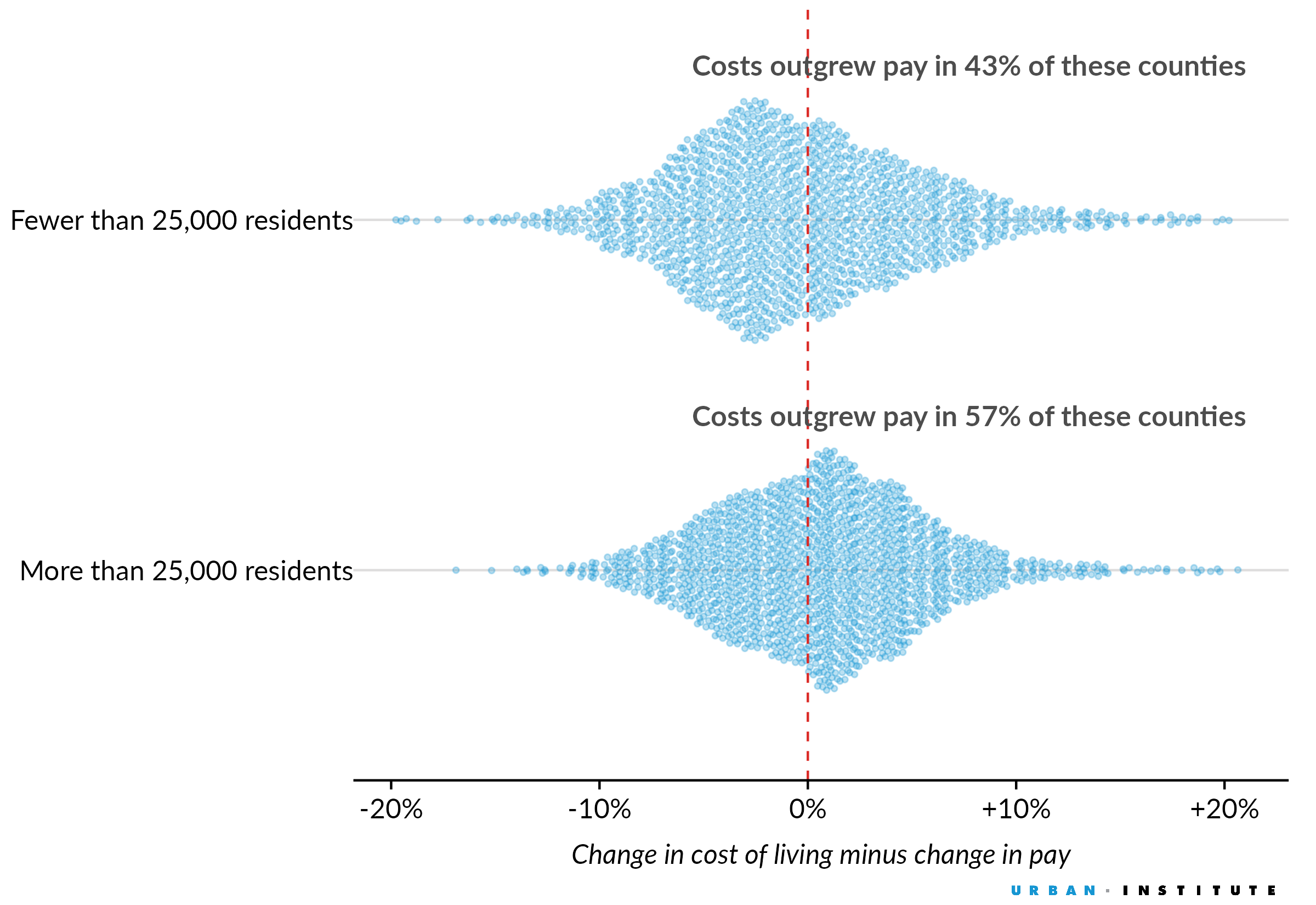
When wages lag the cost of living, many families struggle to keep up with rising costs. Most of the US population—63 percent—lives in the counties where the cost of living rose faster than the average weekly wage.
In Half of All Counties, the Growth in the Cost of Living for Single-Parent Families Outpaced Wage Growth from 2023 to 2024
Source: Urban analysis of the Living Wage Institute Inc.’s Benchmark Living Wage Data Series, 2023 and 2024, and the Bureau of Labor Statistics’ Quarterly Census of Employment and Wages.
Notes: Each dot is a county. In counties to the right of the zero line, the cost of living grew faster than pay. Pay is the county’s average weekly wage. The cost of living is the wage a single parent raising two children needs to earn working full time to afford basic needs like housing, food, child care, and transportation. Changes are between 2023 and 2024 for the 3,119 counties with reliable data in both years.
This pattern affects most larger counties (more than 25,000 residents). For example, Miami-Dade County, Florida, has the largest gap between cost growth and wage growth among the 15 most-populous counties. Average weekly wages grew 4.6 percent from 2023 to 2024, but the cost of living for a single parent and two children grew more than twice as fast, by 10.9 percent.
As another example, Hudson County, New Jersey, is in the Northeast, where the affordability squeeze is the tightest, and it ranks among the wealthiest 10 percent of counties by household income. From 2023 to 2024, its cost of living rose 29.6 percent while wages grew just 3.0 percent.
Still, wages did grow faster than costs in some places. For example, affordability in Cook County, Illinois, which is home to Chicago, remained relatively steady. From 2023 to 2024, wages in the county grew 3.6 percent, while the cost of living declined 2.0 percent. This was also the case for the majority of smaller counties. For example, in Teller County, Colorado, which is home to just under 25,000 residents, wages grew 3.8 percent, while the cost of living fell 4.5 percent.
Even in low-cost counties, jobs don’t pay enough for working parents to afford the basics
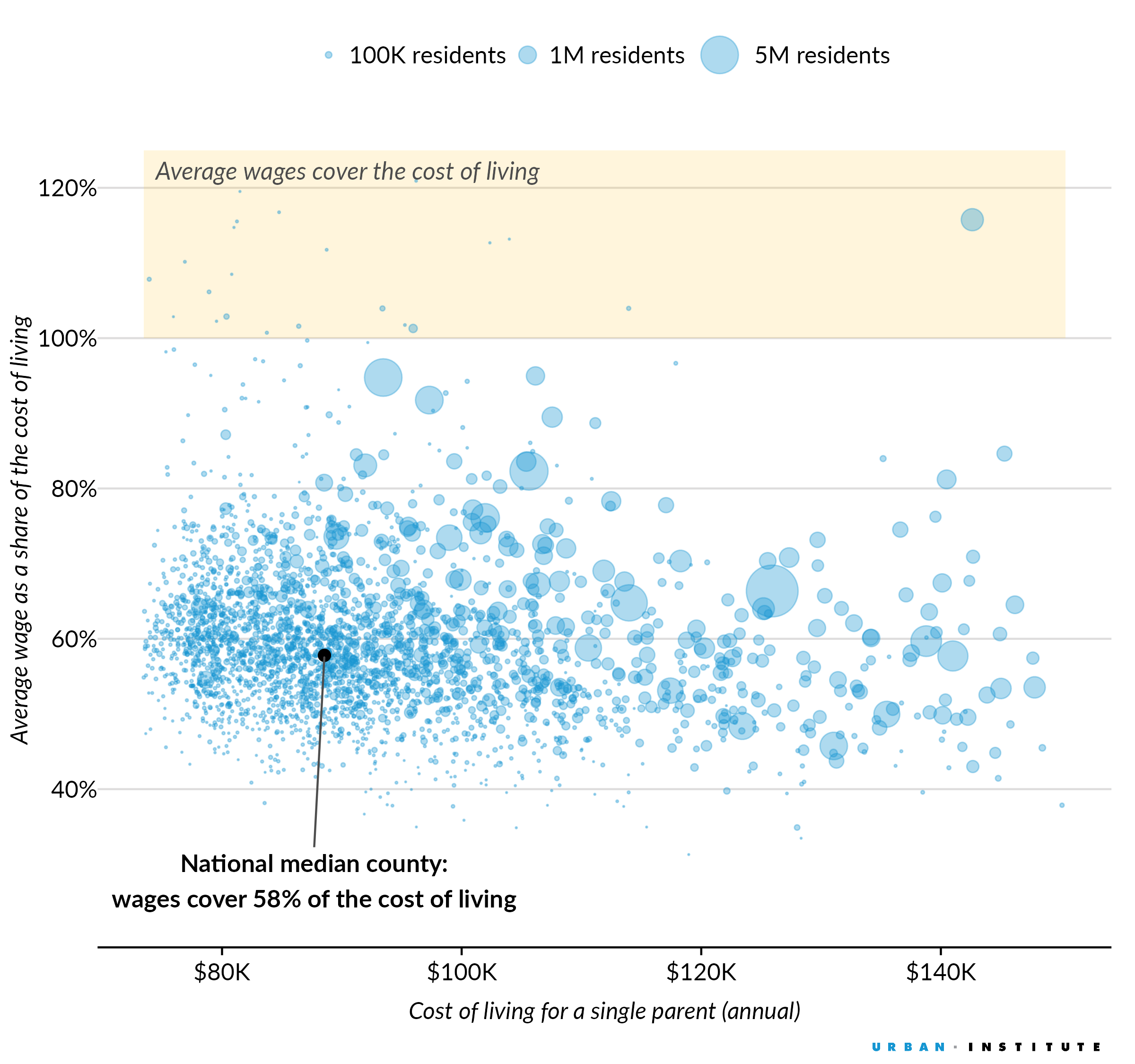
A low cost of living doesn’t necessarily make a community affordable. In fact, the average job covers the cost of living for a single parent raising two children in just 26 of the more than 3,000 counties in the US (these 26 counties are in the shaded band in the graph below).
In 99 Percent of Counties, the Average Wage Doesn’t Cover Basic Expenses for a Single Parent and Two Children
Source: Urban analysis of the Living Wage Institute, Inc.’s Benchmark Living Wage Data Series, 2024, and the Bureau of Labor Statistics' Quarterly Census of Employment and Wages.
Notes: Each dot is a county, and larger dots represent counties with larger populations. The 26 counties in the shaded band have an average wage that covers the cost of living for a single parent raising two children in 2024 for the 3,119 counties with reliable data in both years.
In the typical county—where the cost of living is at or near the national median—wages cover just 58 percent of the cost of living for a single parent and two kids. (Counties with a below-median cost of living do barely better, at 59 percent.) For a single parent living in the typical county to cover the basics, they would need nearly two full-time jobs at the average wage. Alternatively, the average wage would need to increase by more than 70 percent. These data are consistent with Urban researcher’s finding that more than 40 percent of people living in families with a full-time, full-year worker lack the resources needed to thrive socially and economically.
Hidalgo County, Texas, is a case in point. Its cost of living is among the lowest in the country, at about $79,000 a year for a single parent raising two children. But the county’s average wage—about $43,000 a year—covers only 55 percent of it.
Even the 26 counties where a single parent earning the average wage can cover their family’s cost of living are not necessarily affordable to the typical worker. That’s because nearly all of those counties are home to a dominant high-wage industry that likely increases the average wage, such as finance and tech centers like Manhattan and Silicon Valley, oil-producing counties like Midland in West Texas and Alaska’s North Slope Borough, and mining counties in rural Nevada.
Making communities affordable for families raising kids starts with quality jobs
In the counties where most Americans live, the cost of raising a family on one income has grown faster than pay in recent years. Even where costs are comparatively low, the average job does not cover basic needs for a single parent of two children.
Our analysis doesn’t explain what’s causing wage growth to fall behind cost growth in most counties, but research shows that many socioeconomic factors are at play. To create the conditions for affordability and upward mobility, especially for young families, state and local policymakers should consider policy options that focus on rewarding work, not just lowering costs. Leaders can start by exploring how wages and costs have moved in their own communities in Urban’s American Affordability Tracker.
