Urban across the Country

Body

Urban’s researchers partner with state and local leaders to provide the evidence, tools, and support they need to improve lives and strengthen communities. This work includes strategic advising to translate research into action, program evaluations to measure effectiveness, and research and data analysis to inform decisionmaking. Our experts develop custom data tools and modeling to support equitable resource allocation and lead community-engaged research and convenings to ensure policies reflect local priorities.

Use this page to explore Urban’s work. Search by region to see examples of our research, and filter by evidence and products to narrow results by topic or type of work.

Dive deeper into your state and community with our data tools. View highlighted tools below, select “Data tools” under “Filter by Product Types,” or head directly to our data tools page.


Get Involved

State and community data tools

Explore our work by state
President Trump gives a speech in front of a sign that says “Lower Prices.”
Addressing the affordability crisis will require a broad set of strategies from every level of government, including policies that tackle housing, health care, income, and more.
People gather outside a house while someone blows bubbles for a child on a sunny day.
How, when, and where people access housing affects many aspects of individual and community outcomes.
A woman and her four young children unload grocery bags around a kitchen island.
Greg Acs, vice president for the Tax and Income Supports Division at the Urban Institute, spoke with Virginia Public Media about the risks of addressing affordability in a zero-sum context that focuses on who bears the short-term costs of a policy instead of its potential for growth.
Brief Exploring the Small Business Employee Benefits Gap
This brief examines the differences in employer‑provided benefits between micro and small businesses (≤50 full-time equivalent employees) and medium and large businesses (≥100 full-time equivalent employees).
Photo of a young woman holding a credit card and looking at her phone.
An interest rate cap would reduce borrowing costs for some Americans but could also reshape who can access credit, potentially pushing many into high-cost alternatives.
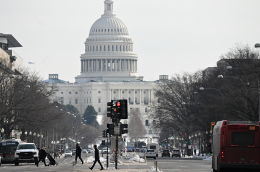
Photo of the Capitol building and a busy street on a gray winter day.
In its budget planning for the decade ahead, Congress should account for the projected exhaustion of Social Security’s trust fund in 2032.
Media Name: arrows.png
This brief illustrates the significant amount of life insurance coverage held among senior Black families, in aggregate and compared with senior white families.