
Every community has unique and multidimensional assets, or capitals, it can leverage to support the well-being of its residents.
In this article, we explore the relationship between a community’s natural capital (i.e., environment and natural amenities) and economic capital (i.e., financial systems and infrastructure) in the context of their capacity to mitigate and recover from disasters.
To do this, we look at disaster risk and flood insurance coverage levels nationally and in the counties affected by flooding in the wake of Hurricane Helene. We find that capacity to prepare for and recover from natural disasters varies widely across communities. Coastal communities, counties with higher flood risk ratings, and counties with more historical experiences with flooding tend to have higher levels of flood insurance.
Still, even in most high risk and coastal communities, most residential properties were uncovered by flood insurance. And many inland and lower flood risk places still experience flooding events and may lack the capacity to recover quickly.
This article gives one example of how exploring community capitals can help communities understand the resources available to leverage in the face of disruptions such as natural disasters. They can also help communities, philanthropy, and impact-minded investors identify disparities, risks, and areas in need of greater investment.
Flood Insurance as a Tool for Mitigating Disaster Risk
A community’s natural capital is directly tied to its risk of disaster. When it comes to flooding, communities with natural assets such wetlands that help absorb floods may be better positioned to avoid losses from flooding disasters.
There are some ways communities can directly invest in natural capital, such as through environmental remediation or green infrastructure. However, natural capital primarily comes from the local environment’s preexisting features.
To mitigate their risk of flooding, communities with lower levels of natural capital can invest in other, complementary capitals. That includes residential flood insurance, an economic capital that plays a large role in allowing households to recover (PDF) after flooding.
The federal government already encourages homeowners to acquire this economic capital by designating some areas with high flooding risk as Special Flood Hazard Areas (SFHAs). Households in SFHAs are required to have flood insurance if they have a federally backed mortgage, including those backed by the Federal Housing Administration and government-sponsored enterprises such as Freddie Mac and Fannie Mae. About 13 million Americans live in these areas. Households that receive the Federal Emergency Management Agency (FEMA) assistance after a flood are also required to maintain flood insurance.
Still, many at-risk properties do not have flood insurance. Many homes at high risk of flooding are outside of SFHAs, which are designated based on historic flood data and do not account for the changing climate. In addition, many households in SFHAs may not have mortgages or federally backed mortgages, or they may not be in compliance with flood insurance requirements.
Communities Hit By Hurricane Helene Had Wide Variations in Flood Insurance Capital
According to our analysis of National Flood Insurance Program (NFIP) data, only 3.4 percent of residential properties were covered nationwide in 2024. And levels of residential flood insurance vary widely across the country, with counties with low income having lower rates of residential flood insurance coverage compared with counties with middle and high income.
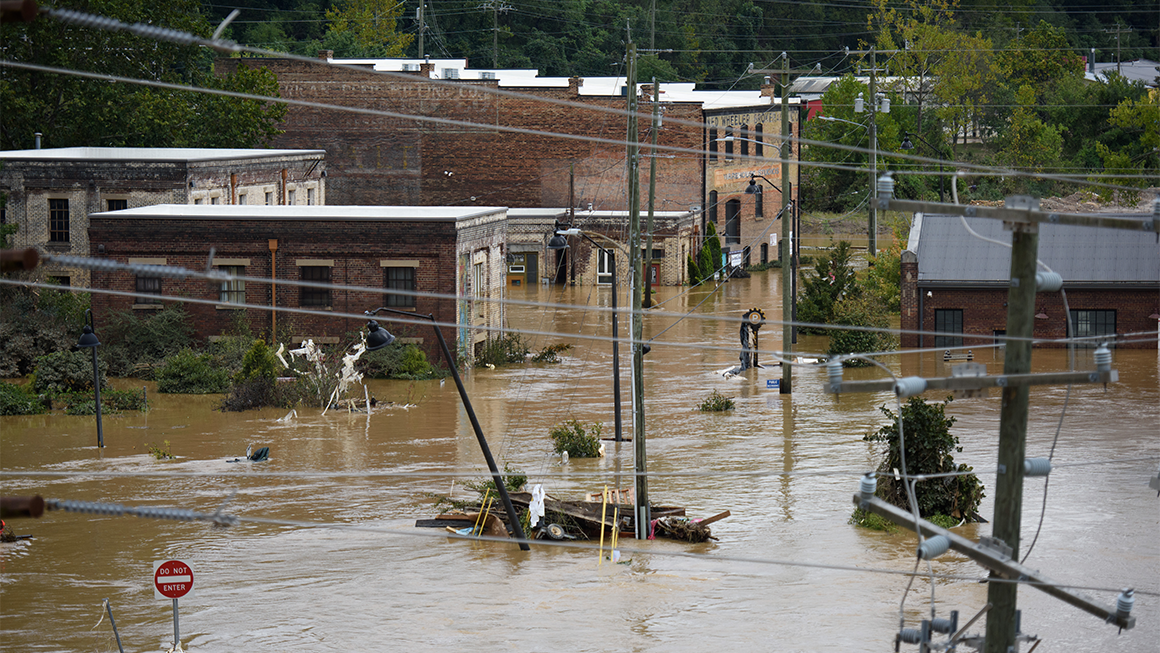
This disparity was particularly acute in the areas affected by Hurricane Helene, which caused catastrophic flooding across the southeastern US (PDF) in the fall of 2024.
As a category 4 hurricane on the Saffir-Simpson Hurricane Wind Scale (which goes from 1 to 5), Helene caused significant damage, at least 250 fatalities (PDF), and intense flooding across six states, including Florida, Georgia, North Carolina, South Carolina, Tennessee, and Virginia. The communities that were affected included areas that were both coastal and inland, and areas that were considered both high- and low-risk for flooding according to FEMA’s National Risk Index.
In many counties affected by Hurricane Helene, less than 1 percent of residential structures were covered by flood insurance. Many inland counties had coverage for less than 0.25 percent of residences. At the high end, about half of homes were insured in coastal counties Monroe (58 percent) and Collier (48 percent) in Florida.
Disaster Exposure Can Lead Communities To Accumulate Economic Capital for Disaster Mitigation
Coastal counties, counties with higher flood risk ratings, and counties that had more flooding disasters in the past had higher levels of flood insurance, both nationally and within the area hit by Helene. Some of this is likely driven by requirements in SFHAs, but not all homes in these areas are subject to requirements.
Research suggests that flood-insurance take-up is driven by a combination of requirements and previous experience with flooding disasters. Together, these factors may play a leading role in the ability of a community to build the economic capital needed to withstand future disasters.
Still, there are many homes that are not protected—no area had more than 16 percent of homes covered.
Relying on existing requirements and past experiences to drive capital-building may not be enough to prepare communities for natural disasters and may leave some communities particularly vulnerable to disruptions. Many counties hit by Helene and affected by devastating floods had lower flood risk ratings and were equipped with lower levels of flood insurance. The disparity in insurance levels between higher risk and lower risk counties and coastal and inland counties was even greater among Helene-affected counties than nationally. Inland counties are particularly underinsured—perhaps because of a lack of requirements and an existing assumption that flood risk is low—despite damaging floods still occurring in these areas.
Income can also affect a community’s ability to accumulate economic capital in relation to its disaster risk. For example, in areas hit by Helene, 29 percent of residential units in coastal communities with high incomes were covered by flood insurance, while only 2.6 percent of residences in coastal counties with low incomes had coverage. Coastal communities with middle income were 14.3 percent covered. Previous research suggests households with higher incomes and education levels are more likely to voluntarily purchase flood insurance, leading to disparities in who can best recover from flooding.
This suggests that insurance requirements, disaster risk indicators, and income levels may drive insurance coverage. As a result, many inland places may be left behind in terms of disaster recovery capacity, even though, as Helene showed, inland places can still be significantly affected by flooding disasters.
Residents in lower income counties may struggle to afford insurance but may also have fewer options for alternative capital—such as available personal wealth or local government support for rebuilding—to aid recovery from flooding events. These communities may benefit from additional investment from philanthropy or impact investors to support recovery from natural disasters, or may be prime candidates for investment in disaster mitigation measures like green infrastructure.
About Community Capitals
This article is a part of series exploring how the Community Capitals Framework can help communities, philanthropy, and impact-minded investors align programming and investment decisions with existing local opportunities. This framework—developed by sociologists and advanced by the Heron Foundation—provides a helpful framework (PDF) for understanding community assets and capacity. The types of capital include
- human capital (i.e., the skills and experiences of residents),
- natural capital (i.e., the environment and natural amenities),
- civic capital (i.e., trust, values, and culture),
- economic capital (i.e., economic systems and infrastructure),
- and others.
Explore our additional articles on business diversification and education anchor institutions.
