
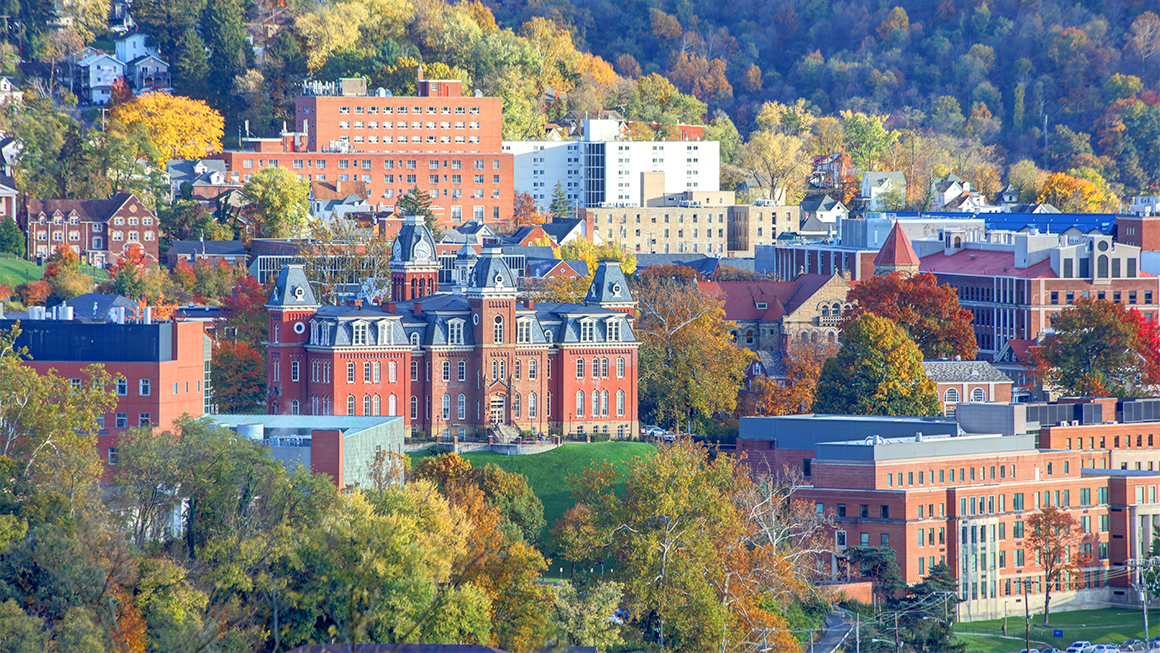
Colleges and universities are often economic anchors—or large, place-based organizations that have significant local economic impact on the surrounding community. Unlike other businesses that may relocate for cost advantages, higher education institutions are usually closely tied to their surrounding communities through physical infrastructure, local relationships, and institutional mission. Additionally, colleges and universities serve as civic institutions that foster community engagement and knowledge creation, while simultaneously functioning as major economic drivers through employment.
In this article, we explore how colleges and universities contribute to the economic capital of local communities. This framework can help local leaders understand how to leverage these local institutions most effectively, especially as higher education deals with federal funding uncertainty.
Colleges as Anchor Institutions
Higher education institutions support local economies through multiple channels. Student spending on housing, food, entertainment, and retail adds to local economies, and institutions often purchase goods and services from local businesses. Colleges and universities foster research and innovation by turning research into patents and licenses, incubating startups, and partnering with local industries. They also provide communities with cultural and social capital by hosting events, providing facilities, and running programs that enhance quality of life.
But perhaps the biggest way institutions support local economies is by directly employing faculty, staff, and administrative positions in stable, often well-paying jobs.
All told, higher education institutions and their hospitals directly or indirectly support 18 million jobs in the US. They also contribute an estimated $1.7 trillion in goods and services to the US economy annually.
How Colleges and Institutions Support Local Employment
To quantify how anchor institutions contribute to their local economies, we analyzed the share of county employment directly supported by higher education institutions. For all colleges and universities represented in National Center for Education Statistics data, we compared their total employment to the total jobs in the county where they’re located.
Given variation in the presence and size of local institutions, the share of county employment supported by institutions varies significantly across the country, from nearly zero to almost 30 percent.
Of the more than 6,000 colleges and universities analyzed, only 44 support more than 10 percent of their county’s total jobs. This means only a small share of counties are significantly economically dependent on higher education, but for those communities, institutions represent critical economic anchors.
In the table below, we show counties with the highest share of jobs supported by higher education institutions. This reveals how diverse institution types can drive local economies—from large research universities like Cornell University and Pennsylvania State to smaller institutions like College of the Albemarle, which supports 21 percent of its county's employment despite having only 219 total staff.
In nonmetropolitan areas, where economies tend to be less diverse and concentrated in fewer sectors, colleges and universities take on heightened importance as economic anchors.
Among the top nonmetropolitan counties by college employment share, colleges and universities represent 9 to 14 percent of total employment. These percentages are lower than among all counties with colleges and universities, but higher education institutions in nonmetropolitan counties often are among the largest—if not the largest—employers in their regions, providing not only jobs but also attracting students, faculty, and resources that might otherwise bypass these communities entirely.
Economic Stability through Educational Anchors
Communities with significant college or university presence possess built-in advantages, such as stable employment bases, educated workforces, cultural amenities, and innovation potential, that communities can harness to attract additional businesses, retain young talent, and diversify local economies.
Many educational institutions continue to expand their community roles beyond education and find creative ways to support local economies, such as developing affordable housing projects, running business incubators, or partnering with local employers on workforce training. These investments can have ripple effects that support rich economic opportunity throughout a community.
However, economic dependence on these anchor institutions also presents potential risks. Communities heavily reliant on a single educational institution may face vulnerability during enrollment declines, funding cuts, or institutional changes.
Currently, higher education institutions across the US are facing federal funding uncertainty, including proposed caps on research reimbursement rates, grant terminations, and budget cuts. These challenges underscore the risk to surrounding communities, as institutions implement hiring freezes and budget reductions in response to funding instability.
To create a more resilient and diversified local economy, local governments, economic development agencies, philanthropies and community leaders can assess higher education institutions’ contributions to local economic capital while simultaneously working to build complementary economic sectors that can both benefit from and support the educational anchor institution.
About Community Capitals
This article is a part of series exploring how the Community Capitals Framework can help communities, philanthropy, and impact-minded investors align programming and investment decisions with existing local opportunities. This framework—developed by sociologists and advanced by the Heron Foundation—provides a helpful framework (PDF) for understanding community assets and capacity. The types of capital include
- human capital (i.e., the skills and experiences of residents),
- natural capital (i.e., the environment and natural amenities),
- civic capital (i.e., trust, values, and culture),
- economic capital (i.e., economic systems and infrastructure),
- and others.
Explore our additional articles on business diversification and disaster risks and recovery capacity.
