
This brief was corrected July 30, 2026. A previous version of figure 1 listed an incorrect share of all rent-burdened households in Massachusetts.
States and localities are experimenting with new innovative financing tools to help catalyze housing development. In this brief, we examine the BILD (Bringing Innovation to Lending and Development) program developed by MassHousing, Massachusetts’s housing finance agency, which provides below-market public equity, mobilizes private capital, and offers long-term debt to help finance mixed-income multifamily housing projects.
Why This Matters
Communities across the United States are experiencing shortages of housing, particularly of affordable housing. One barrier to building more housing is high construction costs, which have increased significantly because of rising land, labor, and materials costs, as well as high financing costs, making it difficult for developers to make their developments financially feasible. Although programs such as the low-income housing tax credit are a lifeline for affordable rental projects, the need for additional public capital for rental housing for housing of all types is high.
Mixed-income housing development can offer affordable units in higher-opportunity neighborhoods than fully affordable projects, on average. MassHousing’s BILD program is a model for a suite of new, innovative housing strategies being deployed by state housing finance agencies in recent years to support mixed-income housing.
Key Takeaways
The program contains both a debt component and an equity component. The debt product, the FORGE Loan, is a blend of permanent senior debt originated by Berkadia, a national mortgage lender, in partnership with MassHousing and purchased by Freddie Mac and a subordinate permanent second mortgage loan from MassHousing. The equity component, the Momentum Fund, reduces the cost of capital by committing below-market-rate preferred equity at project stabilization.
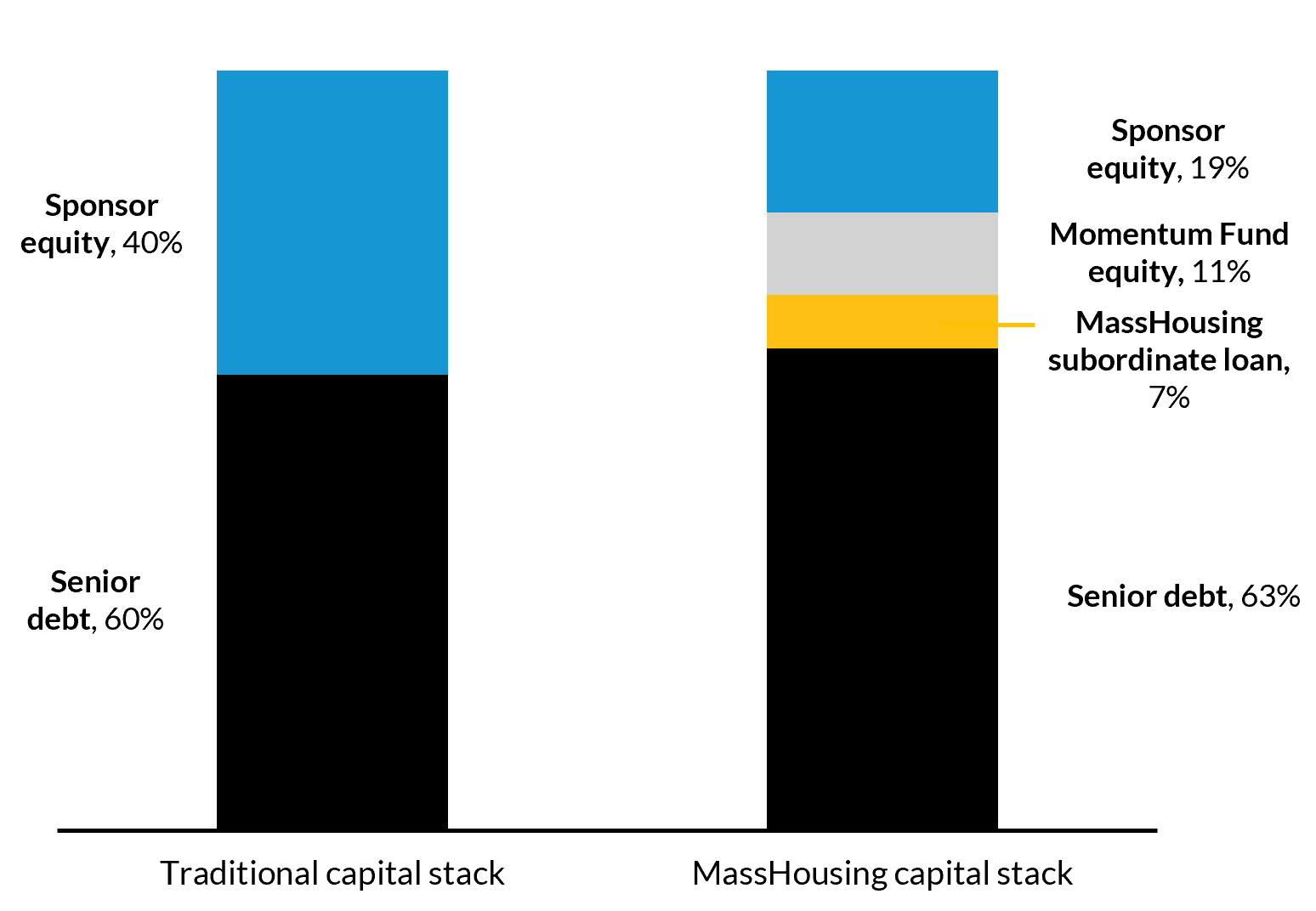
Source: Urban Institute visualization of MassHousing pro formas.
Notes: FHA = Federal Housing Administration; GSE = government-sponsored enterprise ; HUD = US Department of Housing and Urban Development; DOT = US Department of Transportation; Treasury = US Department of the Treasury.
Through our assessment, we recommend four key points for consideration to improve the program’s deployment.
- Add flexibility. MassHousing could consider decoupling the preferred equity from the debt so projects can take only what they need, and consider deeper subsidies tied to greater affordability.
- Implement a coinvestment platform. MassHousing is looking to bring in private coinvestors through the Momentum Fund to accelerate available equity financing.
- Accelerate the approval process. MassHousing could accelerate approval timelines by relying on underwriting from projects’ senior debt lenders for faster capital deployment.
- Adapt to shifting market conditions. As interest rates stabilize and policy environment shifts, MassHousing expects the program’s geographic reach to broaden to less established markets where a BILD commitment can make mixed-income projects viable.
How We Did It
We conducted interviews with key stakeholders engaging with the BILD program, including MassHousing and its developer and lender partners, in addition to representatives from other states with similar mixed-income housing programs. In addition, we analyzed pro formas of BILD deals.
