
Mixed-income housing has become a major source of both overall housing production and affordable housing production in Massachusetts. Examining large multifamily developments in the Boston and Worcester-Springfield regions, we find that mixed-income developments now account for most new multifamily construction, produce a substantial share of affordable units, and are more likely than fully affordable developments to be located in high-opportunity neighborhoods.
Why This Matters
States and localities are increasingly employing mixed-income housing policies and programs—including inclusionary zoning, density bonuses, and construction financing programs—to expand affordable housing while increasing overall supply. Supporters argue these developments can create affordable units with less subsidy and provide access to high-opportunity neighborhoods. Critics argue affordability requirements reduce development feasibility or produce fewer affordable units than fully subsidized housing. Understanding how mixed-income housing functions in practice is therefore critical for housing policymakers.
What We Found
Our analysis shows that mixed-income housing has become a central component of Massachusetts’s housing production system:
- Mixed-income housing now dominates new multifamily construction. Nearly 60 percent of large multifamily developments and 65 percent of new units completed from 2021 to 2025 were mixed-income projects.
- Mixed-income developments produced most of the affordable units built in large multifamily projects from 2021 to 2025. Fifty-six percent of affordable units delivered during this period came from mixed-income developments, despite declining affordable shares within individual projects.
- Mixed-income developments are located in high-opportunity neighborhoods. Compared with fully affordable developments and, in many cases, compared with market-rate developments, mixed-income developments are found in neighborhoods with higher incomes, higher rents, stronger job access, and higher educational attainment.
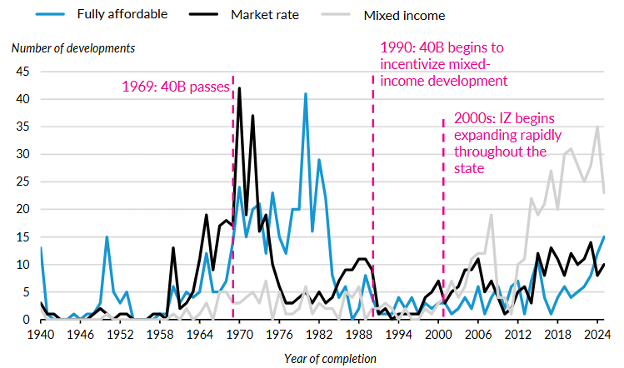
Source: Authors’ analysis of Yardi Matrix data.
Notes: IZ = inclusionary zoning. Some developments had earlier completion dates, but we excluded them from this figure for display purposes.
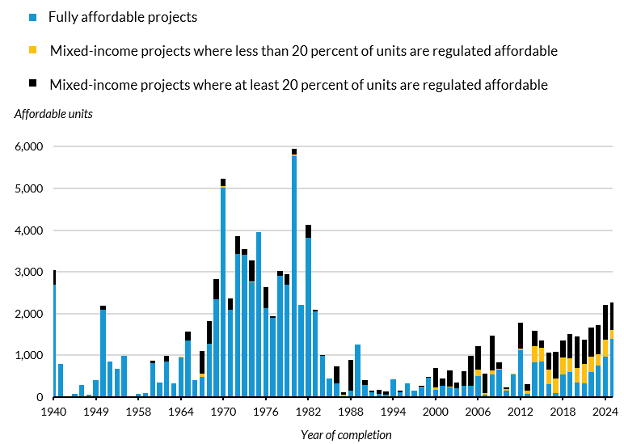
Source: Authors’ analysis of Yardi Matrix data.
Although Massachusetts has a unique policy environment, the findings offer lessons for other states and localities considering mixed-income housing strategies. The state’s experience suggests that mixed-income housing can play a significant role in producing both market-rate and affordable homes and can help locate affordable housing in high-opportunity neighborhoods. These findings highlight the potential of mixed-income development as one component of a broader housing strategy.
How We Did It
We analyzed property-level data on large multifamily developments (50 or more units) in the Boston and Worcester-Springfield metropolitan areas using Yardi Matrix data. We linked those developments to census tract data from the American Community Survey, the US Department of Housing and Urban Development’s Jobs Proximity Index, and Centers for Disease Control and Prevention environmental indicators to examine how mixed-income housing contributes to overall housing production, affordable housing production, and access to neighborhood opportunity.
