
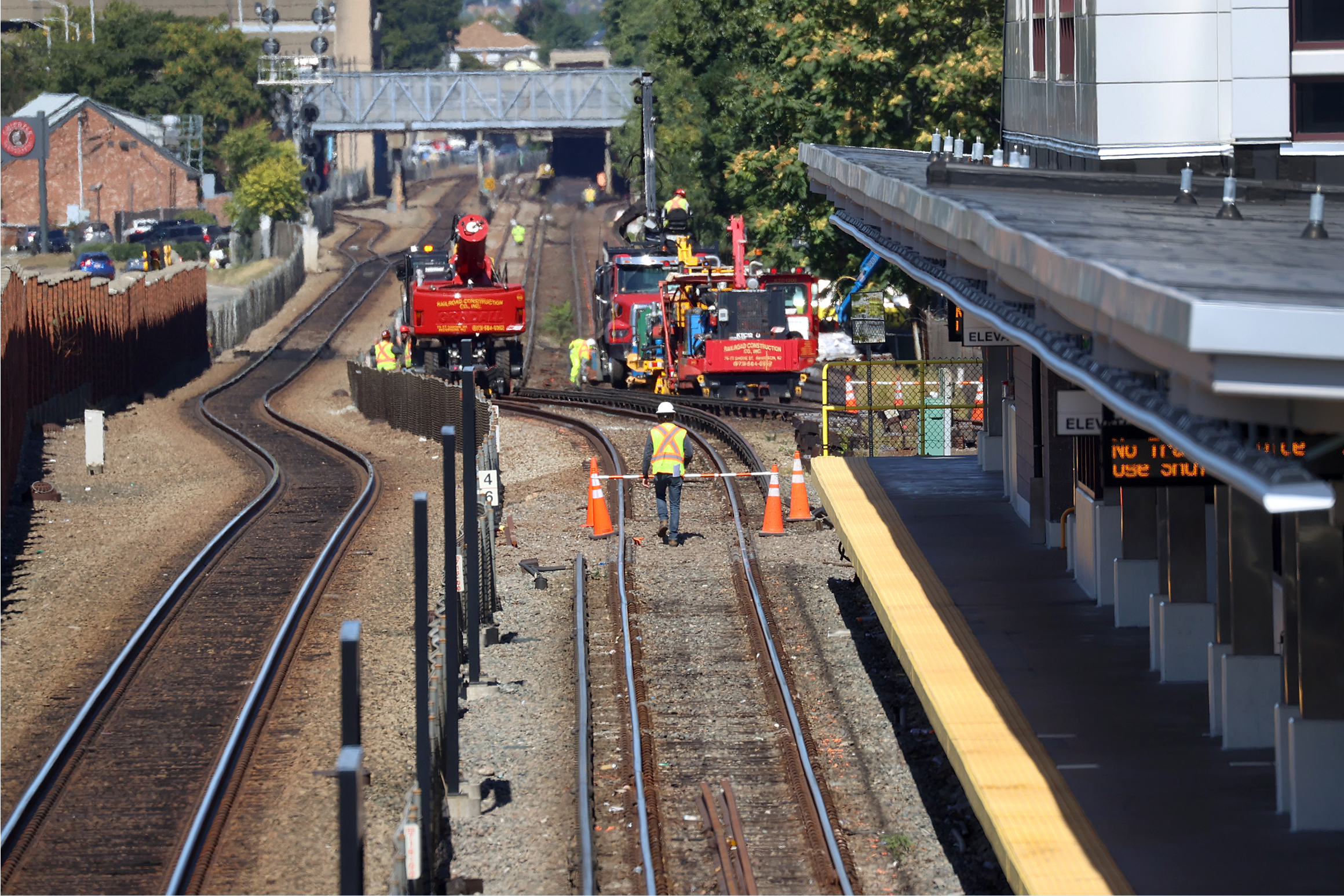
In November 2021, the bipartisan Infrastructure Investment and Jobs Act (IIJA) authorized billions of federal dollars for crucial infrastructure projects, including those focused on public transportation. Now, Congress is considering its policy priorities for the next transportation funding package, which will replace IIJA. Although IIJA allocated tens of billions of dollars toward public transit, the latest draft of the next funding package would significantly reduce those investments.
Given this proposed turn away from public transit, it’s worth asking: To what extent did recent federal funding initiatives meet communities’ transportation needs?
To answer this question, we analyzed whether funds obligated through major federal public transportation programs between fiscal years 2022 and 2025 went to states and communities with the greatest needs. This analysis builds on Urban’s Federal Infrastructure Funding Tracker, which provides detailed data on federal investments across a range of infrastructure categories.
We found the following:
- Despite the increased availability of funding in IIJA, federal support remains far from sufficient to ensure adequate transit service nationwide.
- Rather than being distributed evenly, public transportation funding was concentrated in a few states.
- Many smaller communities, including places where relatively few residents have access to personal vehicles, received little direct federal public transit support.
- Communities with higher public transit ridership received significantly more funds than those with fewer riders.
These findings suggest that federal transportation programs may reinforce local travel trends. Communities with high shares of public transit commuters rely on federal funds to operate, maintain, and repair their systems, though they often do not receive enough to provide adequate service, while places that lack reliable transit may be unable to access federal funds to develop the options their residents need.
Congress and federal agencies must make difficult decisions when allocating public transit funding. With limited resources available to support both current transit systems and new transit services, the federal government could consider options that directly fund communities without established systems while providing more support for planning and capacity building for newer or smaller transit agencies.
Federal Funding for Public Transportation Is Concentrated in a Handful of States
A handful of states received the bulk of per capita public transportation funding from fiscal year 2022 through 2025. New York ($1,311 per capita) received the most, followed by Alaska ($787 per capita), Hawaii ($757 per capita), Connecticut ($577 per capita), and Illinois ($504 per capita). Many of these states include large urban areas with robust public transportation systems, which are eligible to receive funds directly through federal transportation formula programs. Alaska, meanwhile, likely received such high levels because of funding for regional, relatively high-cost ferry services.
States that received the lowest per capita public transportation funding typically were in the Great Plains, Mountain West, and South. Mississippi received only $27 per capita, while Arkansas received $33 per capita, Kansas received $39 per capita, and South Carolina received $45 per capita.
At the local level, we see similar patterns. We analyzed funding distribution patterns to core-based statistical areas (CBSAs) nationwide, which include large metropolitan areas as well as smaller micropolitan communities situated around urban cores with populations as small as 10,000. Because many federal funds are distributed to state governments, those funds are assigned to state capitals in funding distribution records even though they are later distributed throughout states. As such, we excluded any CBSA that includes a state capital from our analysis.
Higher levels of funding were concentrated in parts of the Northeast and many western CBSAs, particularly those in Arizona, California, and Washington. The New York City metro area received $1,410 per capita in direct public transportation funding over the four-year study period, outpacing all other CBSAs. Several other major metro areas were among the highest funded, including Chicago ($666 per capita), San Francisco ($653 per capita), and Los Angeles ($495 per capita).
Some smaller CBSAs also received significant federal investments, including Ames, Iowa ($838 per capita), Barnstable Town, Massachusetts ($775 per capita), and Glenwood Springs, Colorado ($423 per capita).
However, many large CBSAs across the Great Plains, Mountain West, and South received less public transportation funding per capita despite their size. This includes places like Tucson, Arizona ($54 per capita), Tulsa, Oklahoma ($59 per capita), and Chattanooga, Tennessee ($62 per capita). Though each of these regions supplement their federal support with other sources of funding, limited federal funding is generally associated with little funding overall.
Across the US, more than half (59 percent) of CBSAs received no direct funding from major federal public transportation programs during the study period.
In part, this trend can be attributed to longstanding approval processes. Although governments and agencies in large urban areas (those with populations of 200,000 or more) typically receive public transportation funds directly from the federal government, agencies in many small urban areas must get state approval under certain programs before receiving allotted funds and risk losing those funds to other state projects if they do not use them by a specific date. As such, some CBSAs may have received federal funding eventually, once it passed through state departments of transportation or regional transit authorities, but that is difficult to determine using available data.
There Is an Opportunity to Better Support Transit Options in Smaller CBSAs with Lower Rates of Car Access
In places where transit options are unavailable or underperforming, residents without access to a personal vehicle may struggle to access employment, health care, and other essential services. Investing in public transportation can expand affordable transportation options, especially in less densely populated communities where these amenities are harder to get to.
At the state level, places with lower car access generally received more per capita public transportation funding. New York, Massachusetts, New Jersey, and Illinois received the most public transportation dollars, and each has fewer than 90 percent of households with access to a vehicle at home, lower than the national median.
But zooming in to the local level complicates the story. Many CBSAs where lower shares of households have access to personal vehicles received limited direct federal funds, while some CBSAs where car access is more common received more substantial funding support. For example, Gardnerville Ranchos, Nevada, where 98 percent of households have access to a vehicle, received $472 per capita and the Logan, Utah–Idaho CBSA, where 96 percent of households have car access, received $317 per capita. (Even in places with high car access, public transit can provide options for residents who cannot or do not want to drive, including the elderly or residents with disabilities.)
Among the CBSAs with the lowest levels of car access, only the New York City metropolitan area received more than $150 per capita in federal support, and most received little to no direct funding. Metro areas in Puerto Rico—including Aguadilla-Isabela, Ponce, and San Germán—were especially underfunded, despite being eligible for most federal transit programs. They received relatively little federal support for public transportation, even though they have some of the lowest rates of car access in the US and its territories, which raises concerns about residents’ ability to access their daily needs.
Places with lower than median car access and few public transit options may be ripe for public transit investment. Deploying targeted federal public transportation resources to these communities could maximize impact by funding new affordable means of transportation where current options may limit mobility and access.
Some smaller cities where car access was less common have received significant direct funding that is helping them provide mobility options to residents. The Decatur, Illinois, metropolitan area, for example, received more than $29 million in direct public transit funding. This included allotments for the Decatur Public Transit System through the Low-No Emission and Bus Facilities programs, which will allow the city to upgrade and modernize its bus fleet. College towns (like Eugene, Oregon, and Ithaca, New York), with large numbers of students who are less likely to drive, also received higher levels of per capita transit funding than average.
Public Transit Funding Mostly Supported Transit Service in Larger Cities
Federal public transit funding tends to support places with greater public transit ridership, such as large urban areas with metro rail systems (e.g., Chicago and San Francisco) and towns with large health care or university institutions (e.g., Rochester, Minnesota).
At a state level, New York, New Jersey, Massachusetts, and Illinois have the highest shares of commuters who use public transit, and each received higher levels of federal public transportation funding. This relationship seems intuitive: transit systems need to be maintained and expanded, so the formulas that determine the transit funding distribution give priority to communities with higher transit ridership. Many large transit systems receive these formula funds directly, while smaller systems receive federal funds passed through their state departments of transportation.
As a result, places that lack robust public transportation systems but would stand to benefit from public transportation investment are not adequately funded and may be good candidates for federal support. Adding new transit service, even in the form of bus routes, can be difficult to finance without significant resources, such as those provided by the federal government. However, only one CBSA with a public transit commute rate below the national median received more than $150 per capita in public transit funding, a level of support that could increase transit service by 50 percent or more in many communities.
Federal Public Transportation Funding Could Do More to Expand Transit Access in Places Without Service
These funding trends may not be particularly surprising, but they do represent a missed opportunity. Although CBSAs with public transit systems and large populations have a clear and pressing need for repairs, maintenance, and expansion (especially as farebox revenues in major systems fail to make up for these repair costs), communities with less-established transit systems would also benefit from additional federal public transportation funding.
In Alexandria, Louisiana, for example, fewer than 91 percent of residents have access to a car. But Alexandria received just $31 per capita in IIJA funding for public transportation, including a $320,000 grant for general mobility improvements. That helps explain why fewer than 2 percent of residents in Alexandria commute via public transportation. Its residents need alternative transit options, but its direct federal funding for public transit pales in comparison to that received by other areas with established transit systems. Unlike Alexandria, those places tend to have greater staff and budget capacity, allowing them to more easily apply for and administer federal grant dollars.
As Congress contemplates the reauthorization of surface transportation funding, it should consider ways to both support existing public transit systems and help establish new public transportation systems in the communities that need them. Reducing funding to the communities that already receive federal transportation funds would have negative consequences for riders in these areas, as even the best-funded transit systems in the United States provide insufficient service.
Instead, the federal government could provide additional direct funds to small urban and rural areas, rather than relying on states to pass funding through to communities. A new competitive program could establish affordable transportation options in communities with low rates of car access, and the federal government could provide more up-front support for planning and capacity building for newer or smaller transit agencies.
Unfortunately, the current transportation reauthorization language being considered by Congress shifts the nation’s funding priorities away from public transit altogether, and rural states stand to lose the most in the process. In the absence of sufficient federal support, other stakeholders can step up. States could fill in funding gaps and support the bureaucratic capacity of local governments by funding grant writing or planning efforts. And local governments could consider alternative funding sources for establishing new public transportation options in their communities.
