

In the United States, the disparate treatment of people of color by law enforcement has been well documented. Black people and other people of color are more likely than white people to be pulled over while driving and are more likely to be searched during the stop. In other police contacts, law enforcement officers are more likely to use excessive or deadly force when interacting with people of color and other marginalized populations. In addition to these incidents, police misconduct includes unethical or illegal actions done by law enforcement officers that violate the constitutional rights of community members. Though particularly heinous incidents of police violence have become national news, jurisdictions across the country have struggled with police misconduct that hasn’t elicited a large public response.
Though misconduct reporting can create pathways for community members to seek support after experiences of harm, government agencies have demonstrated a lack of transparency and little or no data for community members to build an understanding of these experiences. Knowing which officers are often involved in misconduct cases, how many accusations are made and for what, and even which officers may have left a department because of accusations, along with other data that directly impact safety and perceptions of safety, can help people maintain their own safety and empower them to push for change.
In 2022, two community groups, the Invisible Institute and Act 4 SA, created new tools in Champaign-Urbana, Illinois, and Bexar County, Texas, to advance data transparency on police misconduct and provide community members with data to advocate for reform in their communities. Both groups were grantees of the Catalyst Grant Program, a collaborative effort between the Urban Institute and the Microsoft Justice Reform Initiative that seeks to empower and support nonprofits to use data and technology to advance racial equity in the criminal legal system. Other communities can learn from the grantees’ experiences and undertake similar efforts to pursue transparency and reform in policing. This post details the work of the Invisible Institute and Act 4 SA in building these tools.
The Invisible Institute Engaged Champaign-Urbana Residents to Build a Police Misconduct Tool
In pursuit of transparency, the Invisible Institute in Champaign-Urbana runs the Civic Police Data Project, which provides Chicago residents with a website where they can explore hundreds of thousands of complaints against and use-of-force incidents committed by the Chicago Police Department. Working with Do Big Things, it created and launched a simplified version of the website for the Champaign-Urbana metro area to incorporate reporting and community engagement. Though the data they collected are publicly available through Freedom of Information Act requests, that process can be cumbersome; it often takes weeks to months and one often has to check on the status of one’s requests. And data formats vary between and even within government agencies depending on reporting requirements, further complicating the process for residents who might have been interested in receiving the data. For example, some of the data the Invisible Institute received came in as PDFs, requiring a tool like Microsoft Azure Form Recognizer to extract needed data from the texts. When civilian agencies are involved, misconduct information can come from phone calls, online forms, and even paper forms, all of which lead to missing, incomplete, and inconsistent information and which data analysts must process and help make understandable. The Invisible Institute’s work ensured that residents instead had an approachable and simple way to access and understand this information.
Throughout the development of the tool the Invisible Institute engaged Champaign-Urbana community members to ensure the user experience reflected community needs. It particularly made an effort to hear from people who had firsthand experience being policed by the Champaign and Urbana police departments, since they would better understand what was happening in communities and communities’ specific concerns. Building those community connections encouraged the Invisible Institute to continue its work toward making misconduct by and use-of-force allegations against smaller law enforcement agencies publicly accessible, as community members shared experiences of aggressive policing all over the Champaign-Urbana area. After meeting with various community organizers and nonprofits while building the tool, the Invisible Institute hosted a launch event where about 40 community members attended a walkthrough of the website. The tool provides access to misconduct data and allows users to look up police officers from the Champaign and Urbana police departments. After looking up an officer, users can see which complaints and use-of-force reports they have been mentioned in.
The Invisible Institute was also able to develop relationships with media outlets to further share its work and to continue expanding on what it has already created based on community feedback. It plans to add the relevant documents for residents to review online, and moving forward it will update the data in real time. Its work has increased the attention paid to these issues. Since its project concluded, articles shedding light on communities’ experiences of misconduct and on the work’s connection to mental health training for police officers have been released. When information is accessible in this way, communities can bring attention to issues they experience and advocate for change.
Despite Challenges Getting Data, Act 4 SA Launched a Dashboard on San Antonio Police Officer Misconduct
Act 4 SA in Bexar County, Texas, is another Catalyst grantee that used its project to create transparent and accessible data related to police misconduct for its community. It is a grassroots organization based in San Antonio that works to hold the police accountable and advocate for policies to reduce police interactions and thereby enhance public safety. ACT 4 SA focused on creating transparency around the outcomes of misconduct allegations, namely police suspensions, firings, and rehirings. The San Antonio Police Department (SAPD) often rehires fired officers after their dismissals through arbitration. In fact, the SAPD has a rehire rate close to 70 percent—one of the highest in the country. Ensuring the community has access to these data keeps residents informed about who is serving their streets by providing insights into their disciplinary backgrounds.
Throughout the Catalyst grant period, ACT 4 SA worked to get access to termination and arbitration documents from the SAPD. To obtain these documents, it searched through the SAPD’s data and transparency page and filed Freedom of Information Act and open records requests with the City of San Antonio. Collecting all the data it originally hoped to get, however, proved a major challenge.
Originally, by the end of the grant period Act 4 SA wanted a dashboard that would show police suspensions and terminations for the SAPD, the Bexar County Sheriff’s Office, and all four of the Bexar County Constables Offices. Despite this goal, it was unable to obtain the necessary documents from the sheriff’s and constables offices in time for the launch of the dashboard because of a variety of issues that are not uncommon in the data-accessibility space. The cost of receiving the data was the main barrier. The records of these two agencies had not been digitized until recently, resulting in high charges for labor costs to find, redact, scan, and send the necessary documents. The sheriff’s office wanted to charge ACT 4 SA $35,000 for the documents related to suspensions, arbitrations, and rehirings dating back to 2010. Similarly, the constables offices wanted to charge them $10,000 for access to the necessary documents. These extraordinarily high costs and the tedious labor needed are ongoing challenges in increasing data accessibility and transparency.
To mitigate these barriers, Act 4 SA began working on an AI document-reader tool to help easily pull information from suspension documents and lessen the needed labor. It has also spoken with one of the county commissioners about the possibility of setting a line item in the county budget to have all county law enforcement employment and disciplinary records digitized back to 2010 for accessibility. If both of these come to fruition, major barriers to data accessibility and transparency will be removed in Bexar County, making it a model for other jurisdictions across the country.
Although the first version of the dashboard did not contain all the data they hoped, the product at the launch proved to be a major success. Working with Duable, in January 2023 Act 4 SA launched its public-facing dashboard on SAPD officer misconduct with data from 2010 to 2022. The dashboard is an important step in enhancing public safety, serving as a “watchdog” for officers who violate laws and departmental policies. With easily accessible and digestible public data, the hope is officers will be deterred from engaging in harmful and dangerous behaviors. Further, in pursuit of accountability for officers engaging in misconduct, other law enforcement offices can access these data to make better hiring decisions and stop the problem of “wandering officers.” Community members also have an easy way to stay fully informed about who is policing their neighborhoods. According to Act 4 SA, the dashboard has already been used by lawyers representing clients who have experienced police abuse, by reporters running stories about officers who have committed misconduct, and by community advocacy groups. The dashboard is extraordinarily user friendly, allowing users to search by officer name, type of misconduct, and step in the disciplinary process or to look at the firings. It lists officers in order of number of incidents, provides a graph of indefinite suspension outcomes, and has a visual of the most common incident types. The dashboard also has a section for additional resources on the topic, a glossary of terms, and resources showing how the suspension process works, and it provides a brief analysis of some of the data.
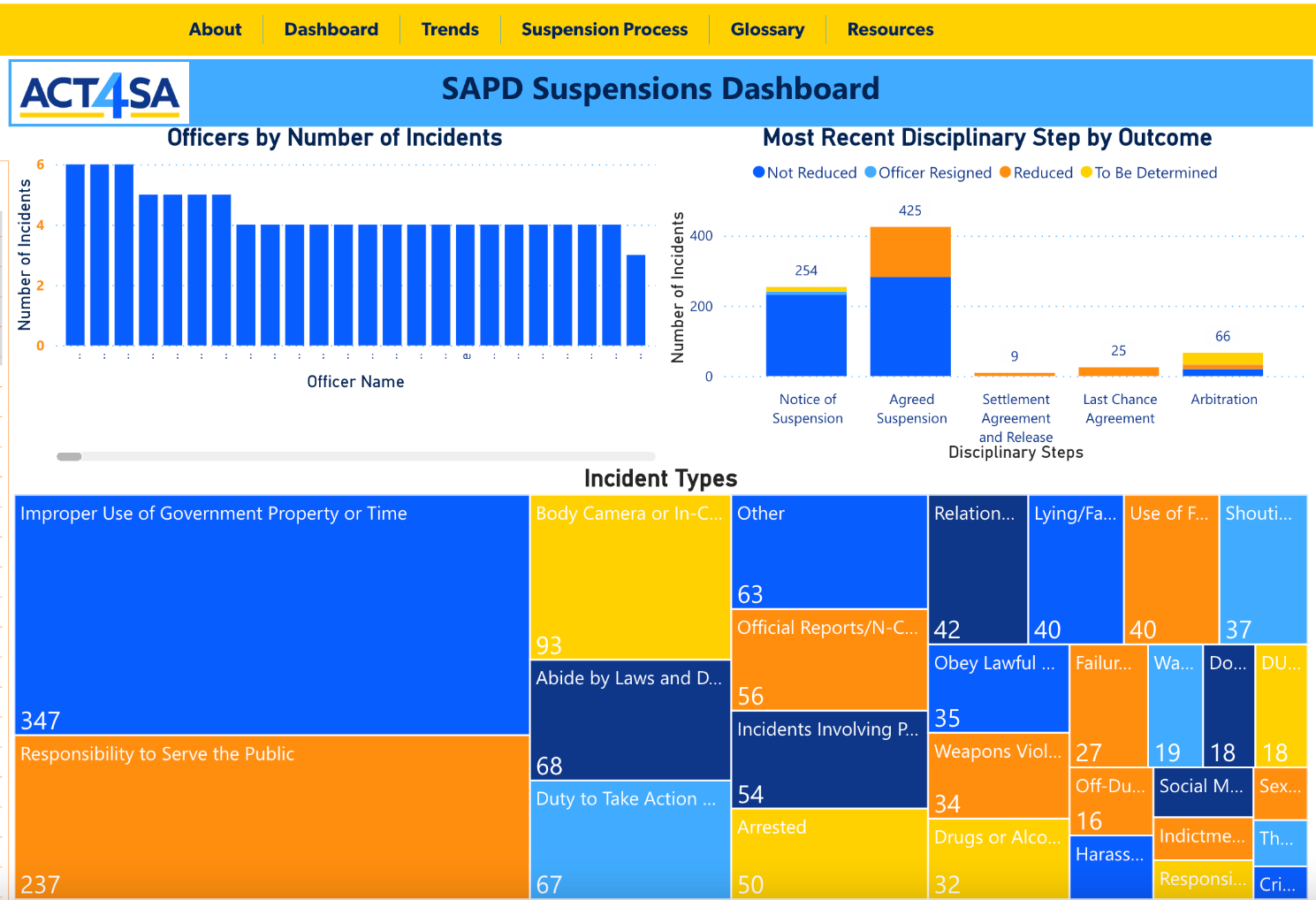
In July of 2023, ACT 4 SA was able to add Bexar County Sheriff’s Office data from 2019 to 2023 to the dashboard. It is still struggling to receive all the arbitration documents for these officers, but it has been adding documentation and data as they trickle in to make the dashboard more accurate. In the future, ACT 4 SA hopes to add two to three more departments and eventually elevate www.copthedata.com to a full statewide dashboard.
The importance of data accessibility and transparency to criminal justice reform and community safety cannot be overstated. Access to data can not only inform communities of racial disparities but can keep residents educated about who is in charge of safety in their localities and empower them to push for reform. Policy change is hard to achieve without both analyses that show the breadth and effects of an issue and the narratives of lived experience that illustrate the issue’s impact. The work and successes of organizations like the Invisible Institute and Act 4 SA can serve as examples of how to address harm and violence caused by law enforcement, improve safety, and support efforts to reduce racial disparities in the front end of the criminal legal system. Though collecting, cleaning, and interpreting data can be difficult, it is clear that supporting organizations’ capacity to take on the challenge helps them succeed and can benefit entire communities, which might not otherwise have the capability to engage with data.
The Catalyst Grant Program is a collaboration between the Urban Institute and the Microsoft Justice Reform Initiative to help nonprofit organizations use data and technology to advance racial equity and reform in the criminal legal system. Visit the Catalyst Grant Program Insights page for more resources and stories about the grantees.
