
Each day, more than 100,000 people in the US visit their local Social Security Administration (SSA) office to apply for retirement or disability benefits, fix an issue with their identity or Medicare registration, or replace their Social Security card.
Though the SSA has moved many of its services online in recent years, customers with complex cases often visit one of the agency’s more than 1,300 local offices for assistance. For people with disabilities and people without reliable Internet access—especially those living in rural or tribal areas—going to a physical office might be the only way they can access SSA’s critical supports.
What would happen, then, if a community’s local SSA office were to close?
In this analysis, we map the current area each SSA office covers to understand how long people in each area would have to drive if their nearest office were to close. We find that closing a community’s SSA office would dramatically increase driving times for most people.
In 2025, the Trump administration proposed closing more than a dozen SSA offices as part of its efforts to curb federal spending. Though closures could save the government money on office leases, they’d come at the expense of people’s access to critical retirement and disability benefits. Consolidating offices could also increase the burden on nearby offices or calls to SSA’s phone system—a system already strained by understaffing at the agency.
Understanding current access to SSA offices and how potential closures could affect people can help federal, state, and local policymakers identify gaps in services and assess which communities would be most affected. Our analysis can also support agencies and policymakers in determining the optimal location for future offices and improving overall service delivery, including strengthening digital infrastructure and increasing staffing for phone systems or at field offices.
Most people live within a 30-minute drive of an SSA office, but access varies by geography
Most people in the US—about 82 percent—live within a 30-minute drive of an SSA office. The rate is higher among people ages 65 and older.
But access to SSA offices varies greatly by geography.
About 1.5 million people have to drive more than 2 hours, one-way, to reach their closest SSA office, including about 330,000 people over age 65. Many live in western states with rural areas like Arizona (205,000 people), Washington (123,000 people), and Colorado (122,000 people). In these communities, a trip to an SSA office could be a full-day endeavor, especially if there is traffic or long wait times at the office.
The drive times presented in our analysis likely underestimate how much time it takes households without access to a car—about 8 percent of the population—to travel to their nearest office. In particular, people with lower incomes, residents of urban areas, and disabled people are less likely to drive. Although we don’t estimate travel times for people who use public transportation, it’s likely their travel times would be longer, based on research showing how commute times vary by mode of travel.
Closing a community’s SSA office would dramatically increase drive time for most people
If a community’s nearest SSA office closed, traveling to the next-closest office would increase the average drive time by 19 minutes. About 28 percent of people would face a drive time increase of about 5 minutes or less, but about 6 percent of people would see their drive time increase by at least an hour.
Beyond increasing travel times for people who need in-person services, closing an SSA office could affect the capacity of surrounding offices.
Consider what could happen if an SSA office with one of the most populous coverage areas in the US were to close.
Based on our drive-time analysis, we find the SSA offices covering the most people are located in sunbelt cities—such as Phoenix, Arizona; Orlando, Florida; and Houston, Texas—that have experienced significant population growth over the past two decades.
If the SSA office located at 250 N 7th Ave in downtown Phoenix closed, more than 1.2 million people—including about 115,000 seniors—would have to be absorbed by the four next closest offices in Phoenix, Casa Grande, Glendale, and Mesa, Arizona. Together, these offices already cover about 3 million people, including about 540,000 seniors. Closing the downtown Phoenix office would mean these four offices would have tens of thousands more people relying on their in-person services.
How would an SSA office closure affect North Carolina?
To understand how the Trump administration’s proposed SSA office closures could affect access to services, consider North Carolina—a populous state with a mixture of rural areas and cities of various sizes.
At the time of this analysis, there are 38 SSA offices in North Carolina. Each office in the state covers at least 50,000 people. Five offices, located in population centers like Raleigh, Charlotte, and Durham, each cover more than 600,000 people.
On average, it takes people in North Carolina about 24 minutes to drive to their closest SSA office; however, drive times vary significantly across the state.
In some areas, it can take less than 15 minutes to drive to the closest SSA office. But for people living in the mountainous, western part of the state and the eastern coastal areas like the Inner and Outer Banks, driving to the closest office can take more than 50 minutes or up to 90 minutes.
In March 2025, the General Services Administration signaled it aimed to close four offices in North Carolina by year’s end. Out of the four offices listed, three are included in the SSA’s office directory:
- Elizabeth City, in the northeastern corner of the state
- Franklin, a small town nestled in the Nantahala National Forest in southwestern North Carolina, and
- Greenville, a city of about 95,000 people in the eastern part of the state
According to our estimates, each office covers nearly 500,000 people in North Carolina and Georgia. That’s because SSA offices serve all people, regardless of what state they reside in.
Though these three offices currently remain open, the effects of their closures would ripple throughout the region, and the people they used to cover would have to drive an average of 34 minutes more to reach their next closest office. This would increase drive times from 35 minutes to 69 minutes on average.
How drives time for people in North Carolina would increase if their census tracts’ closest office were to close
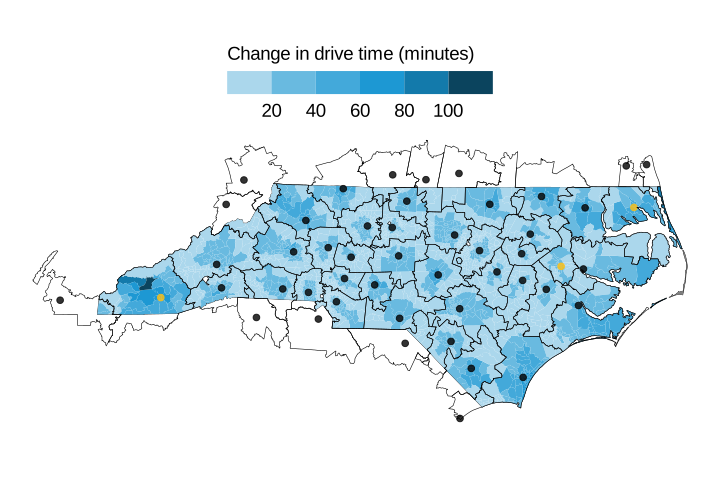
Source: Author’s calculations using SSA office location data and Census Bureau population data.
Note: FSSA = Social Security Administration. Black dots represent SSA office locations that cover the state. The offices in Elizabeth City, Franklin, and Greenville are shown as yellow dots.
Further, closures could increase wait times at nearby offices. We estimate that 15 offices in North Carolina, Tennessee, Virginia, and Georgia would see an increase in people in their coverage areas.
For example, the SSA office in Toccoa, Georgia, could see its coverage area expand by 44 percent, from an area with about 188,000 people to more than 271,000. Staffing levels and facilities at the office might not be able to keep up with the demand for in-person assistance, which could leave people waiting to access benefits and other services.
This analysis represents just a snapshot of the challenges people across the US could face if their local SSA office closed. It’s unclear if SSA will move forward with closing the 27 offices included in the administration's March 2025 announcement or if it will identify more, fewer, or different offices for closure.
To ensure the SSA follows through on its commitment to help maintain the basic well-being and protection of the people it serves, the agency and federal policymakers should consider how communities’ access to services could be affected by office closures. State and local policymakers could also consider ways local service providers could help fill gaps in access in the event closures.
ABOUT THE DATA
We measure the time it takes to drive from every census tract in the US to each tract’s closest SSA offices. Our approach overcomes technical limitations of previous analyses and provides higher-resolution travel times that can be used to analyze “what if” scenarios.
We include all offices in the SSA location data as of August 2025. This includes three types of physical locations SSA uses to offer services:
- Field offices (about 1,200), which are physical offices that generally offer a full range of services
- Video service delivery sites (about 90), which enable people to access services using video conferencing equipment
- Resident stations (about 40), which SSA describes as “a very small facility in remote areas, such as at a community center, nursing home, etc.”
Census tracts are relatively small areas with about 1,200 to 8,800 people. We start with the population-weighted center of each census tract and adjust the center so it is on a road (most centers only move a few yards).
Using open-source routing software similar to Google Maps, we then calculate the driving distance from each SSA office to hundreds of census tracts. Some tracts are never assigned an office because they are more than 310 miles (500 kilometers) from an office or don’t have a drivable office (e.g., Catalina Island, located in the Pacific Ocean outside Los Angeles). This generates a large dataset of routes between neighborhoods and SSA offices.
We create neighborhood-level summaries that focus on the closest SSA office, second-closest SSA office, and the change between the two. We also create office-level summaries that define the primary area covered by each office.
Between each neighborhood and office, we capture the straight-line distance (i.e., as the crow flies), the driving distance, and the driving time. All three variables are correlated but we believe driving durations best represent the experience of people traveling to SSA offices. Many routes near water or in the mountains are winding and differ significantly from straight-line distances. Many short routes with low-speed limits have long durations and many long routes with high-speed limits have short durations.
This analysis only considers drive time and doesn’t capture travel by public transit, biking, or walking. Travel times for these other modes of transportation are likely to take longer than driving and so our results are likely a floor on travel time.
We don’t estimate changes in office wait times in this analysis, as SSA does not publish the necessary detailed operational data necessary to estimate wait times.
PROJECT CREDITS
This data tool was funded by AARP. We are grateful to them and to all our funders, who make it possible for Urban to advance its mission. The views expressed are those of the authors and should not be attributed to the Urban Institute, its trustees, or its funders. Funders do not determine research findings or the insights and recommendations of our experts. More information on our funding principles is available here. Read our terms of service here.
RESEARCH Jonathan Schwabish, Aaron R. Williams, Gabe Morrison
DATA VISUALIZATION AND DEVELOPMENT Aaron R. Williams and Rachel Marconi
DIGITAL PRODUCTION Lydia Nguyen
EDITING Alex Dallman
WRITING Dana Ferrante
