Extending expiring provisions of the 2017 Tax Cuts and Jobs Act (TCJA) is a major goal of Republican members of Congress. This change would reduce taxes by $4.6 trillion over the next 10 years. To offset these lost revenues, Republican leaders in the House of Representatives also propose spending reductions that would likely cut Medicaid and SNAP benefits by $880 billion and $230 billion, respectively, over 10 years. All three of these policies would lead to potentially large changes in taxpayers’ incomes.
In this brief, we estimate the combined impact of these three major proposals on taxpayers’ after-tax, after-transfer incomes to show who would benefit and who would lose.
Why This Matters
As of May 2025, Congress is still debating what set of federal spending reductions could be used to offset the costs of extending the TCJA. The debate is often focused on the proposals that would reduce Medicaid spending.
What We Found
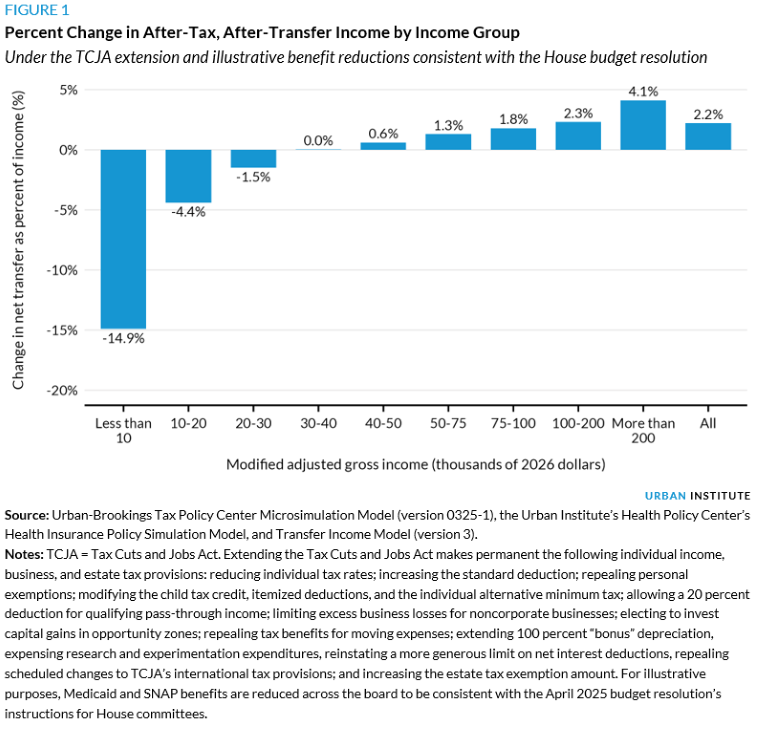
Although the average impact of this policy on after-tax, after-transfer income would be positive, the distribution in the size and direction of change of this effect varies substantially by income group (figure 1). Families in the middle of the income distribution (with incomes of $50,000 to $75,000) would see a small gain of $680 (or 1.3 percent).
The lowest-income families would suffer significant losses in net income. Specifically, families with modified adjusted gross income below $10,000 would lose more than $2,700 (nearly a 15 percent reduction in income). On average, families with incomes below $30,000 would be worse off.
At the same time, families with higher incomes would experience substantial net gains. For example, families with incomes above $200,000 per year would see gains of $13,200 or 4.1 percent in after-tax, after-transfer income.
How We Did It
We use the Urban-Brookings Tax Policy Center Microsimulation Model, Urban Institute’s Health Insurance Policy Microsimulation Model, and publicly available data from the Transfer Income Model, Version 3, to estimate the combined effect of these three changes on families across all income groups.