
In this report, we describe the potential economic benefits of closing Black and Latino racial gaps in income, education, and housing in the Fairfield County area of Connecticut.
Why This Matters
Historical and systemic discrimination in the United States has deeply entrenched racial and ethnic inequities across critical areas, such as wealth accumulation, education, and homeownership. Increasing racial equity can benefit both individuals and communities. For example, research shows that increases in equity have the potential to increase the gross domestic product, enhance educational attainment for both Black people and white people, and reduce homicide rates. Connecticut’s Fairfield County area stands out as having some of the greatest income inequality in the United States, presenting a significant opportunity to advance equity and unlock broader socioeconomic benefits. Increasing racial equity in the Fairfield County area could generate substantial economic gains for the entire region.
Key Takeaways
We found the following:
- If Black and Latino adults in the Fairfield County area had incomes equivalent to their white counterparts, the Fairfield County area’s GDP could increase by $15.6 billion.
- If Black or Latino people then had the tenure and educational attainment of their white counterparts, there could be 33,000 more homeowners and 84,000 more people with college degrees.
- These improvements could equate to $36.6 billion more in home values, $603 million more in local revenue from property taxes, and $1.2 billion more in state revenue from income taxes.
- Increased state income tax revenues could then be used to hire additional teachers, increase current teachers’ salaries, or support tax cuts, infrastructure projects, housing assistance for essential workers, or enhanced mass transit.
- Local property tax revenues could be used to improve road safety, undertake main street development efforts, fund high-quality summer programs, reduce property taxes (especially for seniors), or support small business development.
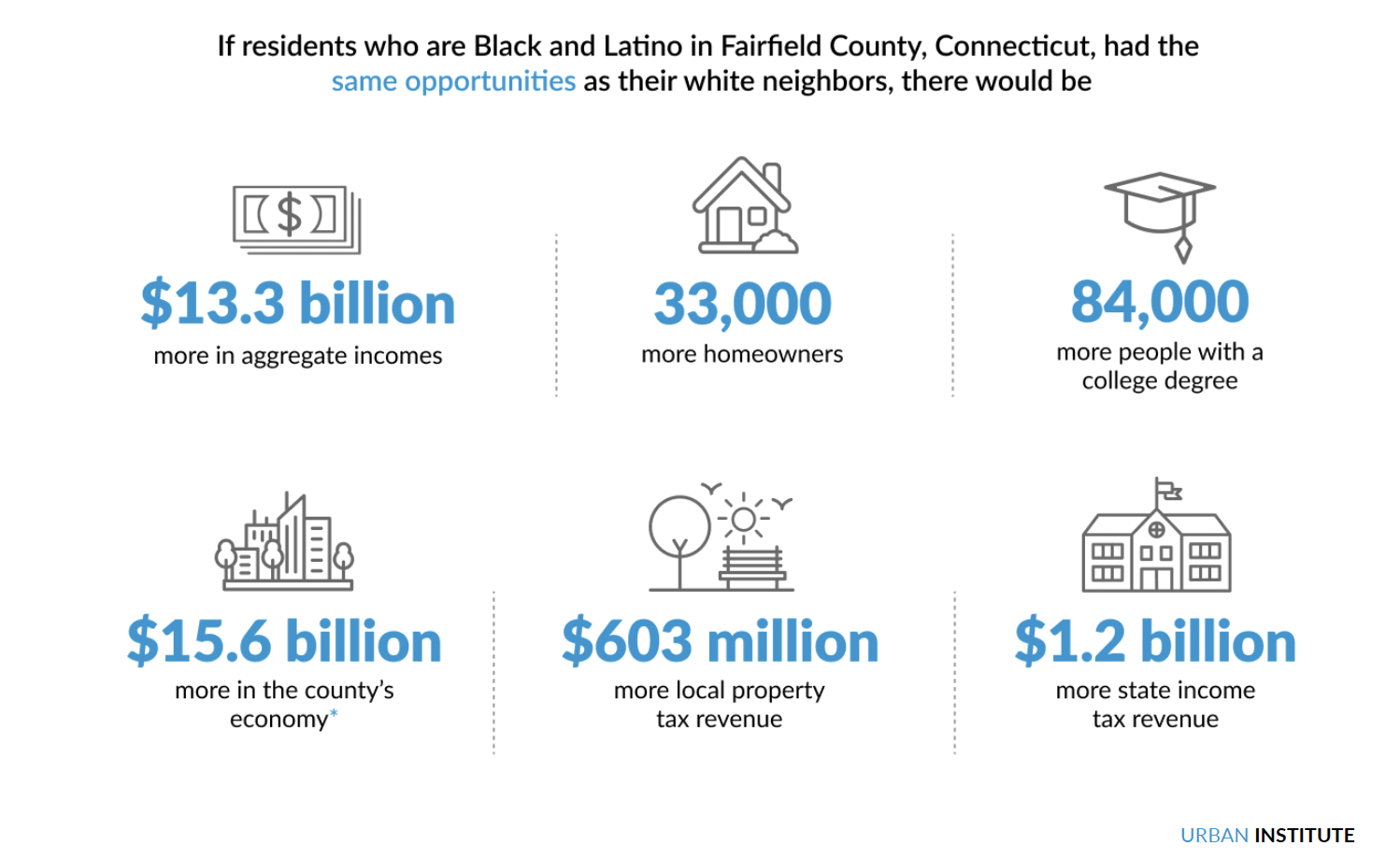
Sources: Authors’ calculations from American Community Survey 2018–22 Public Use Microdata Samples; Bureau of Economic Analysis data on county income and GDP in 2022, 2021, and 2022; and personal income tax totals in Connecticut Open Data’s Personal Income Tax Summary (“2021 and 2022 Personal Income Tax Totals,” Connecticut Open Data, accessed September 5, 2024,); the 2020–2021 Annual Report by the State of Connecticut Department of Revenue Services (“Annual Report Fiscal Year 2020–2021,” State of Connecticut Department of Revenue Services, accessed September 5, 2024,); and sources of state aid to towns in fiscal years 2021–25 according to the Connecticut General Assembly’s Office of Fiscal Analysis (“Major Sources of State Aid to Towns,” Connecticut General Assembly Office of Fiscal Analysis, accessed September 5, 2024,).
Note: *As estimated by the change in county gross domestic product.
To achieve a more equitable Fairfield County area, business leaders, policymakers, practitioners, nonprofits, and philanthropies can work together to reduce inequities by identifying and eliminating practices that perpetuate racism, repairing past harms, and investing in policies and programs that enable communities of color to live in high-opportunity neighborhoods and build intergenerational wealth. With input from the community members and nonprofit professionals on our Equity Research Advisory Panel, and based on their evidence base, we identified the actions listed in the following figure that could be considered by leaders from the business, public, philanthropic, and other sectors in Connecticut if they wanted to further increase equity.
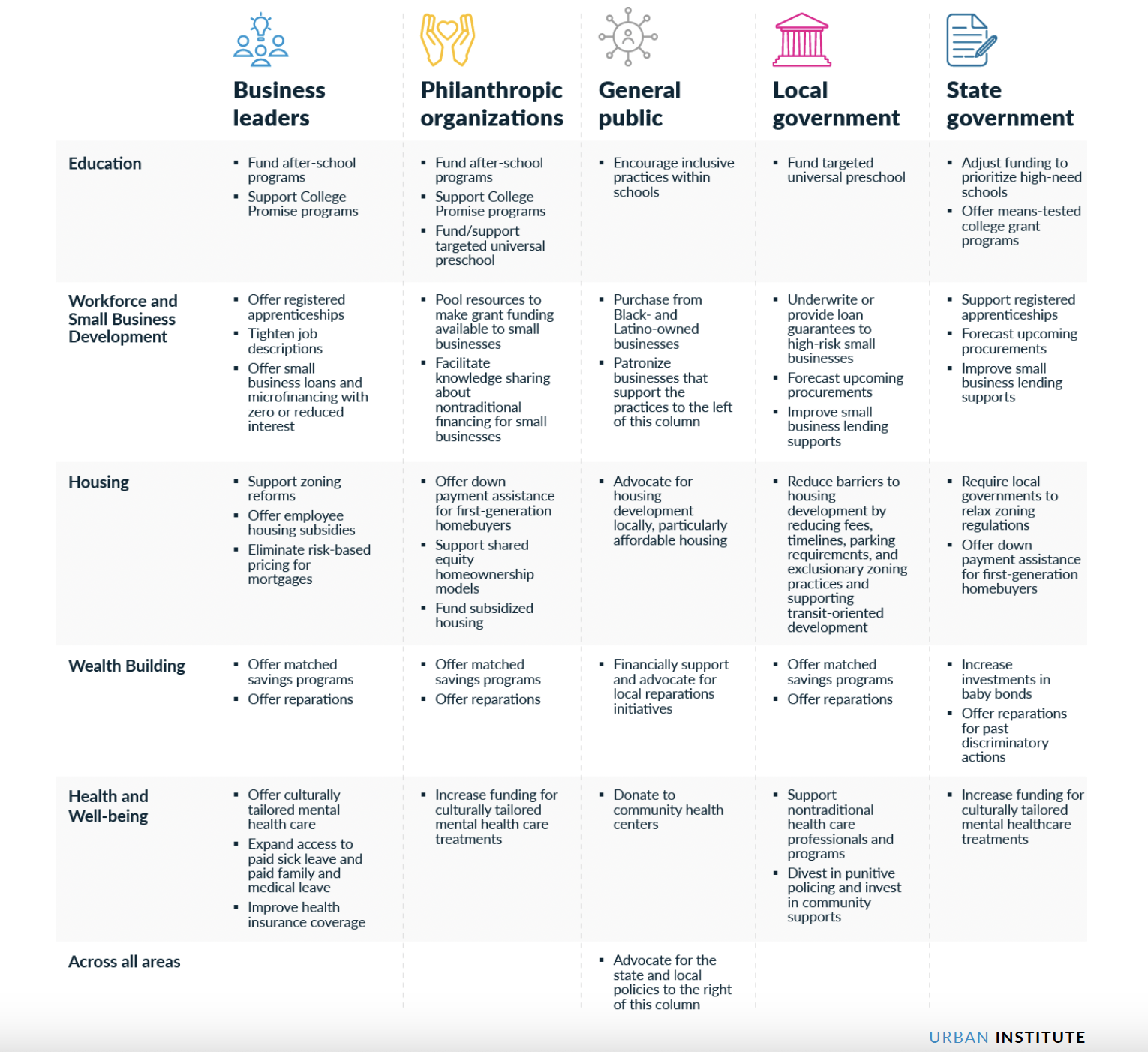
Source: The authors. See detailed sources in the Recommendations section of the report.
Note: This figure does not encompass all possible actions that could increase racial equity in the Fairfield County area.
How We Did It
To conduct this research, Fairfield County’s Community Foundation, Urban Institute, and DataHaven collaborated with an Equity Research Advisory Panel to design and implement a data-driven procedure to estimate the benefits of equity that could accrue to the entire community. We used data from the American Community Survey and local data collected by DataHaven to describe current inequities in the Fairfield County area. We then estimated the benefits that could accrue if these gaps were closed. We matched Black and Latino residents to white counterparts to estimate incomes, education levels, and housing market outcomes in a more equitable world. We then used estimated equalized incomes to calculate increased GDP for the area. We also calculated how much state income taxes and local property taxes could increase in response to closing gaps in income and housing outcomes and explored the types of benefits these increased taxes could generate if equity were achieved.
