
Inflation-adjusted tax revenues declined in more than half of the states during the first nine months of fiscal year 2026. Although a handful of states with progressive personal income tax structures and high concentrations of high-income taxpayers benefited from strong stock market performance and elevated capital gains realizations, this growth masked widespread weakness across the rest of the country.
As states entered fiscal year 2027, slower economic growth, heightened geopolitical uncertainty, renewed inflationary pressures, financial market volatility, and uncertainty surrounding federal fiscal policy and intergovernmental funding complicated revenue forecasting and budget planning. At the same time, states continued to pursue increasingly divergent tax policy strategies, with some implementing previously enacted tax cuts while others broadened tax bases or explored new revenue sources.
Trends in Tax Revenue
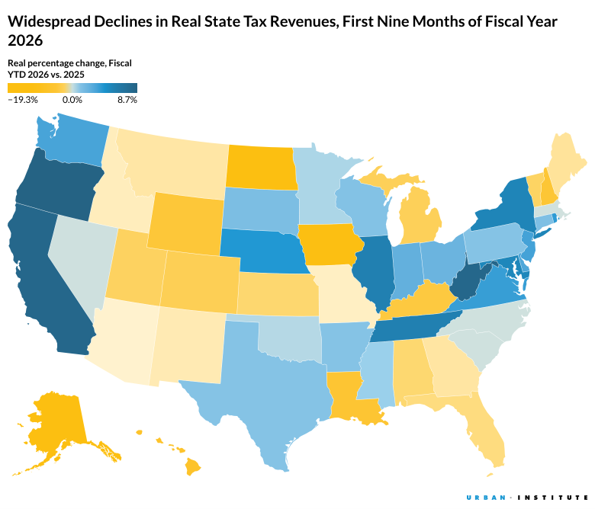
State tax revenue data for the first quarter of 2026 highlight continued variation across states and major tax sources. Key year-over-year trends include the following:
- State total taxes: Inflation-adjusted tax revenues declined in 26 states during the first nine months of fiscal year 2026, while only seven states reported real revenue growth of 4.0 percent or more. Preliminary data for the second quarter of 2026 indicate that revenue growth remained modest overall.
- Personal income taxes: Robust estimated payments and elevated capital gains realizations kept this the strongest-performing revenue source. However, withholding growth continued to moderate, and several states with recently enacted income tax rate reductions reported lower collections.
- Corporate income taxes: Revenues remained weak in many states despite continued growth in national corporate profits. Recent rate reductions, tax planning strategies, apportionment changes, and timing effects contributed to sluggish collections.
- Sales taxes: Sales tax growth remained modest as consumer spending continued to soften. Growth in durable and nondurable goods spending remained weak, while services spending moderated after several years of stronger growth.
What We’re Focusing On
This quarter's report includes a special section on the rapid growth of prediction markets and the challenges they pose for state tax systems. The section examines the evolving federal regulatory framework, recent state tax and regulatory responses, and potential implications for state gambling tax revenues. More broadly, it highlights the growing challenge states face in adapting tax systems to emerging digital markets while protecting existing revenue bases.
What to Expect in the Future
Looking ahead, given their more constrained fiscal environment, many states are considering new revenue sources, including taxes on emerging industries such as prediction markets and large electricity-intensive data centers, while others continue implementing previously enacted tax reductions. These competing policy approaches are likely to contribute to increasingly divergent fiscal outcomes across states.
