
In this brief, we examine 2019–25 trends in the share of adults ages 18 to 64, both renters and homeowners, who had challenges paying housing and utility costs. Our analysis draws on data from the Urban Institute’s Well-Being and Basic Needs Survey (WBNS), a nationally representative annual survey last fielded in December 2025. We find that renters face increasing difficulty affording housing and utilities.
Why This Matters
As US households spend a growing share of their income on housing and face rising costs for other essential expenses, affordability challenges have intensified. High cost burdens leave households with less financial cushion when faced with unexpected costs or income disruptions, making them more vulnerable to missing a rent or mortgage payment and ultimately placing them at greater risk of losing their housing to eviction or foreclosure.
These pressures are occurring alongside cuts to federal social safety net programs, such as Medicaid and the Supplemental Nutrition Assistance Program, and other proposed policy changes that could reduce access to rental assistance for households that receive support from federal rental housing programs.
Key Takeaways
- The share of working-age adults with problems paying rent increased in 2025. One in five (20.0 percent) working-age renters (ages 18–64) reported that they did not pay the full amount of rent or were late with a payment at some point in 2025. This share represents a significant increase from 2024 (16.5 percent) and the highest share observed since the WBNS began tracking this measure.
Payment challenges among adults ages 18 to 64 by homeownership status, December 2019 to December 2025
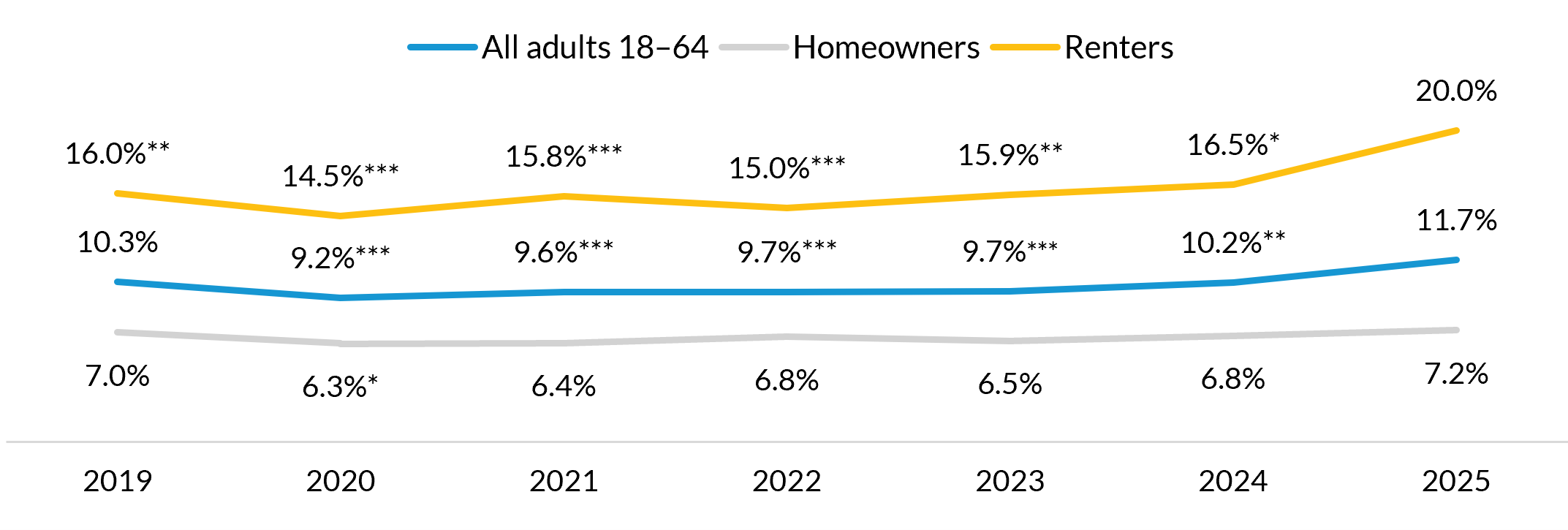
Source: Well-Being and Basic Needs Survey, December 2019 to December 2025.
Notes: Estimates represent the share of adults reporting in December of each year that, in the past 12 months, there was a time when their household did not pay the full amount of the rent or mortgage or was late with a payment because the household could not afford to pay.
*/**/*** Estimate differs significantly from 2025 at the 0.10/0.05/0.01 level, using two-tailed tests.
- The increase in problems paying rent was concentrated among middle-income renters. Lower-income households remained the most likely to report challenges paying rent in 2025 (27.8 percent). However, households across the income scale reported rent affordability challenges, with a sharp increase among middle-income renters, from 14.3 percent in 2024 to 21.6 percent in 2025.
Payment challenges among renters ages 18 to 64 by family income, December 2019 to December 2025
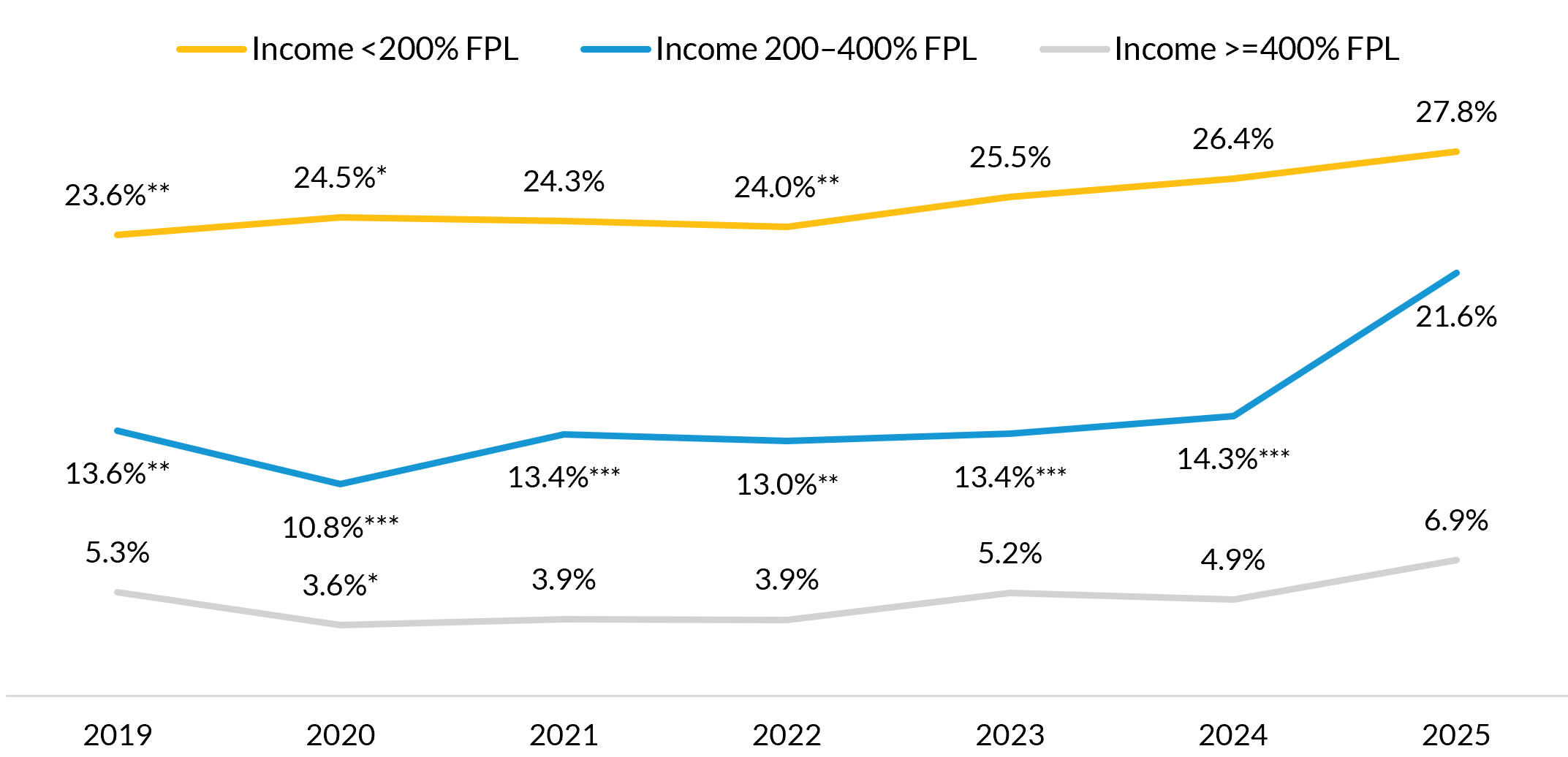
Source: Well-Being and Basic Needs Survey, December 2019 to December 2025.
Notes: FPL = federal poverty level. Estimates represent the share of renters reporting in December of each year that, in the past 12 months, there was a time when their household did not pay the full amount of rent or was late with a payment because the household could not afford to pay.
*/**/*** Estimate differs significantly from 2025 at the 0.10/0.05/0.01 level, using two-tailed tests.
- Working-age renters experienced greater difficulty paying utility bills for home heating and electricity. One in five (20.7 percent) working-age renters reported being unable to pay the full amount of their heating and electricity bills in 2025. This share is similar to 2023 and 2024, but higher than each year between 2019 and 2022.
- Many older adults reported problems paying rent and utility costs. Nearly one in ten (8.9 percent) older adult renters (ages 65 and older) reported problems paying rent in 2025. This was the first year older adults were included in the WBNS sample, providing an important baseline for assessing housing affordability challenges for this age group over time.
How We Did It
This analysis draws on data from the 2019–25 rounds of the WBNS, a nationally representative annual survey of adults that monitors individual and family well-being in the context of a changing safety net. More than 10,000 adults ages 18 and older participated in the December 2025 round of the survey. Between 2017 and 2024, each survey round included more than 7,500 adults ages 18 to 64, and in 2025, the sample was expanded to include 2,500 adults ages 65 and older.
We estimated changes in problems paying rent or mortgage costs and problems paying heating or electricity bills in the past 12 months among households of adults ages 18 to 64 between December 2019 and December 2025.
Problems paying rent or mortgage costs are based on whether respondents reported that there was a time in the past 12 months when their household did not pay the full amount of the rent or mortgage or was late with a payment because their household could not afford to pay. Problems paying heating or electricity bills are based on whether there was a time in the past 12 months when their household was not able to pay the full amount of the gas, oil, or electricity bills.
