As the climate crisis worsens, many local leaders are setting decarbonization goals to reduce or eliminate local greenhouse gas emissions. To support these efforts, we conducted a review of existing literature on climate action planning and interviewed city planners and community stakeholders who have participated in related planning efforts. Based on our findings, we highlight 10 opportunities from the field of climate planning to support greater equity in local decarbonization planning.
Why This Matters
All past energy transitions have created economic benefits for some people at the expense of others. To ensure that past inequities are not repeated, local leaders should ensure that the benefits and burdens of the new energy economy are distributed fairly and that communities who are disproportionately burdened by climate risks are prioritized.
What We Found
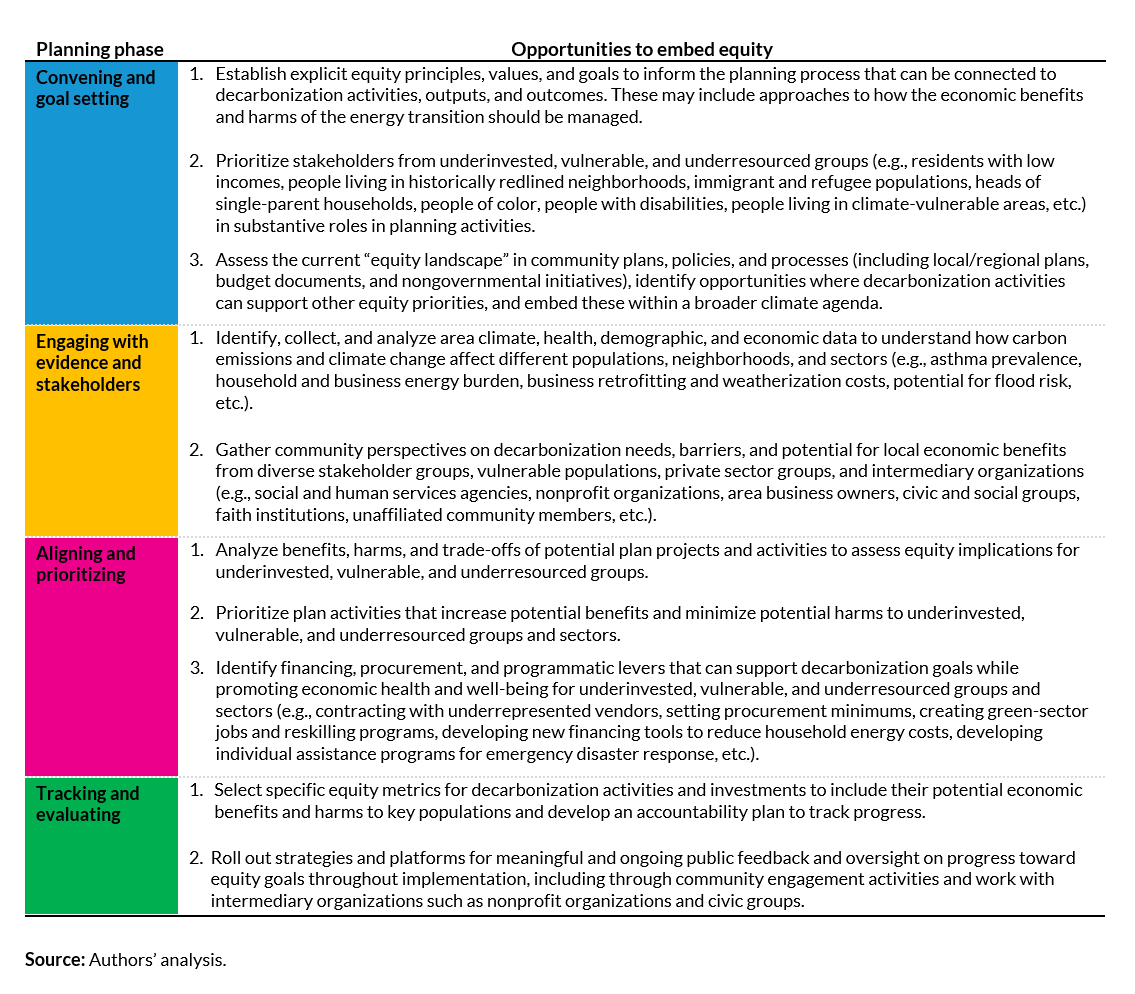
We identified 10 opportunities to support city planners and community stakeholders in centering equity across four common planning phases: (1) convening and goal setting, (2) engaging with evidence and stakeholders, (3) aligning and prioritizing, and (4) tracking and evaluating. For each planning phase, we share key opportunities and highlight concrete examples from the field that planners and stakeholders can consider when integrating equity throughout their decarbonization efforts. Planners, in partnership with community stakeholders, can use these opportunities as a springboard for decarbonization plan development, improvement, and operationalization.
10 Opportunities to Embed Equity along the Climate Planning Process