
In this brief, we use December 2025 data from the Urban Institute’s Well-Being and Basic Needs Survey (WBNS) to estimate the prevalence of unmet needs for personal assistance services among adults ages 60 and older with disabilities living in households and other noninstitutional settings. Our findings highlight current challenges older adults with disabilities experience in accessing key services and supports that are essential for independent living, prior to the service cuts that are likely to occur as reductions in federal Medicaid funding take effect.
Why This Matters
Millions of older adults and people with disabilities receive long-term services and supports that help them live independently in their communities, including personal assistance with self-care tasks (e.g., bathing, dressing, and eating) and household tasks (e.g., cleaning, laundry, preparing meals, and shopping). Unmet needs for personal assistance increase the risk of a wide range of adverse consequences for older adults’ health and well-being.
However, the nation’s system for providing long-term care is under increasing strain as the population ages and families contend with persistent shortages in the direct care workforce. In addition, threats to home and community-based services (HCBS) are emerging due to changes in Medicaid financing under the 2025 budget reconciliation law. As states face pressure to cut HCBS because of reductions in federal Medicaid funding, policymakers will need timely data to assess the risks and impacts of service reductions.
Key Takeaways
In December 2025, nearly 1 in 4 (24.0 percent) older adults with disabilities reported there was a time in the past 12 months when they did not get personal assistance they needed.
- This share includes 7.7 percent who reported that there was a time they needed help with personal care (e.g., eating, dressing, bathing, managing medications, or getting around inside their home) due to a health condition or disability but did not get it. It also includes 22.9 percent who needed help with routine household tasks (e.g., cleaning, managing money, preparing meals, or shopping) but did not get it.
- Approximately one-third (33.1 percent) of older adults who had difficulty with daily activities reported unmet personal assistance needs, compared with 6.9 percent of those with other functional limitations.
About One in Four Older Adults with Disabilities Had Unmet Needs for Personal Assistance in 2025
Share of adults ages 60 and older with disabilities reporting unmet needs for personal assistance in the past 12 months, December 2025
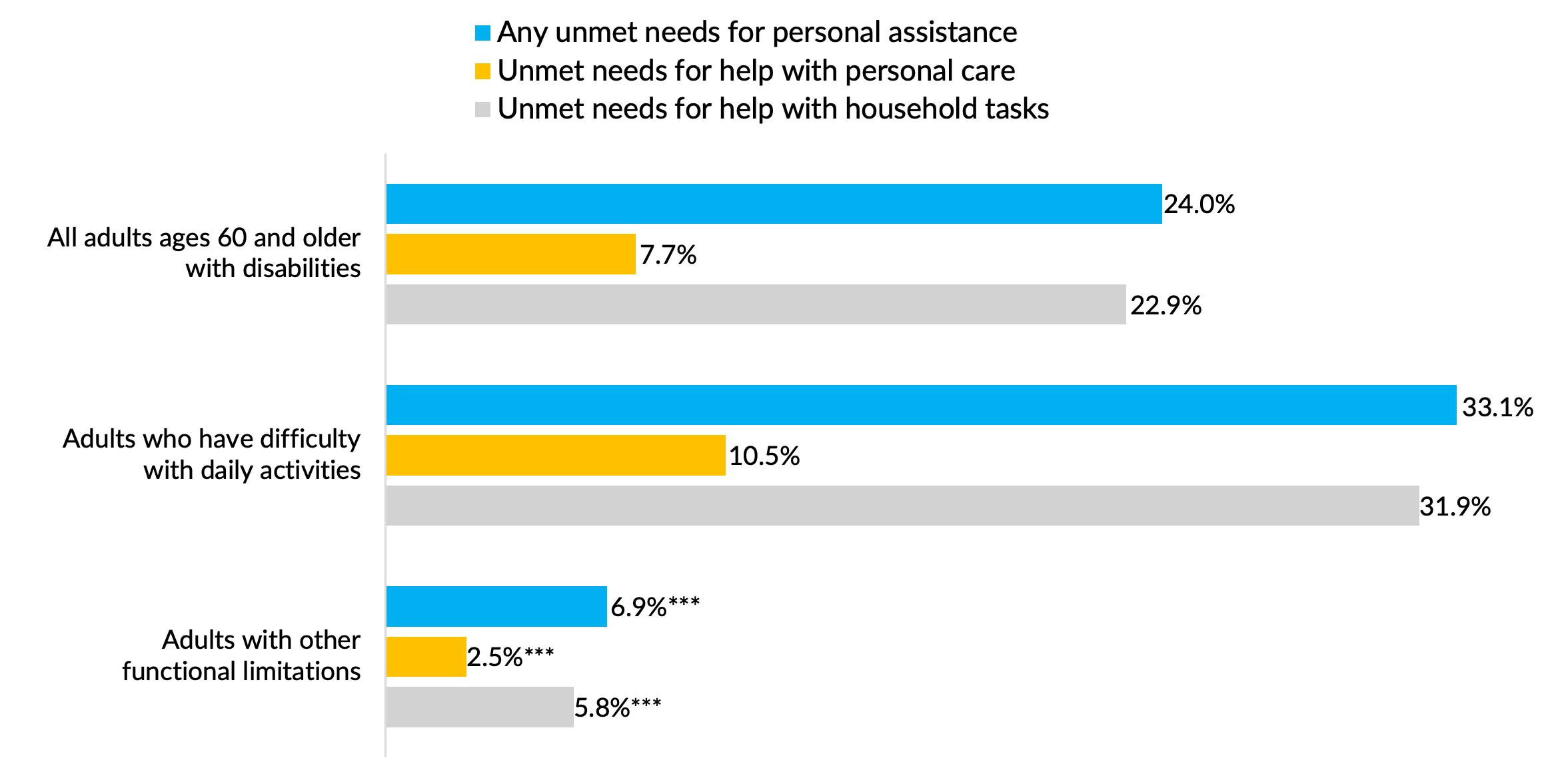
Source: Well-Being and Basic Needs Survey, December 2025.
Notes: The sample of adults ages 60 and older does not include those living in institutional settings.
*/**/*** Estimate differs significantly from that of adults who have difficulty with daily activities at the 0.10/0.05/0.01 level, using two-tailed tests.
- Overall, 11.3 percent of adults ages 60 and older (including those with and without disabilities) reported unmet needs for personal assistance in the past 12 months. Rates of unmet need were higher among groups that are more likely to have a disability and limited resources.
- Older adults were more likely than their peers to report unmet needs for personal assistance if they had family incomes below 200 percent of the federal poverty level (FPL) (20.9 percent), were Black (14.5 percent), or were in fair or poor health (28.6 percent).
- These disparities in unmet personal assistance needs persisted when the sample was limited to older adults with disabilities.
- Among adults ages 65 and older enrolled in Medicare, those who also participated in Medicaid (known as dual enrollees) faced the greatest level of unmet need for personal assistance.
- One in four (24.8 percent) Medicare beneficiaries with dual coverage reported unmet needs, compared with 1 in 10 (9.9 percent) of those with Medicare only.
- These differences largely reflect the greater level of need for personal assistance among adults with dual coverage, who were more than twice as likely as those with Medicare only to report difficulty with daily activities.
- Adults ages 60 and older who reported unmet personal assistance needs also had significant difficulty meeting other basic needs, such as food, housing, and health care.
- Nearly 4 in 10 (39.3 percent) older adults with unmet personal assistance needs reported experiencing food insecurity in the past 12 months.
- Older adults with unmet personal assistance needs were much more likely than their peers to have problems paying family medical bills (29.5 percent) and to forgo needed health care because of the cost (44.4 percent).
- About 1 in 10 (9.6 percent) older adults with unmet personal assistance needs reported problems paying the rent or mortgage in the past 12 months, 14.5 percent had problems paying heating and electricity bills, and 5.1 percent had one of these utilities shut off.
- About 18 percent of adults ages 60 and older reported that they regularly provide help or take care of an adult relative or friend who needs assistance due to aging, disability, or illness.
- These findings suggest that federal and state policy decisions concerning access to paid personal assistance services may affect older adults both as service beneficiaries and as caregivers.
How We Did It
This analysis draws on data from the December 2025 round of the WBNS, a nationally representative, annual survey of adults that monitors individual and family well-being in the context of a changing safety net. More than 10,000 adults, including more than 3,600 adults ages 60 and older, participated in the 2025 survey.
We estimated the share of adults ages 60 and older with unmet needs for personal assistance based on whether they reported there was a time in the past 12 months when they needed help from another person with any of the following activities because of a health condition or disability but did not get it:
- personal care, such as eating, dressing, bathing, managing medications, or getting around inside your home
- routine household tasks, such as cleaning, managing money, preparing meals, or shopping
We estimated differences in unmet personal assistance needs based on whether older adults with disabilities had difficulty with daily activities (e.g., dressing or bathing, walking or climbing stairs, preparing meals, or doing errands alone) or had other functional limitations (e.g., difficulty with hearing, seeing, concentrating, remembering, making decisions, communicating, lifting, or carrying) but no reported difficulty with daily activities.
In addition to examining unmet personal assistance needs by disability status, we assessed variation by family income as a percentage of FPL, race/ethnicity, self-reported health status, and, among adults ages 65 and older with Medicare, by dual enrollment in Medicare and Medicaid versus enrollment in Medicare only.
