
In this brief, we examine difficulties affording health care among families of working-age adults (i.e., those ages 18 to 64) using December 2025 data from the Urban Institute’s Well-Being and Basic Needs Survey (WBNS). We find that difficulties affording care were widespread, particularly affecting adults with fair or poor health, chronic health conditions, or disabilities.
Why This Matters
US households face growing challenges in affording health care as costs have outpaced earnings growth. Millions of Americans remain without health insurance, and even with insurance, many struggle to pay for care. Faced with high costs, some people jeopardize their health by delaying or skipping needed care and medications, while others incur medical debt.
The expiration of enhanced Marketplace premium tax credits in January 2026 and forthcoming changes to Medicaid and the Marketplaces are expected to increase the number of uninsured and raise cost burdens for families. Families may also experience growing difficulties affording care as employers shift some of the increase in health care costs to employees through higher deductibles and coinsurance.
Key Takeaways
- In December 2025, 46.0 percent of working-age adults reported their families faced difficulties affording health care. This included 16.9 percent of adults ages 18 to 64 reporting problems paying family medical bills in the past year, 34.9 percent reporting someone in the family experienced unmet health care needs because of costs in the past year, and 29.4 percent reporting the family had medical debt at the time of the survey.
Share of adults ages 18 to 64 reporting difficulty affording health care for their families, December 2025
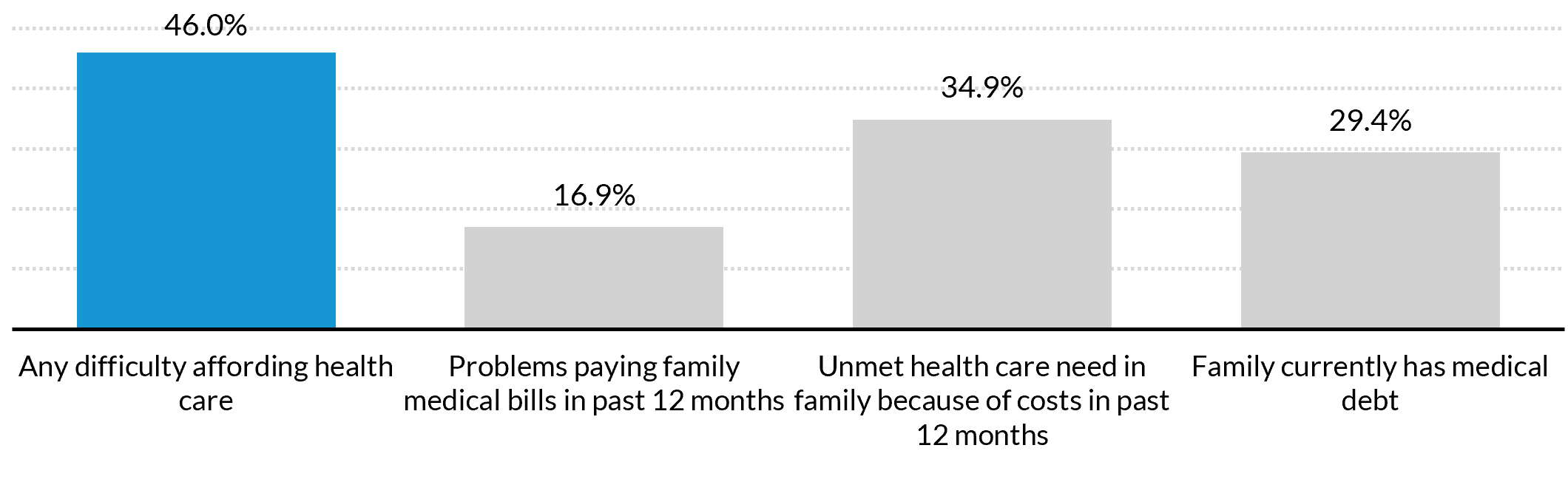
Source: Well-Being and Basic Needs Survey, December 2025.
- Uninsured adults were more likely to be in families with difficulty affording care, but those with insurance coverage also experienced affordability challenges. About 6 in 10 uninsured adults (60.4 percent) reported at least one affordability problem, as did 39.0 percent of adults with employer coverage, 53.8 percent with Marketplace or other individual market coverage, and 57.0 percent with Medicaid. When we limit these comparisons to families with incomes below 200 percent of the federal poverty level, affordability challenges rise significantly for adults with employer or individual market coverage: 63.0 percent of low-income adults with individual market coverage and 54.3 percent with employer coverage faced these challenges, compared with 57.1 percent of low-income adults with Medicaid.
- Affordability challenges were more common among families of Black or Hispanic adults. More than half of Black adults (56.8 percent) and Hispanic adults (56.2 percent) reported that their family had difficulties affording health care, compared with 41.6 percent of white adults and 28.3 percent of Asian adults.
- Half of adults living in the South and in rural areas reported affordability difficulties. Problems affording health care were more common in certain regions and communities, affecting just over half of families in the Southern census region (50.9 percent) and in rural areas (50.2 percent). But more than 4 in 10 adults in every region and outside of rural areas also reported difficulties affording care.
- Adults who are in fair or poor health or have a disability or chronic condition faced greater difficulties affording care. Approximately two-thirds of working-age adults in fair or poor health (65.0 percent) or with a disability (68.6 percent) reported one or more affordability problems. In addition, more than half of those who had ever been diagnosed with one or more of nine chronic conditions reported affordability difficulties, including more than 70 percent of adults with stroke or chronic obstructive pulmonary disease and more than 60 percent of those ever diagnosed with cancer, heart disease, or diabetes.
- About 1 in 3 adults with individual market coverage reported facing steep increases in health insurance premiums in the prior year. Adults with individual market coverage were nearly twice as likely as those with employer coverage to report that the costs their families pay for health insurance premiums increased a lot in the 12 months before the December 2025 survey (33.1 percent versus 18.0 percent). This may capture early experiences related to increasing Marketplace premiums and the expiration of the enhanced premium tax credits. About 1 in 5 adults (19.9 percent) with private insurance reported that their family's out-of-pocket health care costs (excluding premiums) increased a lot.
How We Did It
This analysis draws on data from the December 2025 round of the WBNS, a nationally representative, annual survey of adults that monitors individual and family well-being in the context of a changing safety net. More than 10,000 adults, including about 8,000 adults ages 18 to 64, participated in the 2025 survey.
We examined the share of adults ages 18 to 64 who indicated that their families have had difficulty affording health care, defined as one or more of the following experiences:
- Having problems paying family medical bills in the past 12 months
- Having unmet needs for health care in the family because of costs in the past 12 months
- Owing medical debt at the time of the survey
Though these outcomes reflect experiences of everyone in the respondent’s family, we examine differences based on the health insurance coverage, disability status, health conditions, health status, and race/ethnicity of the respondent.
Respondents were also asked how the costs they and their families pay for certain expenses changed in the past 12 months, including health insurance premiums and out-of-pocket health care costs.
