
This analysis draws on December 2025 data from the Urban Institute’s Well-Being and Basic Needs Survey (WBNS) to examine the prevalence and burden of medical debt.
Why This Matters
Rising health care costs are placing growing pressure on household budgets. Employers are responding to accelerating cost growth by increasing required premium contributions, deductibles, and other employee cost-sharing responsibilities. Costs have also been rising for health plans sold through the Affordable Care Act Marketplaces following the loss of enhanced premium subsidies. Federal cuts to Medicaid and Marketplace coverage in last year’s reconciliation law, the One Big Beautiful Bill Act, could further exacerbate affordability challenges by increasing the number of uninsured people.
Collectively, these policy changes, combined with rising health care costs, are likely to increase households’ risks of incurring medical debt at a time when households are already struggling to afford basic expenses. Households with past-due medical debt are at risk of damaged credit; civil lawsuits that may result in wage garnishment, bank account seizure, property liens, or other financial consequences; and denial of additional needed care because of nonpayment. People with medical debt may also forgo needed care to avoid incurring additional bills and experience higher stress that interferes with their ability to manage complex medical conditions. Growing difficulty paying medical bills among households may lead to higher uncompensated care costs for health care providers, jeopardizing their financial stability.
Key Takeaways
- In December 2025, more than 1 in 4 adults (26.6 percent) reported they or their family members owed medical debt. This includes more than 1 in 7 (15.4 percent) with past-due medical bills or bills they were unable to pay.
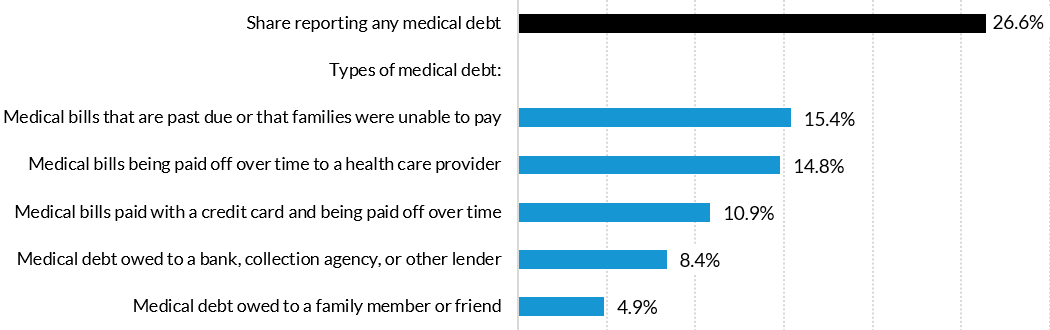
Source: Source: Well-Being and Basic Needs Survey, December 2025.
Notes: Types of medical debt are not mutually exclusive; respondents could report multiple types. See the data and methods section for details on how medical debt is measured.
- Medical debt was most prevalent among adults ages 45 to 54; adults who are Black, Hispanic, or of races other than white or Asian; and those with incomes between 100 and 200 percent of the federal poverty level (FPL). Rates were also higher among people who were uninsured, had a disability, or reported being in fair or poor health.
- Despite nearly universal Medicare coverage among adults ages 65 and older, 17.6 percent reported that they or a family member owed medical debt.
- More than half of adults with medical debt (53.8 percent) reported owing $1,000 or more, and 15.5 percent owed $5,000 or more. Debt amounts were highest among uninsured adults, those with past-due medical bills, and those who owed money for hospital services.
- More than 1 in 3 adults with medical debt (35.2 percent) reported being contacted by a collection agency about their unpaid medical bills. About 1 in 5 adults with medical debt (21.7 percent) reported that having this debt lowered their credit score, even in states that have passed laws prohibiting or restricting medical debt in collections from appearing on credit reports (18.1 percent), suggesting consumers have limited awareness of these state laws.
How We Did It
This analysis draws on data from the December 2025 round of the WBNS, a nationally representative, annual survey of adults that monitors individual and family well-being in the context of a changing safety net. More than 10,000 adults participated in the 2025 survey round.
