
Students of color represent the majority of enrollment in career and technical education (CTE) fields of study at community and technical colleges, which offer programs as pathways to further education, jobs, and careers. Following years of expansion and a rapid shift to remote learning during the 2020 pandemic, colleges increasingly offer online and hybrid programming—yet notable disparities exist in access and outcomes for students of color in CTE programs, especially in online courses and programs. The Career and Technical Education CoLab (CTE CoLab) aimed to advance racial equity by reducing disparities in academic and career outcomes for historically marginalized students—especially students who are Black, Latinx, or Indigenous—enrolled in online and hybrid postsecondary career-focused programs at community and technical colleges. By “racial equity,” we mean fair treatment and intentional strategies that eliminate disparities for students of color and ideally result in equal academic and career outcomes for all students.
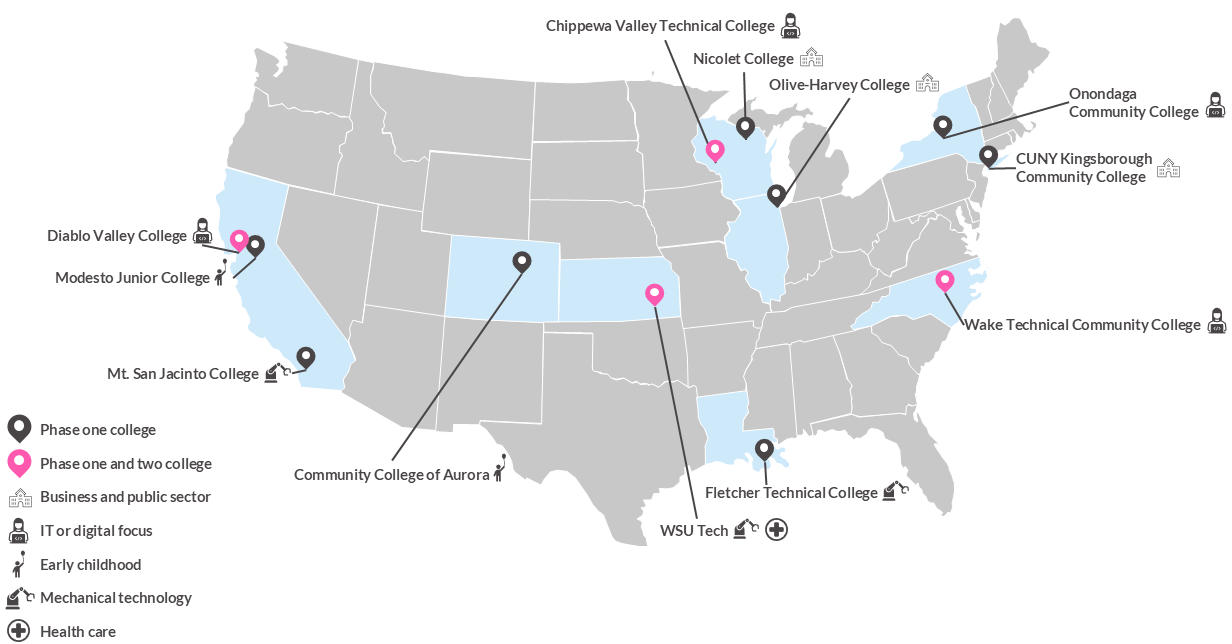
In phase one of the initiative (2021–23), 12 colleges implemented equity-centered approaches to online teaching and learning in credit-bearing CTE programs (see map). In phase two (2023–25), 4 of the phase one colleges were selected to continue work to advance their programmatic strategies while expanding practices across their CTE divisions and their broader institutions.
The final brief provides an overview of the CTE CoLab, summarizes strategies colleges implemented, and reflects on lessons learned and future directions, with a focus on insights from the second phase. The case studies share key strategies phase two CTE CoLab colleges implemented to inform other college practitioners and the policymakers and funders that support their work.
Why This Matters
There are gaps in outcomes for students of color participating in CTE programs, especially those delivered online. Compared with all students in community and technical colleges, CTE students are more likely to be Black or Latinx, but they have lower rates of degree or credential completion, job attainment, and earnings than white students in the same programs. These disparities are larger among students in programs offered partially or fully online, and gaps in outcomes persist after accounting for college preparation, which suggest structural barriers rather than individuals students’ shortcomings. These disparities motivated the need to address gaps for students of different racial and ethnic backgrounds within CTE courses and programs and laid the groundwork for the colleges’ strategies implemented in the CoLab. By addressing disparities for historically marginalized learners, the benefits accrue to all students.
What We Learned
The final brief and the case studies elaborate and provide examples on several key strategies implemented by the CTE CoLab colleges:
- Use data to drive change. Colleges collected their own data through focus groups and surveys, which allowed them to better understand faculty and student experiences in their programs.
- Center students to improve navigation and the delivery of support services. Colleges meaningfully engaged students to inform program design, offered navigation through tutoring and orientation programming, and implemented strategies to build social capital.
- Design strategies for online and hybrid learners to increase engagement. Colleges prioritized efforts to improve student engagement and belonging, addressed digital access barriers, and developed accessible materials to orient students to the online learning experience.
- Support pathways to careers by engaging employers and providing employment resources. Colleges embedded information on college and career pathways and industry-relevant credentials into orientation programming and attempted to connect students directly with employers and industry via mentorship programs and work-based learning opportunities.
- Support practitioners as leaders. Colleges developed cross-functional teams to implement strategies aligned with their goals, built community with peers working toward similar goals, and benefited from coaching that pushed college practitioners’ thinking and implementation.
- Connect program-level and institutional-level change. Colleges expanded program-level orientations across their institutions, leveraged existing partnerships and institutional initiatives, and shared insights from the CoLab with other departments and college leaders.
Colleges and project team staff members identified several future directions for the work, including bolstering program and career navigation strategies, focusing on hybrid learning to enhance student success, extending lessons on online and hybrid learning to the rural context, and considering the role of artificial intelligence for learning and at the workplace.
How We Did It
Data for the final brief and case studies come from interviews with college staff members and previously published research that reflects the perspectives of the CTE CoLab project team and the CTE CoLab college teams.
Additional Materials
The case studies provide insights and strategies on the following topics from each of the phase two CTE CoLab colleges:
- Centering Student Belonging in Online Programs: Chippewa Valley Technical College
- Leveraging Data to Inform Student and Faculty Success Initiatives: Diablo Valley College
- Expanding Institutional Partnerships to Support Student Achievement: Wake Technical Community College
- Supporting Student Success through Coordinated, Data-Driven Strategies: WSU Tech
Learn more at the CTE CoLab website.
