
Strong evidence exists on how housing affects the health of individuals, families, and communities and on its impact as a social determinant of health. In Philadelphia, low-income renter households and Black and low-income households are more likely to live in substandard housing.
In this health impact assessment we examine Philadelphia’s rental housing quality regulation system and seek to understand the health and regulatory challenges facing renters, landlords, and housing code enforcement entities, and we put forth recommendations on how to improve the housing quality regulation system’s capacity to address substandard rental housing conditions.
Why this matters
The importance of responding to substandard rental housing is particularly acute in Philadelphia, a high-poverty city with poor health outcomes. Philadelphians have lower life expectancy and higher infant mortality than the national average. At least one in five Philadelphia children, more than twice the national average, suffers from asthma—a health condition closely tied to housing conditions— and 54 percent of renters are housing cost burdened. When confronted with unsafe or unhealthy housing conditions, the growing gap between housing costs and household income can pose significant barriers for Philadelphia renters seeking affordable quality housing.
Key Takeaways
This health impact assessment employed mixed qualitative and quantitative methods, interviewing key stakeholders including tenant advocates, landlord representatives, health care practitioners, and local government officials. Additionally, we examined the Department of Licenses and Inspections’ code enforcement data from January 2018 through December 2019 and overlaid that data with information on rental licenses and Office of Property Assessment data on property ownership in order to understand what kinds of violations occur where, who lives in those properties, and who owns those properties. We found the following:
- When code violations are overlaid with demographic data, code violations are concentrated in census tracts with high shares of Black residents and high poverty rates.
Code Enforcement Violations in Philadelphia Overlaid with Poverty and Race/Ethnicity, 2018–19
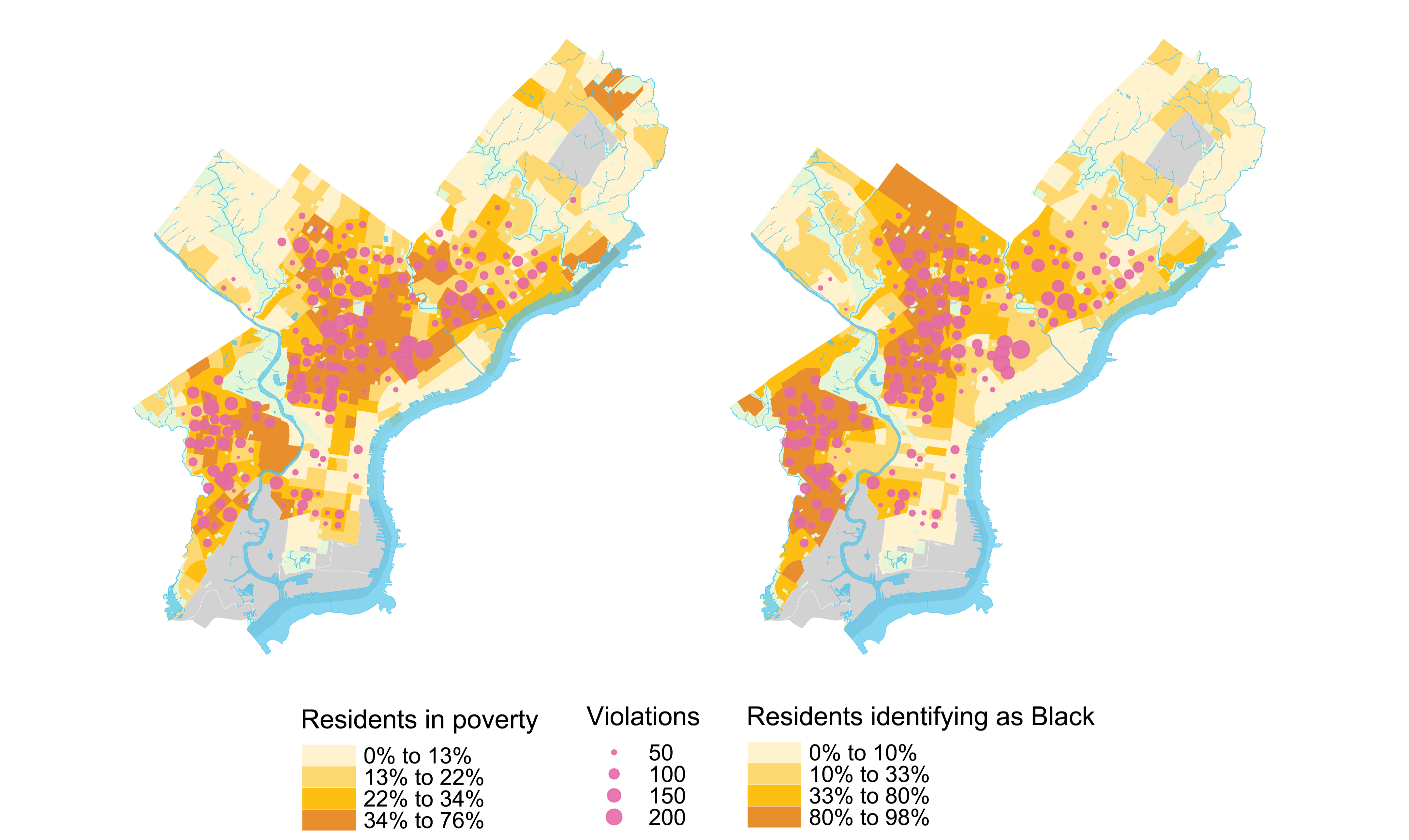
- Approximately two-thirds of complaints are related to conditions that could contribute to chronic health concerns and safety hazards. Of those, nearly three-quarters were in areas with higher-than-average poverty rates, and more than two-thirds were in areas with a higher-than-average share of Black residents.
- Because the city’s housing code enforcement program is complaint-based, code violations do not represent all substandard housing—only that housing where violations are reported. Stakeholders expect that many residents, particularly those in Latine and Asian households and those who fear retaliation from landlords and possible displacement, may underreport subpar housing conditions.
- External structure violations are the most common type of complaint. They can be visible from outside without needing to enter the home, so they can be identified by neighbors or inspectors rather than the renter.
- The majority of code violations are found in properties owned by landlords with only one to two properties. These same small landlords may lack the capital to make needed repairs. Stakeholders reported that complicated processes and systems within the Department of Licenses & Inspections, along with limited access to loans and grants, can make it difficult for landlords who want to maintain quality rental units to do so.
- Because of limited capacity, the Department of Licenses & Inspections does not take enforcement action against all landlords that do not remediate cited code violations.
- The current rental license self-certification process does not incentivize landlord rental registration, and a lack of streamlined procedures can make the process cumbersome, contributing to the estimated 30 percent of rental units that are not registered rental units.
Given these findings, we lay out short-, medium-, and long-term recommendations that work toward creating a Strategic Code Enforcement paradigm.
This report was corrected on September 30, 2022. Table 1 was amended to show that San Francisco does not have mandatory proactive inspections for rental housing units.
