
To the best of our knowledge, this is the first study to assess how Latinx-white racial disparities in COVID-19 mortality at the county level are associated with immigration enforcement. Our findings provide some support for how medium-to-high exposure to immigration enforcement may be having harmful effects on Latinx people’s health at the county level.
Why this matters
Latinx people have been among those with disproportionately high rates of COVID-19 infection and mortality. Several factors have contributed to these disparities, including Latinx people’s disproportionate employment in occupations with high risk for coronavirus exposure and limited access to federally funded public health insurance for immigrants. But studies have not yet examined how immigration enforcement has contributed to disparities in COVID-19 mortality among Latinx people, despite evidence that immigration enforcement affects Latinx people’s health and health care access. Continuing to study the effects of immigration-enforcement policies on health—and identifying evidence-based interventions to reduce their negative effects—will be imperative in efforts to reduce health inequities for the Latinx and immigrant populations.
What we found
Across all US counties, although white people had slightly higher COVID-19 death rates than Latinx people overall, the COVID-19 death-disparity ratios between Latinx people and white people were higher in counties with histories of medium-to-high immigration-enforcement exposure, many of which are located along the southern border and in the western and eastern US (see the figure below).
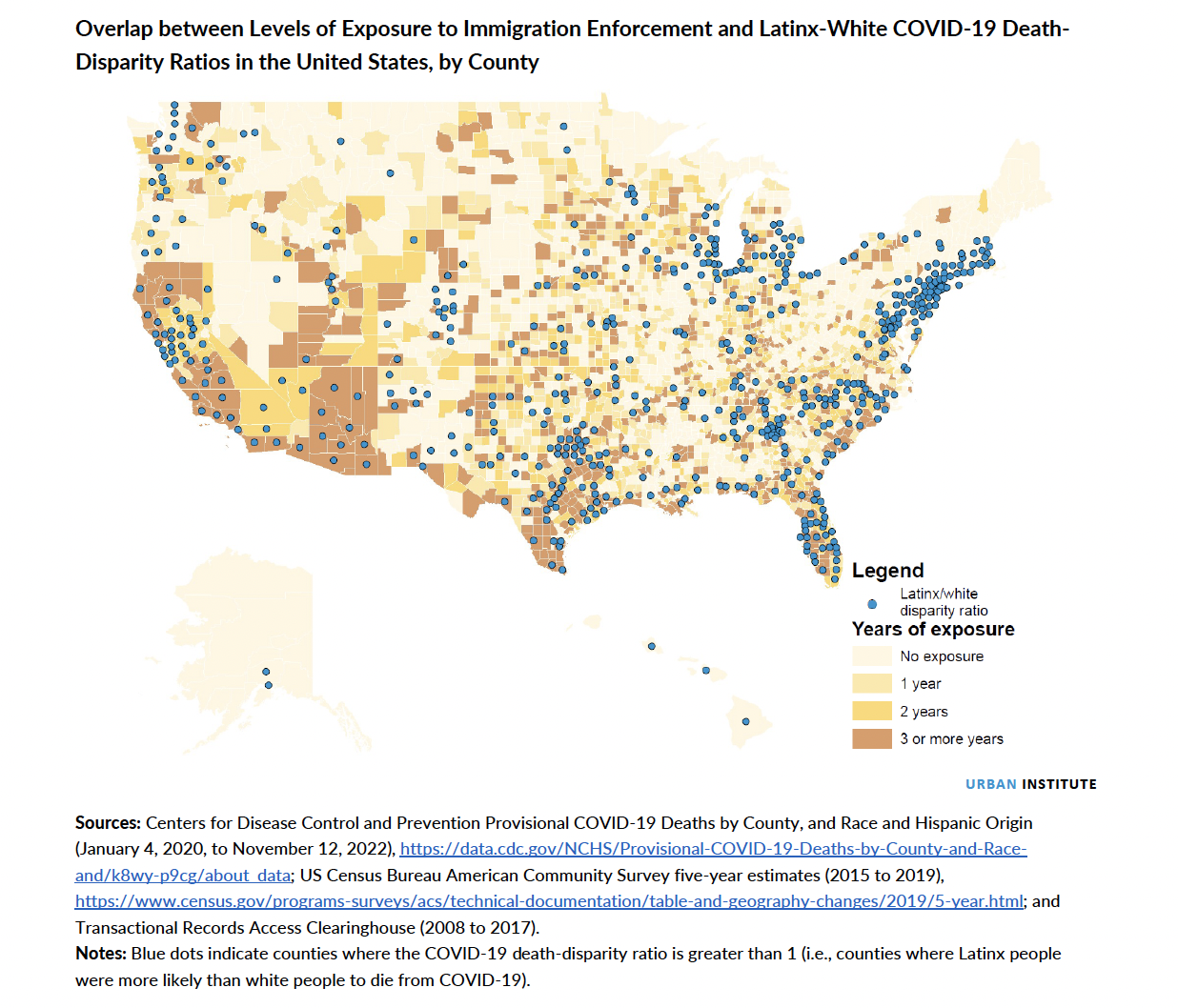
Among Latinx-concentrated counties,
- the majority (88 percent) showed a COVID-19 death-disparity ratio between Latinx and white people greater than 1, meaning Latinx people were more likely to die from COVID-19 than white people in those counties; and
- most (71 percent) were at or above the annual average for deportations at least once between 2008 and 2017.
As the number of years a county is exposed to medium-to-high immigration enforcement increases by one, the Latinx-white COVID-19 death-disparity ratio increases by 21 percent, after controlling for counties’ key observable characteristics.
How we did it
We used multiple data sources that contain county-level information on immigration enforcement, COVID-19 deaths, and socioeconomic and demographic characteristics. We conducted descriptive analysis and employed a linear regression model to explore the association between immigration enforcement and COVID-19 death disparities between Latinx people and non-Latinx white people, controlling for key observable characteristics of counties.
