
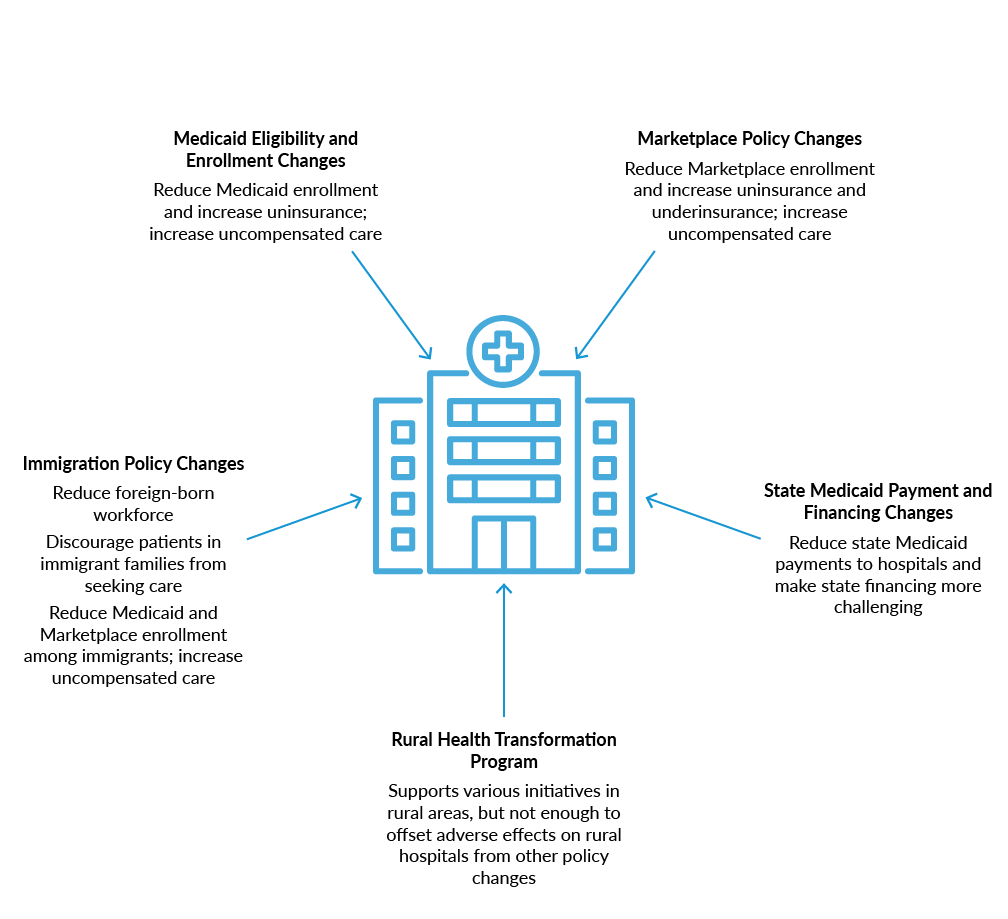
Recent actions by the federal administration and Congress will have far‑reaching implications for hospitals and the broader health care system. In this brief, we provide an overview of recent federal policy changes, describe potential risks and anticipated impacts on hospitals, and assess variation in impacts across hospital characteristics and locations. We focused on five key areas: Medicaid eligibility and enrollment policy, state Medicaid payments and financing, Marketplace policy, immigration policy, and the Rural Health Transformation Program.
Why This Matters
Changes to Medicaid and Affordable Care Act Marketplace policy, including in the One Big Beautiful Bill Act, as well as federal actions related to immigration policy, are expected to reduce enrollment in publicly subsidized coverage and increase uninsurance, raise hospitals’ uncompensated care costs, limit states’ Medicaid payment and financing options, and elevate workforce pressures—all while constraining state resources for safety net programs. These dynamics could create considerable uncertainty and financial and operational challenges for hospitals and health systems, undermine access to care, and have broader negative effects on public health and local economies.
Key Takeaways
- Changes and new initiatives in federal policy will have significant consequences for hospitals’ and health systems’ patient volume, uncompensated care, state funding, workforce, and ultimately, financial stability. Medicaid and Marketplace enrollment declines, along with associated increases in underinsurance and uninsurance, are expected to reduce hospital revenue and increase uncompensated care. At the same time, new and proposed constraints on state Medicaid financing would further reduce Medicaid payments to hospitals, while other changes like immigration-related policy changes would affect hospitals’ patient volume and workforce.
- Impacts will vary widely across hospitals. The large range of policy changes and hospital characteristics means that federal policy changes will affect facilities unevenly. Key drivers of variation include state policy environments (e.g., Affordable Care Act Medicaid expansion versus nonexpansion status, use of state directed payment and provider tax policies); hospital payer mix, financial status, and levels of uncompensated care; and rural versus urban location. Impacts will similarly vary across states, with some states experiencing substantially greater financial pressures on their hospital delivery systems and broader economies than others.
- Rural and Medicaid‑dependent hospitals face the greatest financial risk. Many hospitals already operate with negative margins, with rural hospitals and those serving a high share of Medicaid patients disproportionately affected. These facilities are therefore at greatest risk of service reductions or closures, which could further exacerbate health disparities by increasing barriers to care in rural and low‑income communities relative to urban and higher‑income areas.
- Impacts will unfold gradually and with some uncertainty, offering opportunities for adaptation and innovation. The implementation of federal policy provisions will take effect over several years, offering hospitals and state policymakers time to plan, adapt, and deploy mitigation strategies. At the same time, this phased implementation introduces uncertainty as evolving federal agency guidance and court rulings may reshape some of the policies. This level of uncertainty may heighten financial risk for hospitals that delay strategic responses, while for others, it may create space to experiment with innovation and adopt new approaches to care delivery.
How We Did It
We reviewed recent literature, estimates of impacts of recent federal policies, and policy documents to provide an overview of recent federal policy changes, describe potential risks and anticipated impacts on hospitals, and assess variation in impacts across hospital characteristics and locations.
