
Between 2000 and 2022, more than 200 new cities and towns incorporated in the United States. Most of these cities formed around majority-white communities, although some new cities formed around majority-Black communities. For instance, in the metropolitan area of Atlanta, 13 new cities incorporated after 2000, 3 of which are majority people of color.
Some research has measured the impact of cityhood on home prices, but there is little research comparing this impact among majority-white and majority-Black new cities.
Our research analyzes property values before and after incorporation in majority-white and majority-Black new cities and in areas left unincorporated in the metropolitan area of Atlanta. We test whether new incorporations in majority-white cities lead to increases in home values, therefore whether such incorporations disproportionately increase the ability of high-income and white-majority communities to continue accumulating wealth. Additionally, we test whether Black-majority new cities experience the same economic benefits from municipal incorporation or if various factors, such as preexisting conditions of residential segregation between communities, could be dampening economic gains from new city formation.
What We Found
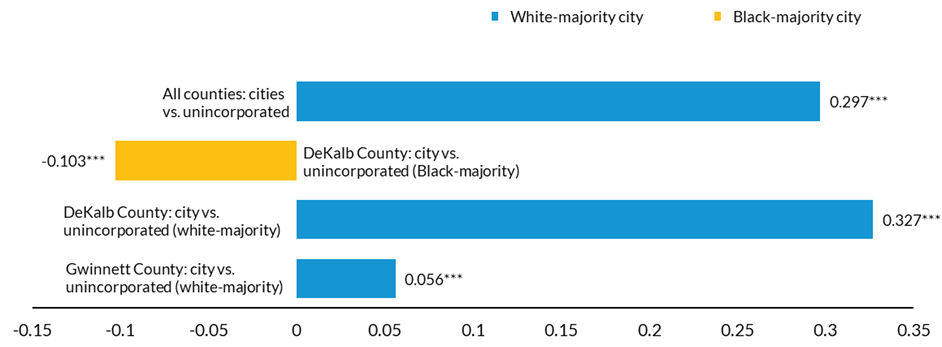
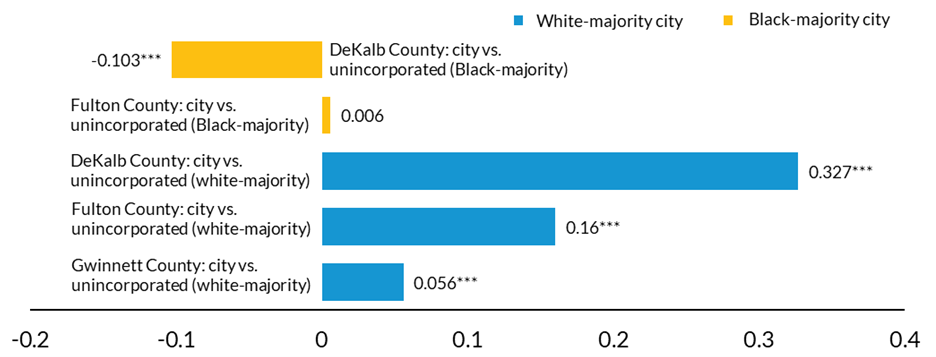
The before-after and between-place comparisons (difference-in-difference regression analysis, explained below) point to a positive property capitalization effect for cities with a majority-white population at the time of incorporation and a negative or near-zero, non-statistically significant increase in property capitalization effect for newly incorporated cities with a majority-Black population, even after controlling for property and neighborhood characteristics.
This is also the case for new cities situated in counties with unincorporated or left-behind communities, such as those in the figure below. We find that, on average, the incorporated cities in our study in DeKalb and Gwinnett Counties saw an increase in home prices after incorporation, in contrast with homes in unincorporated areas.
Difference-in-difference results for majority-white and majority-Black cities in Gwinnett and DeKalb Counties
Source: Authors’ analysis of data from a major property records provider.
Notes: Difference-in-difference results are shown only for the selected newly incorporated cities in DeKalb and Gwinnett Counties, with sufficient unincorporated transactions for the control group. These regressions include three cities: one Black-majority city (N = 33,326) and two white-majority cities (N = 77,697 and N = 102,143). The associated control groups capture unincorporated areas in each given county. The overall regression (N = 213,166) includes the three incorporated cities in DeKalb County and their associated control groups. The displayed regression results include hedonic pricing controls for property, neighborhood characteristics, and distance to neighborhood amenities. We calculate standard errors using heteroskedastic robust standard errors clustered at the block group level. *** = p < 0.01.
We observe a somewhat similar dynamic in Fulton County, which is fully incorporated. We observe that in Fulton County, a newly incorporated majority-Black city experienced a near-zero non-statistically significant increase in home prices after incorporation, whereas the newly incorporated majority-white city in Fulton County experienced a statistically significant 16 percent increase in home prices after incorporation.
Difference-in-difference results for majority-white and majority-Black cities in Gwinnett, DeKalb, and Fulton Counties
Source: Authors’ analysis of data from a major property records provider.
Notes: Difference-in-difference results are shown for the three cities in DeKalb and Gwinnett County: one Black-majority city (N = 33,326) and two white-majority cities (N = 77,697 and N = 102,143), and their associated unincorporated areas control groups. We also include the results for two newly incorporated cities in Fulton County—one Black-majority city (N = 33,326) and one white-majority city (N = 138,605)—and compare them with established cities (cities that incorporated before 2005), given that no incorporated areas were available to construct a large enough control group in Fulton County. The displayed regression results include hedonic pricing controls for property, neighborhood characteristics, and distance to neighborhood amenities. We calculate standard errors using heteroskedastic robust standard errors clustered at the block group level. *** = p < 0.01.
How We Did It
We used a hedonic difference-in-difference regression model to isolate the causal effect of municipal incorporations on housing prices within four years of incorporation. We focused on three counties in metro Atlanta—Fulton, DeKalb, and Gwinnett—where all municipal incorporations have taken place since 2000.
We used data on 400,000 property records between 2000–20 from a major property records provider, which provides data on every property sold with a deed and its assessment information. In addition to the property records data, we obtained neighborhood-level characteristics to incorporate as neighborhood-level controls, including demographic data and data on public amenities.
