
The federal government supports the US housing market through dozens of initiatives administered by several agencies—in total, spending hundreds of billions of dollars each year. These initiatives support over 15 million homeowning and renter households by subsidizing housing costs, reducing housing tax burdens, securing mortgages, and incentivizing new housing development. Together, federal housing supports form the scaffolding that holds up the national housing market.
The Federal Role in Housing
Federal funding accounts for more than two-thirds of state and local government housing and community development funding, which makes housing affordable for tens of millions of US residents. But misconceptions around the federal role in housing linger. Some of the lesser-understood aspects of the federal government’s role in supporting housing in the US include the following:
- A wide range of agencies oversee housing supports, not just the US Department of Housing and Urban Development (HUD). Government-sponsored enterprises (such as Fannie Mae and Freddie Mac), the US Department of the Treasury, the US Department of Veterans Affairs, the US Department of Agriculture, and, increasingly, the US Department of Transportation all play a role. HUD’s assistance accounts for a minority of overall federal housing assistance.
- More money goes toward reducing homeownership costs and investment in development than toward rental assistance. The amount the federal government distributes in tax benefits that assist investors and homeowners—mostly with middle or high incomes—is more than three times the amount it spends on housing for renters with low incomes.
- Federal housing supports benefit all types of US households. Households benefitting from housing supports have incomes across the spectrum and include both renters and homeowners. Government-sponsored enterprises guarantee or secure most mortgages nationwide.
- Federal housing supports are deeply connected to each other and to the housing market overall. Multiple supports—including low-cost financing, grants, and tax credits—are needed to build and preserve affordable housing. Homeowners often benefit from a combination of publicly provided supports, including downpayment assistance, preferential financing from state agencies, guarantees from federal housing agencies, and tax breaks on interest, property taxes, and capital gains.
Federal tax expenditures and budgetary obligations for fiscal year 2024, by agency, in billions of dollars
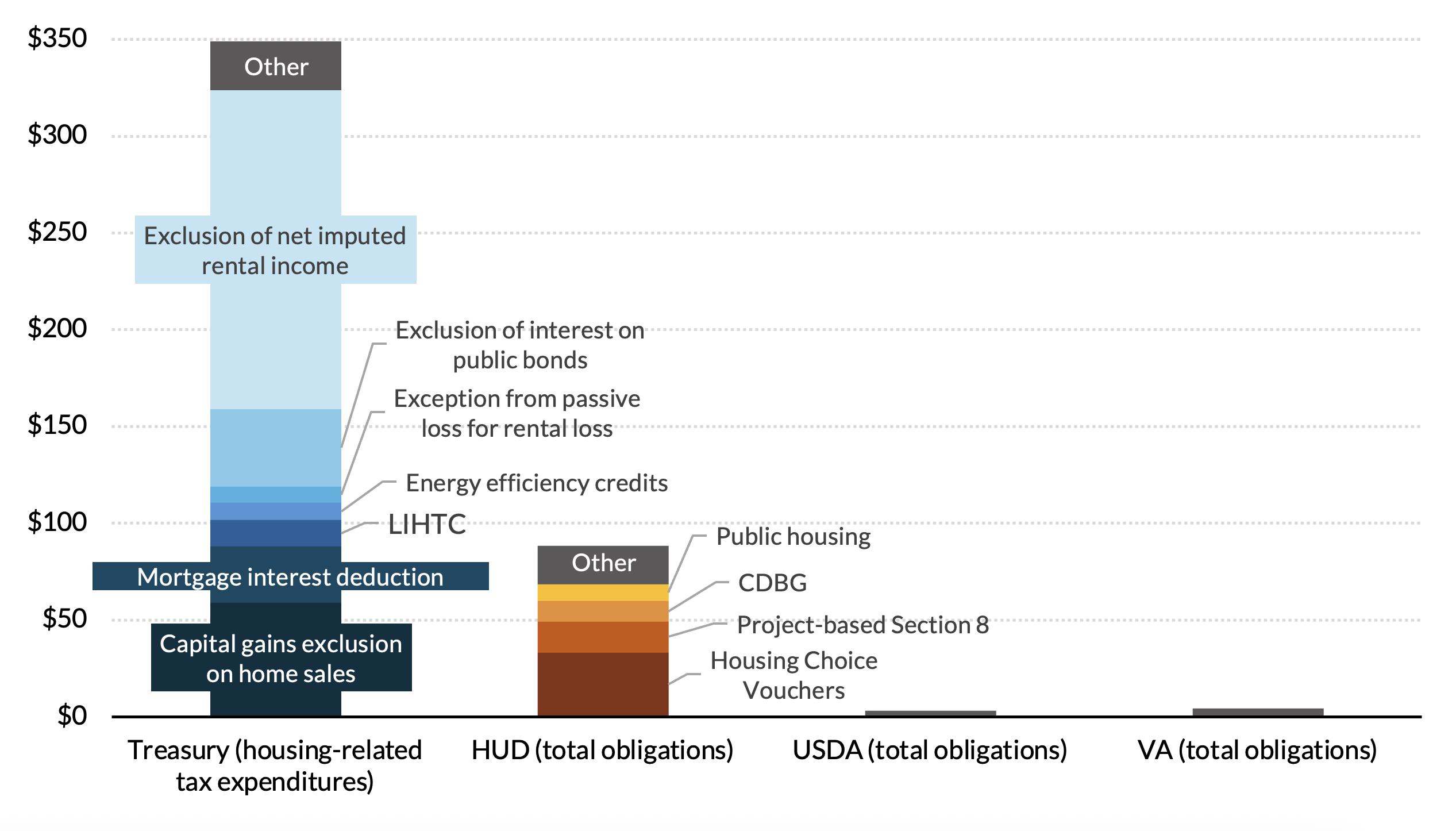
Source: Author analysis of data from USA Spending and Department of the Treasury tax expenditures (both accessed 2025).
Notes: Certain programs (e.g., HUD’s CDBG), are often used for non-housing purposes; “other” category includes tax expenditures for factors such as opportunity zones, which include nonhousing investments; a full list of programs included is in table 1. Graph does not include expenditures by government-sponsored enterprises. CDBG = Community Development Block Grants; HUD = US Department of Housing and Urban Development; LIHTC = Low Income Housing Tax Credit; VA = US Department of Veterans Affairs; USDA = US Department of Agriculture.
Public Data on Federal Housing Supports
We conducted a comprehensive review of current federal housing supports to help policymakers at all levels, practitioners, advocates, and researchers understand the scale and scope of the federal government’s role in housing. We define supports as programs, investments, tax policies, and financing products that the government uses to reduce housing costs and to stimulate an active debt financing industry. We identified how much the federal government spends to maintain each support, how many households benefit, and how these supports are interrelated.
Understanding the mix of available supports is crucial for local leaders to maintain safe and affordable housing for residents, especially with federal housing dollars now at risk. To empower these leaders, we also compiled a catalog of publicly available data on federal housing supports. This collection of public data sources and tools can help local policymakers and practitioners understand the federal housing program landscape and explore how it affects their community. The tools can be sorted by source, housing program, and geography.
Navigating Federal Housing Supports Using Public Data
Filter by data source, housing metric, or geographic level. To learn more and download data, click the bolded text in the Resources column.
How We Did It
We identified publicly available data sources providing information about federal housing supports and reviewed recent scholarship on this topic to establish a list of current federal mechanisms for supporting housing. We documented federal budgetary expenditures in fiscal year 2024 by consulting USA Spending and other data sources. We explored information about federal tax expenditures in the same year using information provided by the US Department of the Treasury.
To compare programs, we catalogued available data about what types of households benefit from different types of investments and reviewed federal data on the demographics of the people benefiting from these programs. Finally, we catalogued information from the National Housing Preservation Database to compare the sources of financing for project-based affordable housing units across the United States.
We then compiled the data sources used in the report and other publicly available data tools on federal housing supports into a data catalog. The list of sources presented in our catalog is not exhaustive, and we welcome suggestions for other tools to include. Housing program names have been adjusted and standardized across datasets for clarity. Information regarding the survey period, update dates, and geography is captured at the source level and is not necessarily specific to each metric. For example, some metrics may only be available for specific geographies or for certain years within a dataset. Source-level information is accurate at the time of publication but may change over time. Please see each dataset’s original documentation for additional details about the availability of specific information.
We do not provide details about datasets relevant to housing assistance funded by state and local governments using their own revenues. Many states, cities, and counties have revenue streams, such as housing bonds or development impact fees, devoted specifically to funding affordable housing, often in parallel with federally funded assistance.
This data catalog was produced by the Infrastructure Equity at Urban team. Efforts were led by Amanda Hermans and Yonah Freemark. We are grateful to our Urban colleagues who contributed to the development of the tool: Wesley Jenkins, Lauren Lastowka, Samantha Cressman, and Lydia Nguyen. This work was produced in partnership with the Lincoln Institute of Land Policy and funded by a contract from Furman Center at New York University.
