
An estimated 59 percent of college students experience at least one form of food or housing insecurity, and unmet basic needs are linked to stopping out, lower GPAs, and not completing a degree. As basic needs insecurity has become more visible at colleges over the past decade, institutions are seeking cost-effective strategies to support students’ basic needs. This brief provides guidance drawing on our evaluation of Single Stop, a basic needs access technology that uses a screening tool to connect students to public benefits and local resources.
From our evaluation, we learned that basic needs technology tools are helpful pieces in the puzzle of addressing college student basic needs insecurity. However, they are not full solutions. They require participation from at least a few college staff members, building awareness of the tool college-wide, and an understanding of the types of resources the tools are more and less likely to help students access.
Why This Matters
Basic needs insecurity—which, for college students, can include hunger, housing insecurity, child care challenges, insufficient technology, unmet health and mental health needs, transportation barriers, and limited legal access—is associated with students’ stopping out, having lower GPAs, and not completing degrees.
This brief shares insights that apply to other basic needs access technology tools, including 211, Benefit Kitchen, FindHelp, Mirza, MyFriendBen, NAVVY, and UThrive. These insights can be useful for college and system staff, policymakers, researchers, funders, and technology developers looking into strategies for providing college students with access to basic needs resources.
Lessons Learned
- Implementing a basic needs access technology should be one part of a college’s broader basic needs strategy
Across the 56 colleges in our sample, colleges with the highest screening rates screened up to 13 percent of enrolled students, so a screener is unlikely to reach every student experiencing basic needs insecurity. College staff found Single Stop useful for connecting students to resources and removing barriers to college success. For several students, the screener was most useful alongside staff support to help them make sense of the results and connect them with the next resource. Colleges should treat these tools as one part of a broader basic needs strategy that also includes establishing resources, partnering to provide resources, building a campus culture that normalizes seeking help, encouraging screening, and assisting students with connecting to supports. - Colleges can accelerate adoption of basic needs technology tools
Controlling for institution size, we found that sites with longer-standing contracts with Single Stop screened significantly more students in later years of implementation. Each additional year of Single Stop participation was associated with approximately 74 more students screened, on average. These results suggest that colleges learn from additional years of implementation, and that their awareness-building and implementation practices can speed up connections to the resources many students need. Colleges can speed up implementation with adequate staffing, established responsibility, required screener use in first-year courses, and other promising approaches
Colleges with higher screening rates reported an average of 4.6 staff members who used Single Stop as part of their role, compared with 2.5 at colleges with lower screening rates, and their staff were more likely to be in a single department. Inconsistent approaches to processing screeners and case management across departments can lead to uneven access to resources for students. Colleges with higher rates were also more likely to use social media (70% vs. 27%) and flyers designed by college staff (70% vs. 45%), present the screener in a class (90% vs. 55%), and require the use of the screener in a class (90% vs. 64%). Peer referrals also stood out as a promising practice.Percentages of Low- and High-Screening Colleges That Used the Awareness-Building Strategy 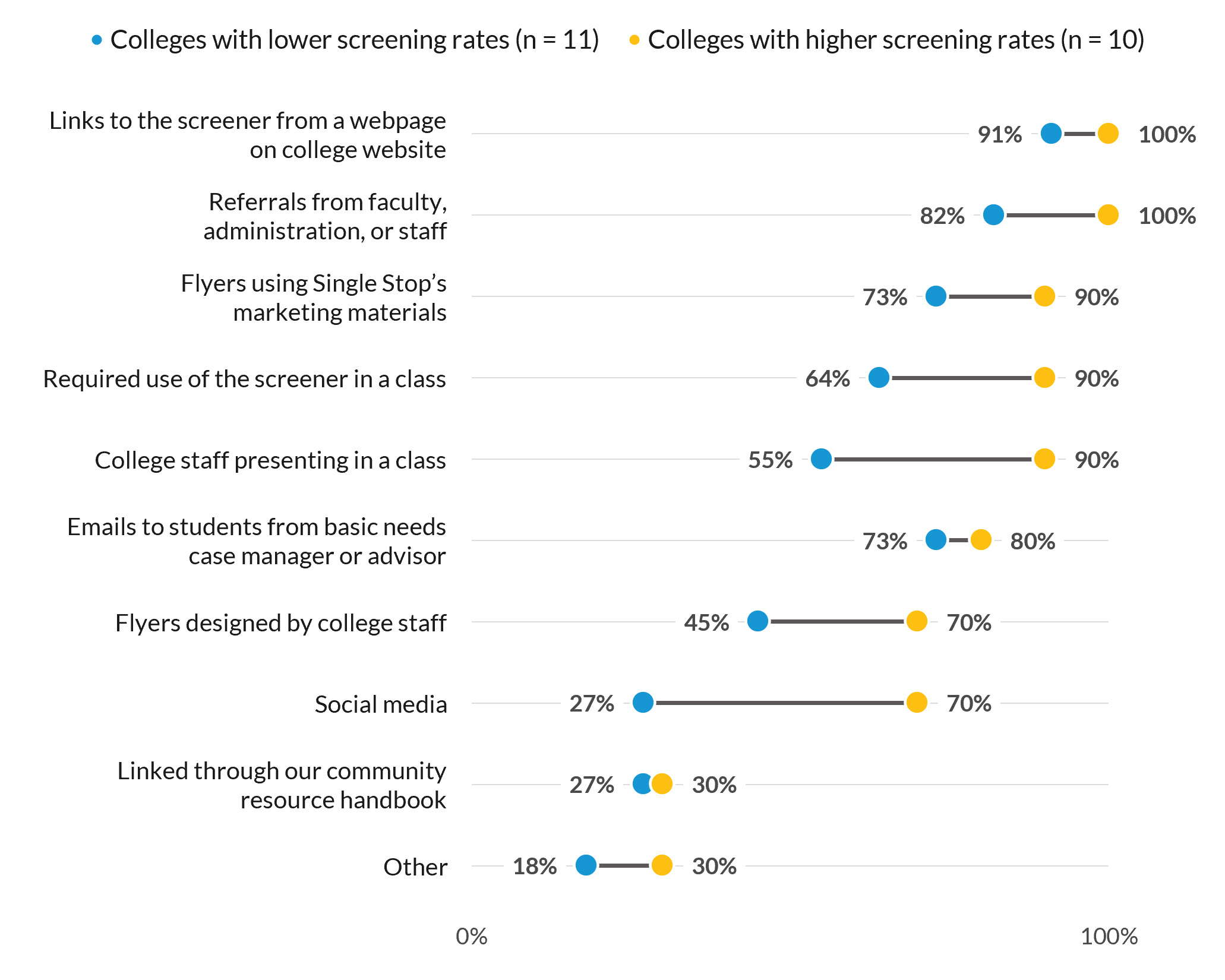
Source: Survey of college staff who use Single Stop.
- Students were more likely to access some basic needs resources than others
At colleges using Single Stop, staff reported that students were more often connected to financial grants, food resources, and health resources than to other types of support. These resources are tied to programs with strong federal and state support, such as Pell Grants, SNAP, WIC, and Medicaid. Reported access to child care, housing, transportation, and legal resources was lower. This may reflect that fewer public programs reliably fund these supports, so students’ access depends more on what is available locally. To address this gap, colleges can regularly update their known offerings and build partnerships with community organizations to understand and improve availability of resources. - Colleges can use data from screening tools to improve basic needs referral processes and make the case for basic needs support
Only a third of colleges (33%) reported using applicant or referral data (such as number of students screened) to a great extent, although Single Stop provides this. Data regarding screenings, cases, referrals, and confirmed connections to resources may help colleges describe the scope of the work being done and the staff capacity needed to sustain it.
How We Did It
We employed a mixed-methods evaluation approach, including a landscape scan of technologies that exist. We analyzed existing Single Stop data regarding 56 colleges, 63 percent of which were community colleges, merged with the Integrated Postsecondary Education Data System. These colleges span 18 states, and about a third are in Virginia. We also surveyed staff at 31 of these colleges, interviewed seven college staff and school system members, conducted focus groups with 15 students, and engaged 33 staff and students in participatory interpretation of findings.
