
In the May 2024 edition of At A Glance, the Housing Finance Policy Center’s reference guide for mortgage and housing data, shows slightly improved mortgage affordability, only 1.24 percent of borrowers with agency loans are able to attain a better rate by refinancing, and the Fed held its short-term rate steady at 5.25-5.5%, but slowed the run-off of Treasuries and will reinvest excess agency debt/MBS dividends into US Treasuries. The introduction takes a close look at the role of housing and healthcare in inflation measures.
The role of shelter in rising inflation
Accelerating consumer prices have weakened consumer sentiment. Higher inflation not only makes many everyday consumer goods and services more expensive, but it also undermines consumers’ purchasing power.
Why is inflation staying at elevated levels? According to the often-cited Consumer Price Index (CPI), higher inflation is heavily influenced by housing. In its most recent release, the Shelter Index, in addition to gasoline, were mentioned as key contributors to the rise in headline inflation.
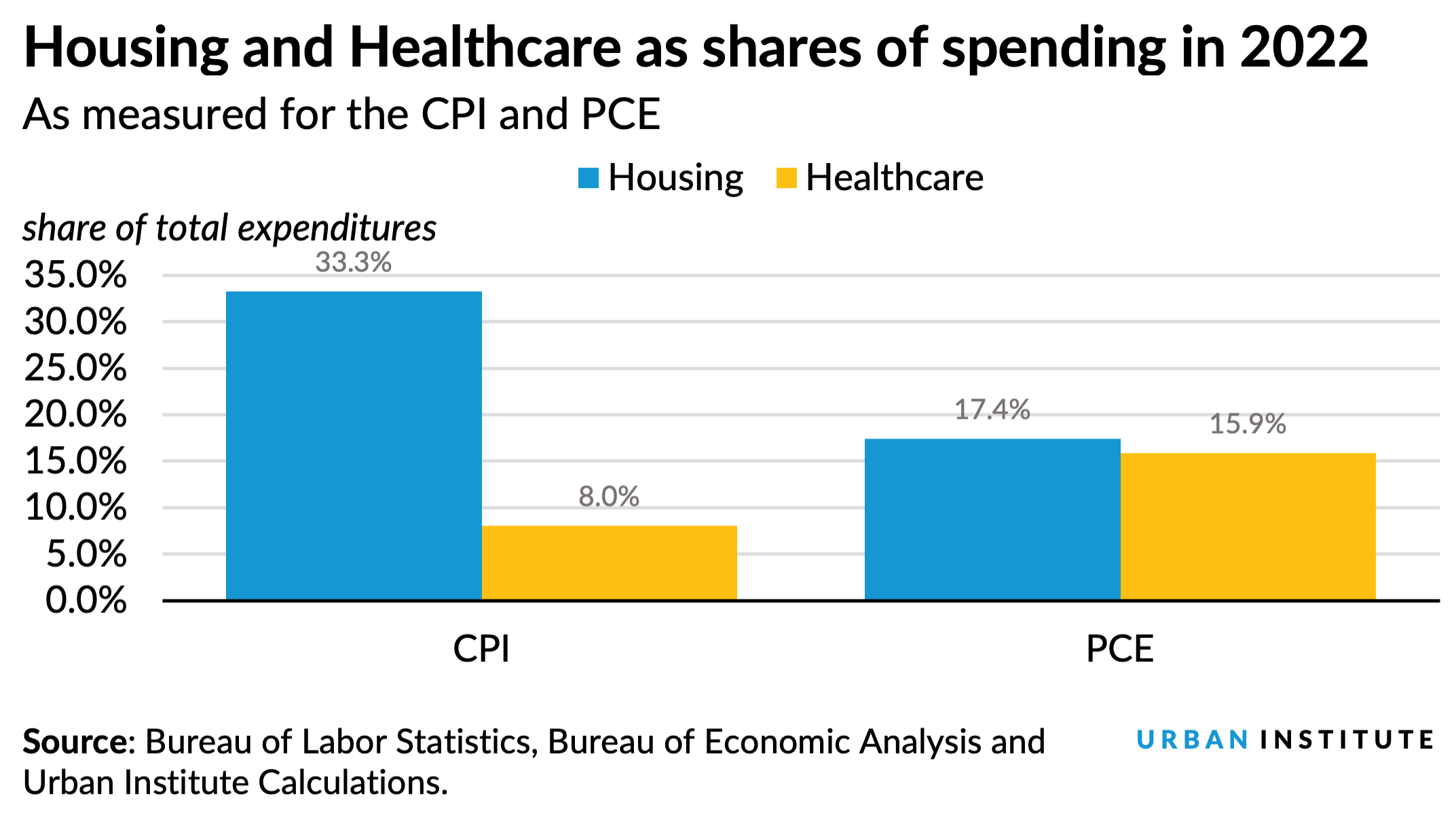
Housing’s contribution to overall inflation partly reflects the economy-wide lack of affordable housing and the high resource costs associated with building new housing. All else equal, these challenges can increase housing costs. And housing has a heavy weighting in the Consumer Price Index. The figure below indicates that the Housing Index represents 33 percent of the CPI, it is the largest single component.
However, the CPI is not the only commonly used measure of consumer inflation. The personal consumption expenditures index (PCE), which tracks changes in the personal consumption component of the economy’s gross domestic product is also used to measure consumer inflation. The Federal Reserve’s relies on this measure of consumer inflation to determine price stability, which forms one-half of its Congressional mandate (maximum employment is the other component).
In both indices, housing costs are measured as the rental value of the unit. For homeowners, the BLS collects data from homeowners on how much they believe their home would rent for (owner’s equivalent rent (OER)). For renters, rent information is collected directly through a different survey. Note that housing will be a lagging measure, as borrower’s perceptions may not quickly adjust to market conditions, and most leases roll over only once a year.
Moreover, OER does not capture what homeowners are actually paying. Given that current home prices and interest rates are both high in a historical context, the costs to a new homeowner have rarely been wider relative to renting. Thus, the OER will understate the costs to new homeowners. However, existing homeowners bought years ago and who refinanced their mortgage in a lower rate environment will likely face lower costs than that reflected by todays OER.
While housing costs are an issue, health costs may well be a larger issue in the Federal Reserve’s preferred measure. The figure below illustrates that the Housing Index share of PCE is only half its share of CPI, while the healthcare index in the PCE is nearly double its share in the CPI. While healthcare accounts for only 8 percent of the CPI, it represents 16 percent of PCE, similar to the housing share of PCE. This difference reflects two distinct approaches to measure consumers’ costs, particularly with respect to healthcare. The CPI measures out-of-pocket spending on medical services whereas the PCE measures households’ own medical care spending as well as spending on their behalf by their insurance. Including health spending on behalf of consumers raises its share in the PCE and helps to reduce the role of housing.
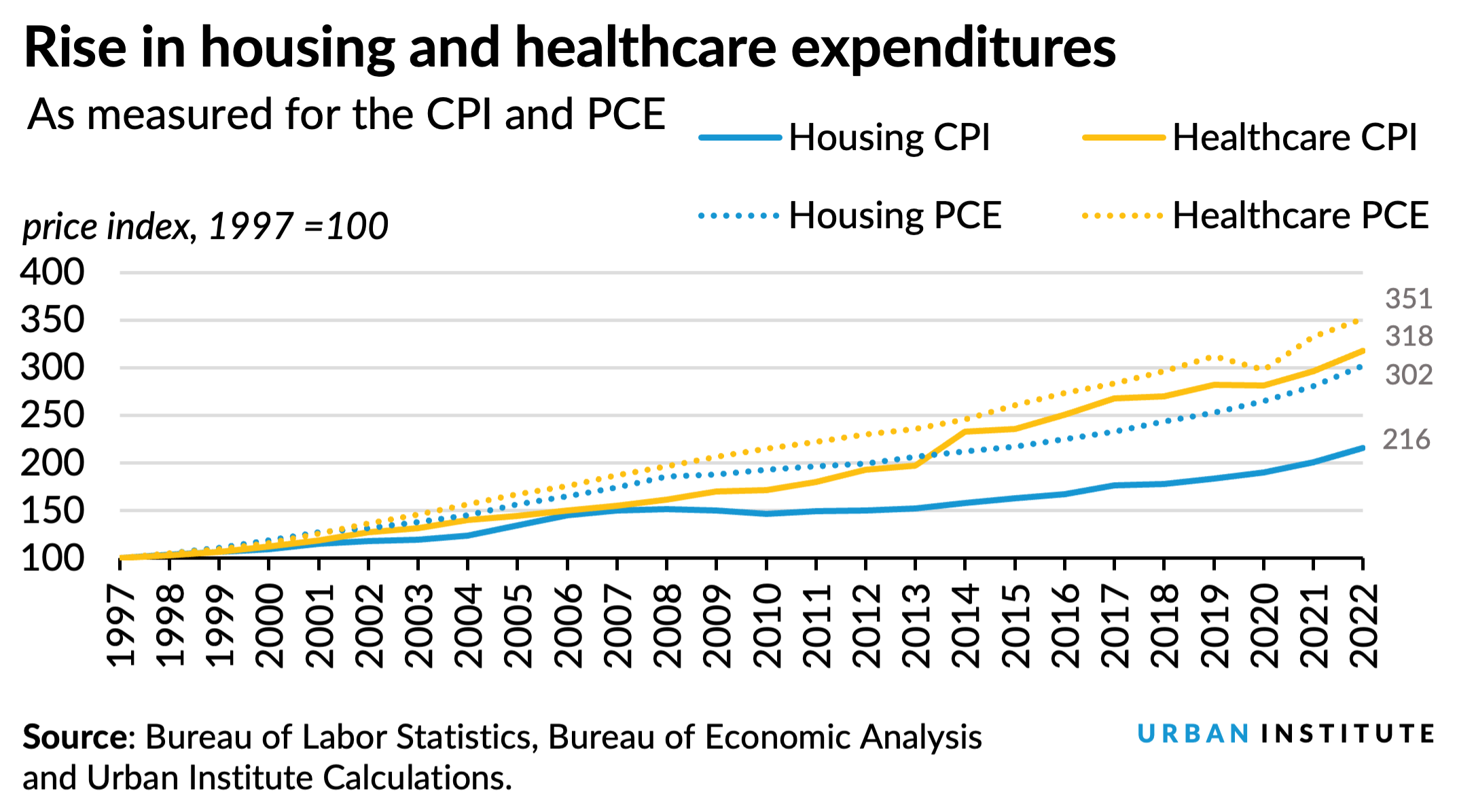
In both measures, medical spending has risen more than spending on housing since 1997, the beginning of the series. Healthcare spending as measured by PCE is 3.51 times higher in 2022 than it was in 1997, a steeper increase than the 3.02 times increase in spending on housing. In the CPI, healthcare spending today is 3.18 times its 1997 level while Housing is 2.16 times its 1997 level.
Understanding different calculations of consumer inflation and what they measure is critical. While high housing costs are a debilitating challenge the country faces, particularly for renters and for new homeowners, the growth of healthcare costs also pose important difficulties. And may pose a bigger hurdle to reducing PCE inflation.
