
Local and state governments across the United States spend billions of dollars each year building new transportation projects—including roadways, bike lanes, and rail lines. These investments play an important role in expanding access to employment, recreation, and services for Americans. That improved mobility and its associated neighborhood improvements, such as new station facilities, can also contribute to neighborhood demographic change. In some cases, this can mean gentrification, defined as the influx of new residents with higher incomes and educational attainment into formerly disinvested neighborhoods. If gentrification results in displacement—meaning long-time residents are involuntarily pushed out of the neighborhood or choose to leave because of economic or social pressure—then people with fewer resources could lose access to transportation options.
In this project, funded by the National Academies of Sciences, Engineering, and Medicine, we investigated what is known about the links between transportation investment and gentrification and surveyed practitioners working in the field to learn about how gentrification and displacement factored into transportation planning at their agencies.
Why This Matters
Transportation investment is one factor in the complex feedback loop that causes and responds to gentrification. Transportation planners and policymakers need to understand where their work fits into this system to effectively preempt and mitigate the negative effects of gentrification that may be associated with transportation projects. Our research indicates that transportation agencies only occasionally incorporate planning to counter the negative impacts of gentrification into the implementation and funding of their transportation investments, such as to cover the costs of rental assistance for people who are cost burdened by rising housing costs. Agencies seeking to ensure that projects benefit all members of the community should consider expanding this sort of spending.
Scholarship Shows a Link Between Some Transportation Projects and Gentrification
Many people believe that investment in transportation can induce gentrification. This is based on the theory that new transportation options increase access and neighborhood desirability—which encourage an influx of both financial capital and individuals with higher incomes and educational attainment. This can increase housing costs and displace people with the least ability to afford those homes.
We found that there is some evidence linking gentrification to light rail and metro projects, but there is limited or no evidence linking gentrification to bus projects, greenways, bike lanes, or sidewalk infrastructure. Repeated studies show an association between the construction of rail transit and increased home values in areas surrounding stations. These increased home values could prevent many people from living in the areas where they want to live—and could push out people who live in these areas. There is substantially less evidence on the link between other types of transportation and gentrification, though the construction of the US freeway system is associated with massive displacement due to neighborhood demolition.
The literature on gentrification and displacement is rife with debate and plagued with measurement challenges. And there is a substantial gap in evidence on the degree to which transportation investment is linked to gentrification.
Transportation Planners Agree that Addressing Gentrification Matters—but Lack the Resources to Do So
We surveyed transportation and planning practitioners across the United States to evaluate the degree to which they plan for gentrification in their work. We found that over 60 percent of those surveyed thought that transportation projects were at least sometimes associated with gentrification and/or displacement.
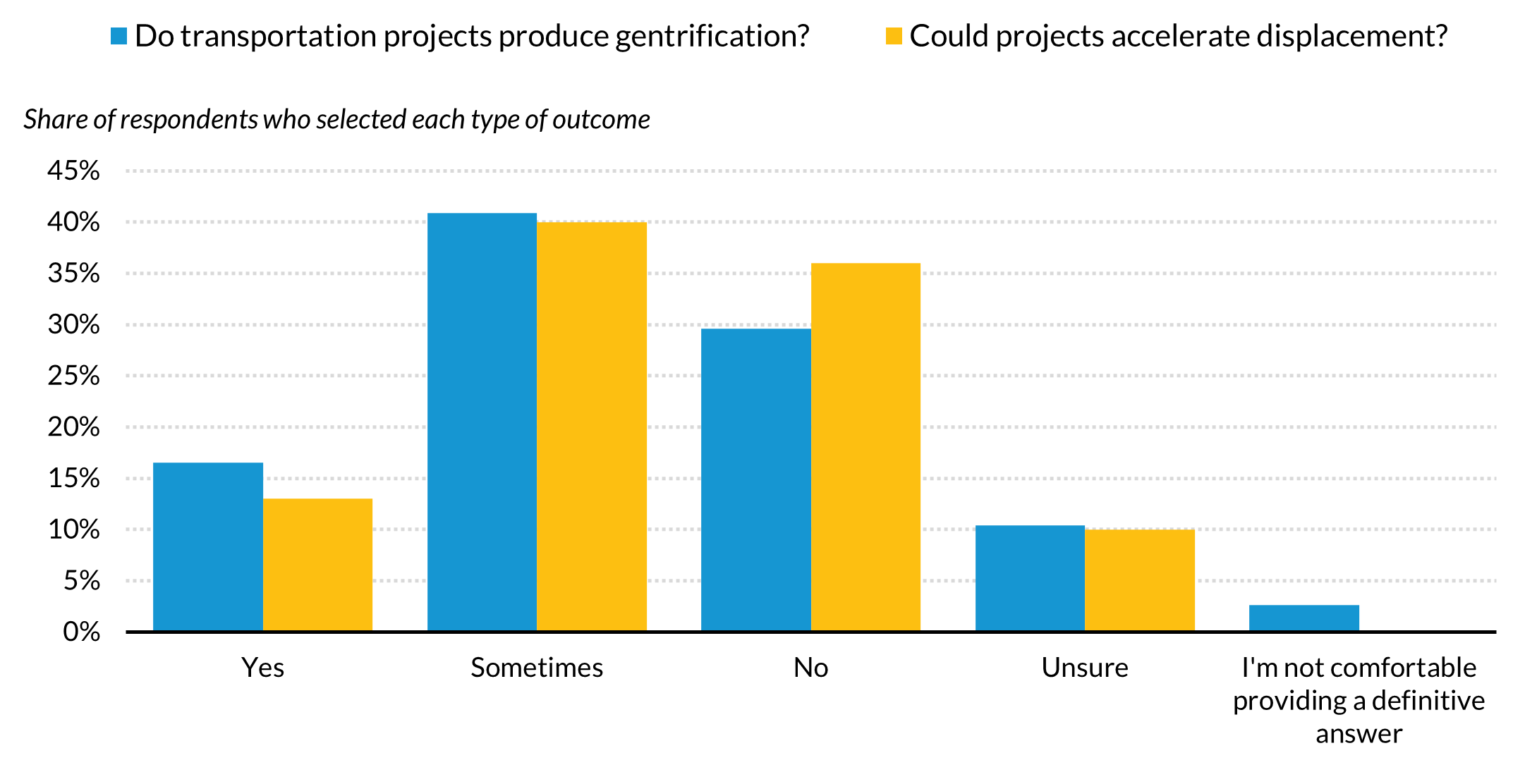
Source: The authors, based on a review of survey responses.
A majority of survey takers reported that gentrification was infrequently or never incorporated into their agency’s transportation project implementation. And more than 60 percent responded that their agencies never allocated funding for displacement prevention.
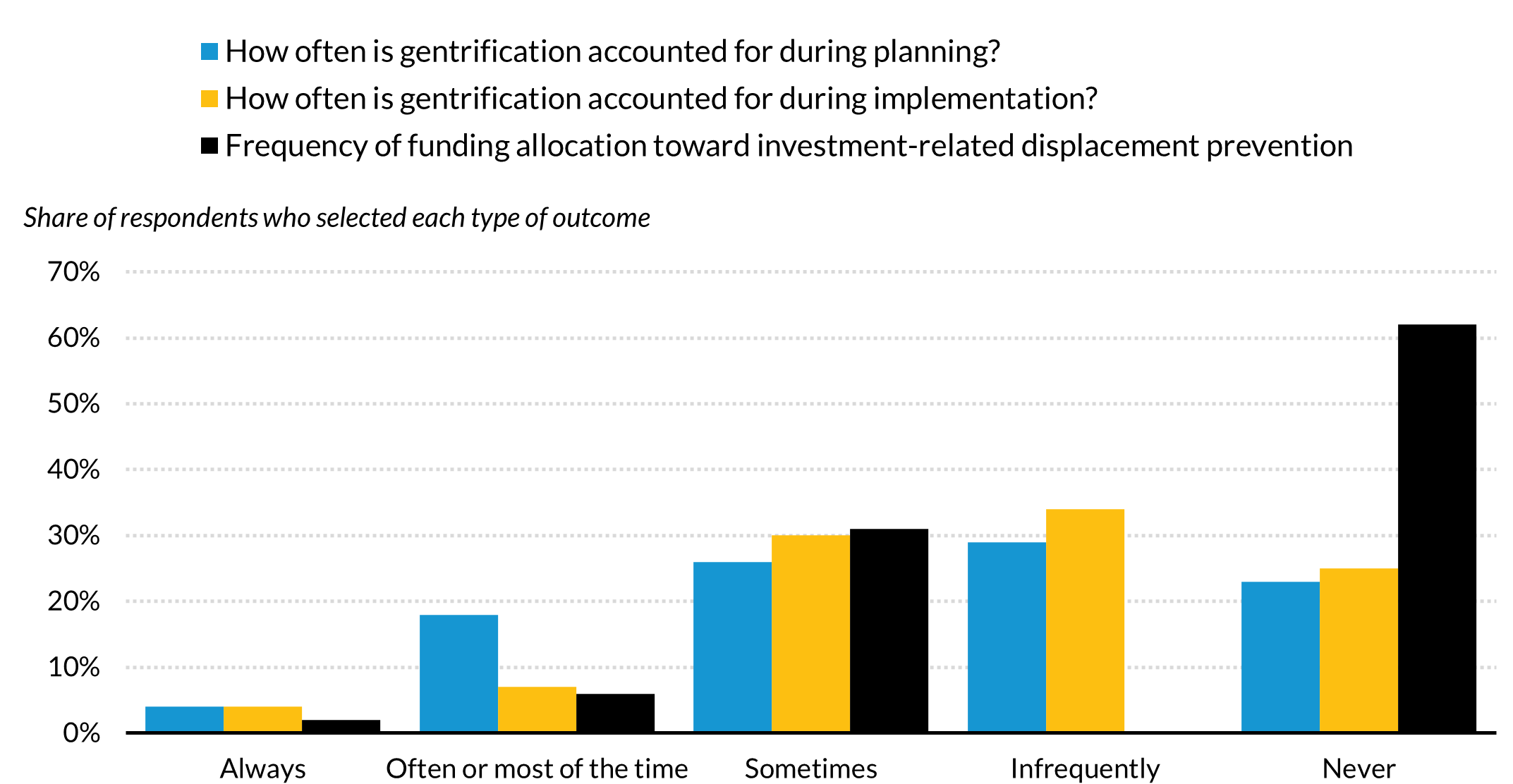
Source: The authors, based on a review of survey responses.
Notes: Respondents to the question “frequency of funding allocation toward investment-related displacement prevention” were not given the opportunity to answer “infrequently.”
Our findings suggest that additional research is needed to understand the link between many types of transportation investment and neighborhood change. Without more evidence, it is difficult to assess the degree to which any individual project could result in negative outcomes.
How We Did It
We conducted a detailed review of the scholarly literature linking transportation and gentrification, identifying the connections in the context of several different modes of transportation. We interviewed 17 practitioners working in the field and then fielded a nationally representative survey of 139 staff of planning and transportation agencies working in 25 states and the District of Columbia.
