
Washington state is one of the nation’s most prosperous thanks to a welcoming climate and a growing economy. New construction is often a way of life in neighborhoods around the rapidly expanding transit networks that have recently been completed or are now being built in the Puget Sound, Spokane, and Vancouver metropolitan areas. Yet not everyone has been able to take advantage of the state’s boom, as housing costs have increased at much higher rates than those of the nation overall. Between 1990 and 2021, median rents in Washington increased more than in all but two other states, and the share of renters paying more than 30 percent of their incomes to rent increased from 39 to 49 percent.
In recent years, the state legislature has sought to address these problems through new municipal requirements and new funding for subsidized housing. What strategies can Washington use to further increase the availability of housing, especially affordable housing, in mixed-use neighborhoods near transit? In this report, we recommend ways to get there.
Cities in Washington State Are Experiencing Opposing Trends in Population and Housing
Neighborhoods near Washington’s transit stations—including light rail, commuter rail, streetcar, and bus rapid transit stops—have generally higher population and housing densities than other neighborhoods, and they have grown at a more rapid clip. But differences abound between cities with high housing costs and those with low costs, especially in transit areas, which we define as those within a half mile of rail stations and a quarter mile of bus rapid transit stops. Transit areas in high-housing-cost cities have experienced substantial construction and population growth, particularly of people with high educational attainment, high incomes, and low car ownership. But low-housing-cost cities have not experienced these trends. In low-housing-cost cities, residents have become increasingly car reliant, and they face high housing-cost burdens. Meanwhile, these latter cities struggle to provide the infrastructure and accommodating public realm needed to attract private investment near transit.
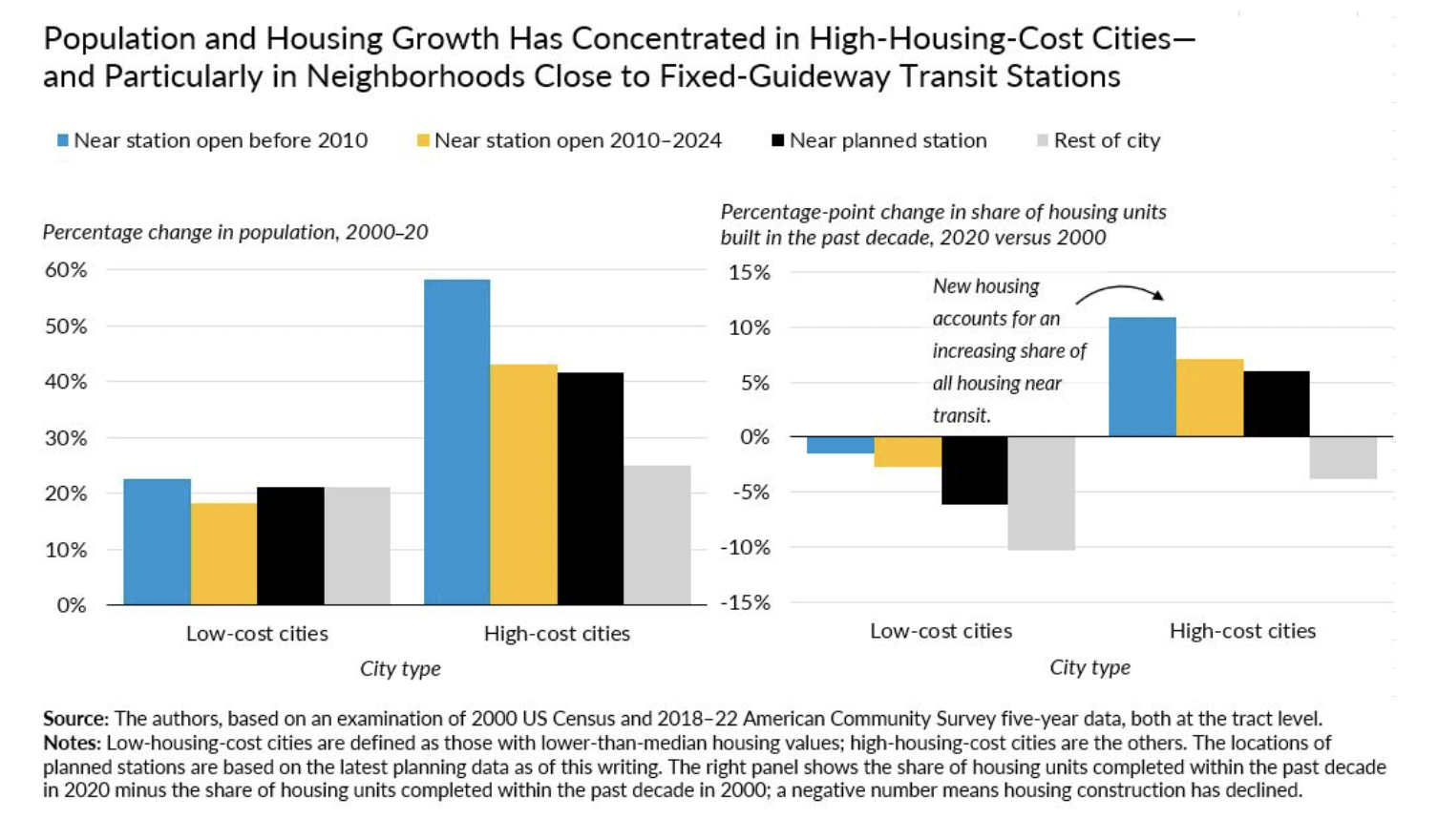
These trends suggest that a Washington state transit-oriented development strategy must account for, and plan for, sometimes opposing trends in different types of communities. Transit areas in cities with high housing costs are experiencing changes akin to gentrification as the availability of homes affordable to low-income households declines. Meanwhile, residents of transit areas in cities with low housing costs are experiencing rents rising more rapidly than incomes. Everywhere, there is an inadequate supply of housing available to families with low incomes.
Ensuring Washington’s cities offer abundant and affordable transit-oriented development requires building more homes—particularly affordable ones—and surmounting barriers that limit construction, including the following:
- financing barriers that limit the potential for housing construction in cities with low housing costs due to high project development risk, combined with inadequate subsidies to cover the costs of units affordable to households with low incomes
- cost barriers owing to high land values in the cities with the most demand for housing and inadequate funding for complementary infrastructure needed to create vibrant, pedestrian-friendly, and mixed-use neighborhoods
- regulatory barriers, such as parking rules and discretionary design review, that expose projects to unnecessary requirements or delay them
How to Generate Abundant and Affordable Transit-Oriented Development in Washington State
Based on case studies of six other regions in the US and Canada and our examination of Washington cities’ current regulatory and financial landscapes, we recommend that the state legislature do the following:
- Ensure communities can implement TOD by funding an expansion in neighborhood infrastructure grants, particularly to low-housing-cost cities with limited local tax bases.
- Make room for affordable housing by increasing investment in the housing trust fund; leveraging publicly owned land for affordable housing; expanding public agencies’ ability to acquire land for TOD projects; enabling public agencies, including transit authorities, to facilitate development; and enabling affordable housing developers to preempt local zoning in cities with low supply of subsidized housing.
- Expand options for development by allowing very high densities close to frequent, fast, and reliable transit.
- Adjust the state’s property tax exemptions and affordable housing requirements so that they do not inhibit construction in communities with relatively low demand.
- Create opportunities for a mix of uses by implementing zoning policies that encourage small-scale retail formats, introducing a state master lessor for retail space in TOD buildings, and encouraging state and local agencies to lease TOD retail for customer-serving uses.
Municipal governments throughout the state are largely supportive of additional development, and many local staff want to encourage affordable housing in their communities. They can partner with the state, transit agencies, and developers in advancing the collective goal of a more affordable, transit-oriented Washington.
How We Did It
Our team assembled datasets on demographics, housing availability, and affordability for areas along existing and planned fixed-guideway transit lines, including light rail, commuter rail, streetcar, and bus rapid transit routes, in the Puget Sound, Spokane, and Vancouver regions. We undertook interviews with a variety of stakeholders who have experience working on issues related to urban development in the state of Washington. And we conducted case studies of other regions that are pioneering new approaches to TOD. This analysis thus offers a varied view of the issues faced by the state when it comes to advancing TOD—and the potential opportunities offered by future change.
