
According to the US Department of Labor, in early 2024, the employment rate for people with disabilities stood at 37 percent, compared with 75 percent for workers without disabilities. Even larger disparities exist for workers of color with disabilities. Quality jobs for workers of color with disabilities are especially limited because of systemic barriers such as ableism and its intersection with racism. This publication addresses the persistent employment disparities faced by workers of color with disabilities—especially those who are Black, Latine or Asian—and proposes strategies to improve their economic mobility. It contains effective employment-based programs, policies, and employer practices that support economic security and mobility for this group, with the goal of fostering inclusive workplaces and leveraging the talents of all workers.
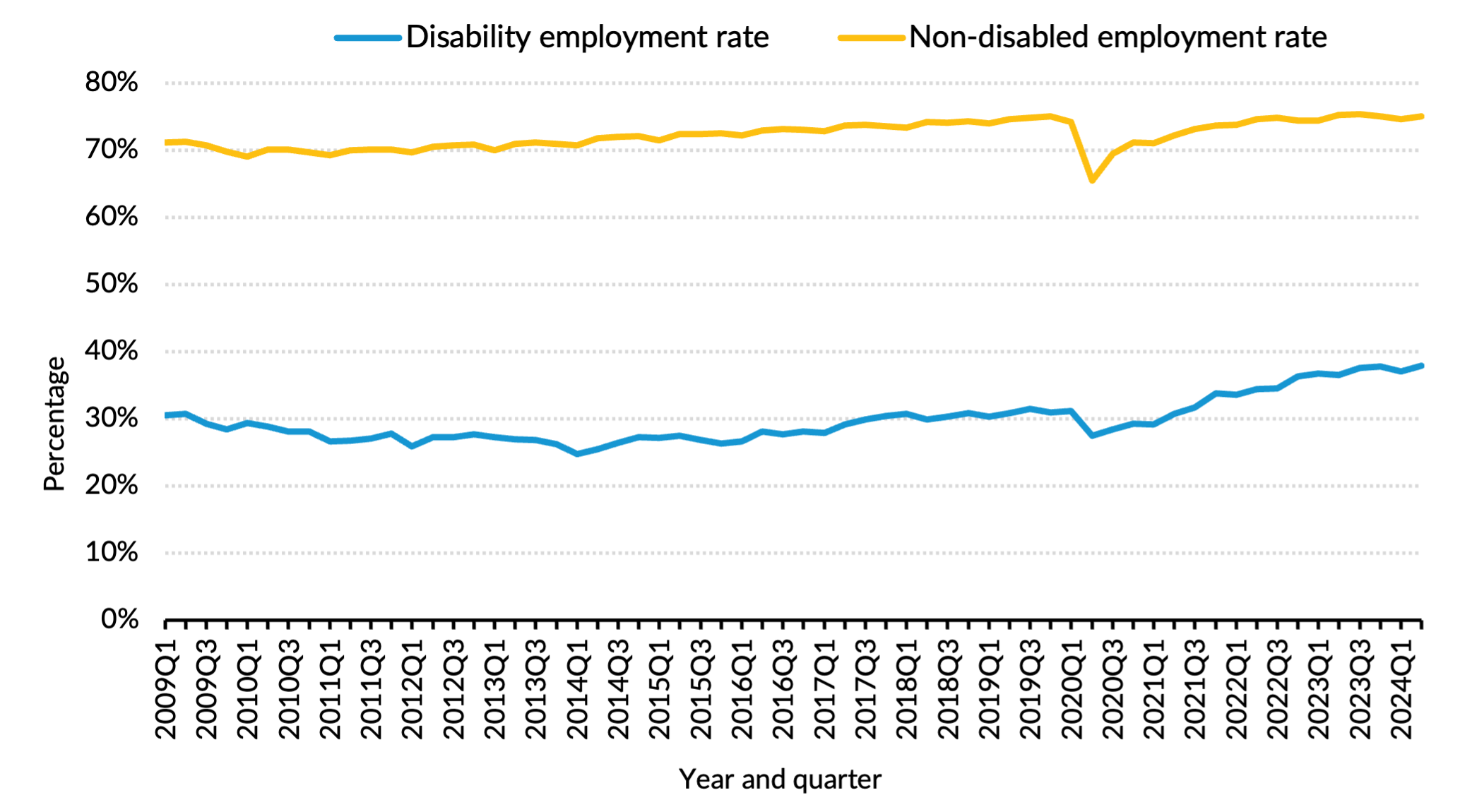
Source: Kyle DeMaria (ed.) and Christopher McLaren, “Trends in Disability Employment,” Trendlines 13, US Department of Labor Employment and Training Administration (October 2024), accessed December 7, 2024, https://www.dol.gov/sites/dolgov/files/ETA/opder/DASP/Trendlines/posts/2024_10/Trendlines_October_2024.html.
Why This Matters
Employment is foundational for economic mobility, but workers of color with disabilities face compounded barriers that negatively impact their livelihoods, families, and economic prosperity. Policymakers, philanthropists, and practitioners can play a pivotal role in advancing equity through evidence-based strategies that foster access to quality jobs. As the workforce continues to age and diversify, using inclusive employment practices will advance economic justice and sustain prosperity for future generations.
What We Found
- Economic security through policy change: Reforms such as phasing out the subminimum wage, providing benefit counseling, and modernizing benefit programs are crucial for ensuring fair wages and access to critical supports for workers of color with disabilities.
- Skills development for quality jobs: Initiatives like competency-based apprenticeships and tailored job training programs help workers of color with disabilities develop skills aligned with industry demands.
- Job access and retention: Effective models like Individual Placement Support (IPS) and employer collaboration initiatives address hiring biases and promote job retention.
- Improve workplaces: Employers can attract and retain talent and help disabled workers of color advance by promoting inclusion and offering accommodations. Employer collaborations—led by government or intermediary organizations—can support these efforts.
- Entrepreneurship pathways: Entrepreneurship offers autonomy and flexibility for disabled workers of color. Improving access to capital, business development training, and vocational rehabilitation supports can help overcome systemic barriers.
Research and philanthropy can play an important role in promoting narrative change, which is about changing preconceptions about workers of color with disabilities. Workforce philanthropy can take steps to make people with disabilities more of a focus by engaging disabled people and disability-focused organizations in shaping grantmaking. More research is needed at the intersection of race, disability, and work; research that includes disabled people of color and disabled researchers of color as integral to building evidence.
How We Did It
This work was led by researchers from the Urban Institute’s Work, Education and Labor Division (WELD) and Disability and Equity Policy Initiative (DEPI) with guidance from an external advisory group of representatives from disability-focused organizations. These efforts ensured our findings reflect diverse perspectives and real-world challenges.
