
Why This Matters
One of the chief paths to wealth building in the United States traditionally involves homeownership, though people of color have often been prevented from purchasing or maintaining ownership. These dynamics have undermined the ability of homeowners of color to access opportunity by achieving and preserving homeownership. But through the Wells Fargo Foundation’s Wealth Opportunities Realized through Homeownership (WORTH) initiative, seven markets are investing in self-selected strategies to boost or preserve homeownership among households of color, allowing them to achieve the American dream.
What We Found
Through two years of WORTH investment, Urban estimates that 9,762 people of color have reached homeownership or had homeownership preserved. The total estimate of new and preserved homeowners of color reflects 3,998 in the first year. In the second year, Urban estimates that 5,764 additional people of color either achieved or preserved homeownership, an increase of 1,766, or 44 percent over the first year. These figures likely underestimate WORTH’s impact because they exclude those that were in the pipeline before WORTH investment and they mask the community-wide benefits.
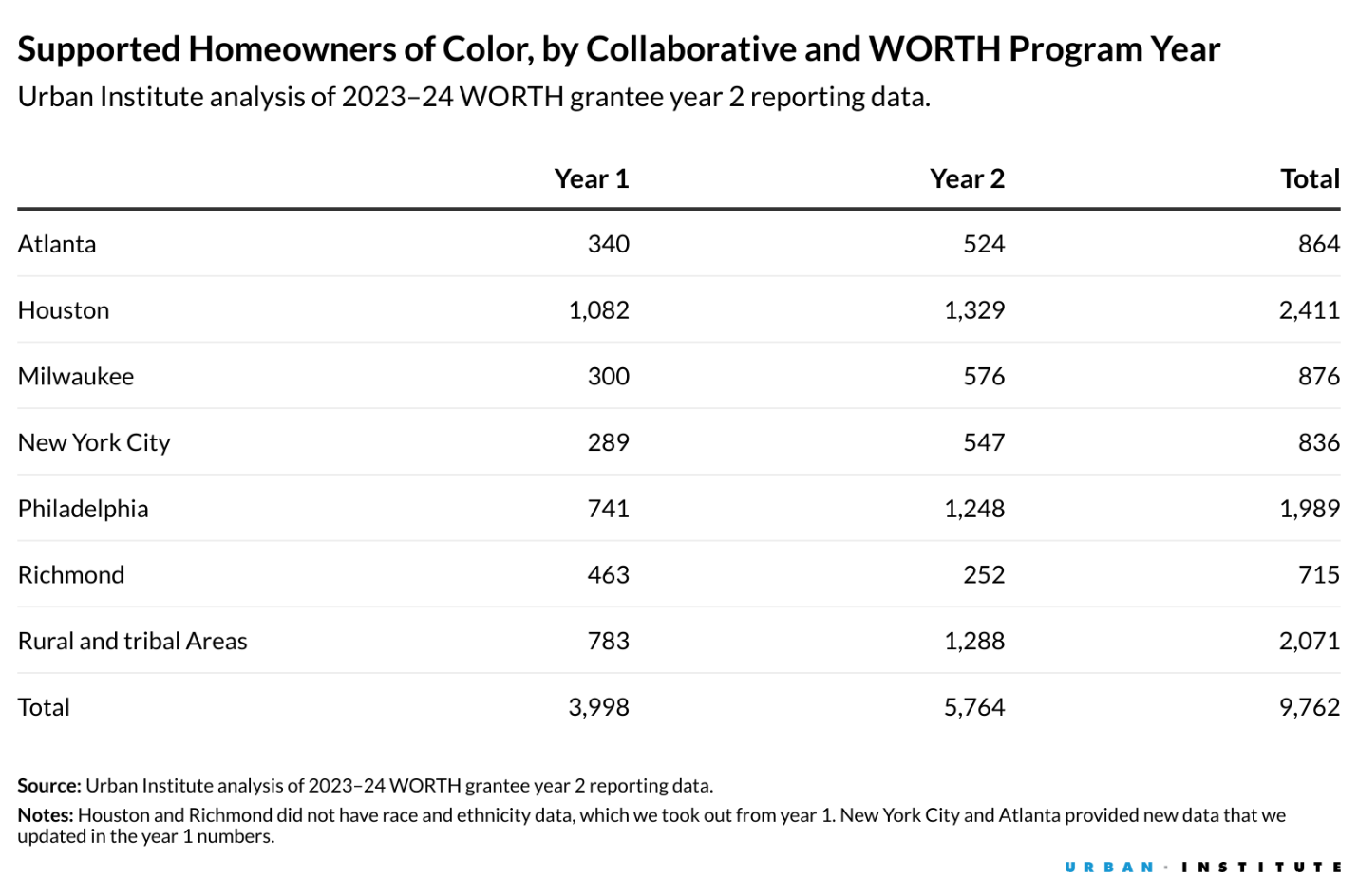
This report provides an account of the challenges encountered, efforts put forth, successes achieved, and lessons learned during the second year of implementation among the collaboratives composing the WORTH initiative. Key findings include the following:
- Collaboratives’ strategies in year 2 seamlessly continued those launched in year 1 but with deepened sophistication.
- Collaboratives expanded their strategies along the homeownership pathway to more intentionally address housing supply and affordability as well as homeownership preservation.
- Collaboratives have strengthened their local networks, outreach, and referral processes to improve service.
How We Did It
Urban came to these conclusions using a mix of interviews with participating collaboratives and analysis of data provided by these grantees. One parameter in our data calculations is that we count people of color that entered the program on or after April 1, 2022. Persons served or participating in activities within the evaluation period are still excluded if they entered the overall system before that date. This date is when we assume the Wells Fargo Foundation sent the first payments to collaboratives. But some collaboratives have shared outcomes for people of color that entered strategies before this date. If those entering strategies before April 1, 2022, and if those who either achieved or preserved homeownership were included, the activity counts would be higher.
