
This report examines the coverage and cost impacts of Senators Jeff Merkley and Chris Murphy’s Choose Medicare Act. The Act’s key feature is a public option plan that would be available in the nongroup, small group, and large group markets. The intent is to address the high premiums of plans in areas with concentrated insurance and hospital markets.
WHY THIS MATTERS
Health care costs are a major issue facing households, employers, and the federal government. A public option is one way to address the high level of health care spending.
WHAT WE FOUND
The Choose Medicare Act would introduce a public option into the nongroup, small group employer, and large group employer insurance markets and make reforms to the Affordable Care Act Marketplaces, including tying benchmark premiums to the gold metal tier rather than silver (providing premium tax credits for a more generous benefits package), enhancing Marketplace cost-sharing reductions, and providing a national reinsurance plan. We estimate when all provisions are included:
- the number of uninsured would fall by 3.6 million because insurance is now more affordable,
- households would save $20.3 billion in premiums and out of out-of-pocket costs,
- the federal government would save $20.8 billion, mostly on premium tax credits in the nongroup market, and
- employers would spend $23.3 billion less on premiums and would ultimately pass the savings to workers as higher wages.
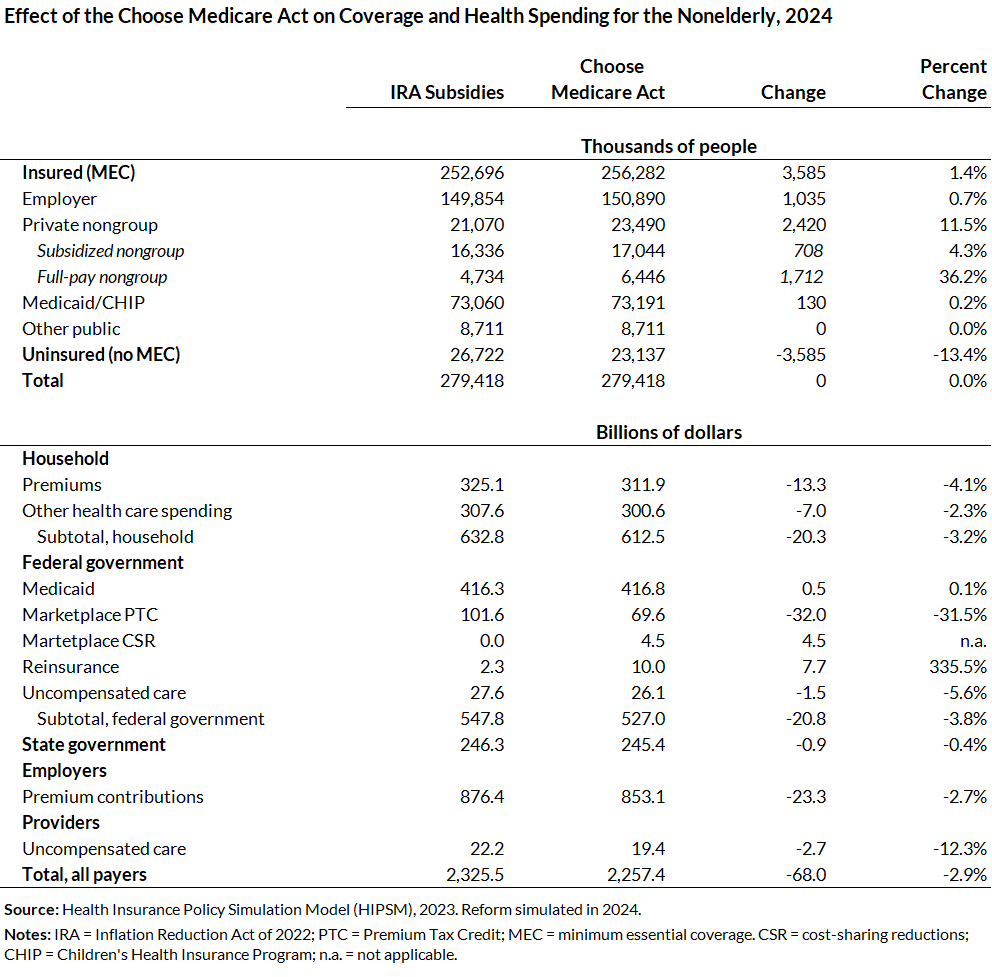
Over 10 years, households would save $241 billion, employers would spend $284 billion less on premiums, and the federal government would save $265 billion. The federal deficit would be reduced by about $388 billion over 10 years because wages are taxable while employer premiums generally are not.
While the public option would provide employers and households with more affordable insurance choices, it could be disruptive in many markets. Some insurers and providers could face serious financial consequences from the public option, but this would be true of any significant effort to contain health care costs.
HOW WE DID IT
We estimate the coverage and cost effects of the Choose Medicare Act provisions that affect the nonelderly population using the Urban Institute’s Health Insurance Policy Simulation Model, a detailed microsimulation model of the health care system designed to estimate the cost and coverage effects of proposed health care policy options. The model simulates household and employer decisions and models the way changes in one insurance market interact with changes in other markets.
