
Gentrification-related concerns are prevalent across much of the US. In many metropolitan areas, housing unaffordability is high, and changes in neighborhood character associated with dispossession and cultural removal of communities of color are common. There is a need to better understand effective place-guarding strategies relevant to race and socioeconomic factors.
Answering this call, this study uses street names to quantitatively describe the ways that racialized values and sentiments get absorbed into the housing market and shape neighborhood demographic composition. We ask two questions: All else equal, to what extent does being located on a street named after a Black cultural icon affect a property’s value in a gentrifying neighborhood? And how does being situated close to a street named after a Black icon affect an area’s Black population share over time?
Why This Matters
Met with the pressures of physical removal and cultural erasure that have been present in many changing neighborhoods over the last three decades, housing advocates, community organizers, local planners, policymakers, and residents of color are doing all they can to maintain the affordability and demographic character of gentrifying areas and areas at risk of gentrifying. This work has taken many forms, such as fighting for legal protections against eviction pressures, campaigning in support of rent-stabilization policies, securing funding for inclusive development, advancing collective ownership and communal living practices, and tenant unionizing. These efforts have had mixed degrees of success at slowing the pace of gentrification across much of the country.
This study contributes to a body of evidence that speaks to strategies with proven, measurable impacts on the gentrification-related factors of affordability and social clustering. We view this work as relevant to changemakers interested in expanding their toolbox of place-guarding strategies that can contribute to advancing housing justice.
What We Found
Looking at Harlem between 2000 and 2020, we find that, on average, properties situated on streets named after Black cultural icons had sale prices that were 13.8 percent lower than those of otherwise comparable properties on other streets. This suggests that naming streets after Black cultural icons may help dampen upward pressure on housing costs, contributing to affordability.
In our second line of inquiry, we find that areas surrounding streets named after Black icons do not experience higher shares of Black population retention over time compared with other parts of this rapidly gentrifying neighborhood. In fact, our analysis reveals that block groups intersected by a Black-icon-named street saw a greater decrease—of about 20 percent—in their share of Black residents between 2000 and 2020 than other block groups throughout Harlem.
How We Did It
This work involved three stages:
- In the first stage, we developed a theory of change that related housing purchase decisionmaking to concepts of othering, belonging, and racial identity.
Flow of impact from street name to housing market pressures
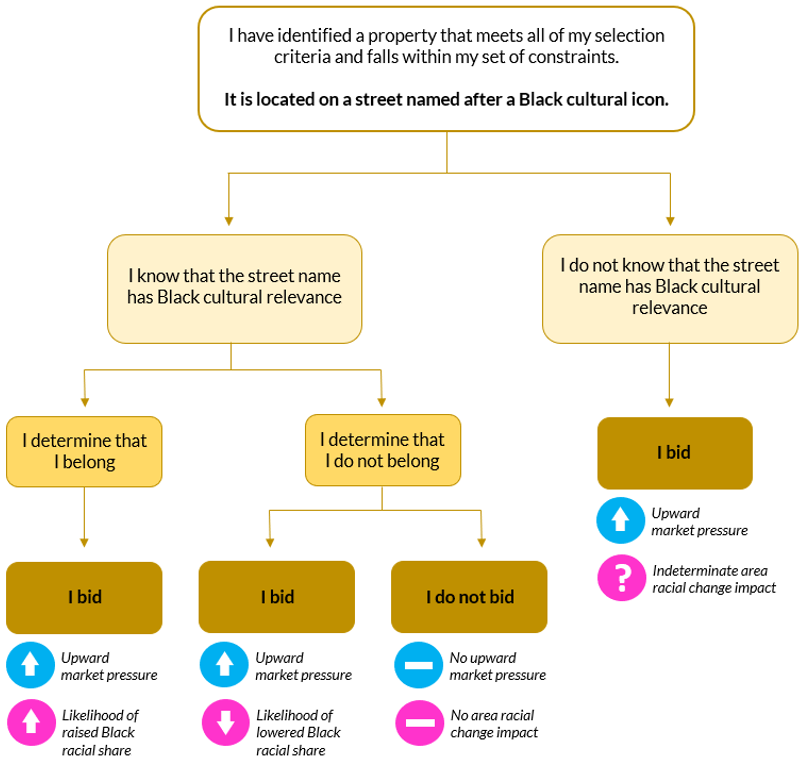
Source: Framework developed by the authors.
- In the second stage, we gathered and cleaned our data. This entailed reviewing the NYC Official Street Map dataset to classify every roadway segment in Harlem into several categories: numbered streets, worded (i.e., nonnumerical) streets, and streets named after identifiable individuals (i.e., street names with first and last names). For the last category, we also classified the racial information of the individuals. We then cleaned housing sale price data on properties sold in Harlem between 2000 and 2020, and amassed block group–level resident demographic data from the American Community Survey and NYC Open Data portal for the years spanning our two focal decades.
- In the third stage, we ran a hedonic pricing model to explore to what extent being located on a street named after a Black cultural icon affects a residential property’s value. We also ran an ordinary least squares regression to see how being situated proximately to a Black icon–named street affects change in an area’s Black population share over time.
