
The United States in is in the midst of a housing crisis, with residents facing rising housing costs and limited supply. To strengthen affordability, the US Department of Housing and Urban Development (HUD) funds a mix of programs that together are the largest single source of housing subsidies in the nation; however, this funding is nowhere close to adequate to meet the national need.
These programs, which generally distribute funds through formulas, reflect past choices made at the state and local levels. As a result, some communities consistently receive little affordable-housing funding per capita—even when their residents need it. This leaves many areas that suffer from high housing costs with low levels of support for housing and community development.
Why This Matters
HUD’s funding formulas reward communities that received funding in the past. For example, communities that received HUD funds decades ago for the construction of public housing are likely to continue to receive public housing support now. However, even in the best-funded communities, HUD funds are inadequate to meet housing needs. Moreover, HUD’s funding formulas present a reinforcing challenge: the less federal funding that communities received to develop or subsidize housing units in the past, the harder it is for them to access HUD funds today. This suggests the need for Congressional efforts to both expand support for housing subsidies and ensure that more funding is directed to communities where residents need support.
Key Takeaways
The presence of HUD-subsidized units, often first subsidized decades ago, is a strong predictor of federal housing spending; our analysis shows that communities with a limited number of such units received minimal support. We also found the following:
- Among the largest metropolitan areas, Boston, New York City, and San Francisco received the highest share of HUD funds, adjusted per capita.
- Funds from the Community Development Block Grant Program tended to benefit metropolitan areas with higher incomes. Community Development Block Grant funds cannot be used for the construction of new housing, but can subsidize associated investments, such as land improvements.
Areas with higher housing cost burdens tended not to receive increased housing voucher funds, suggesting the program’s formula does not respond directly to the need.
Per capita outlays for HUD programs, by metropolitan area, fiscal years 2022 and 2023
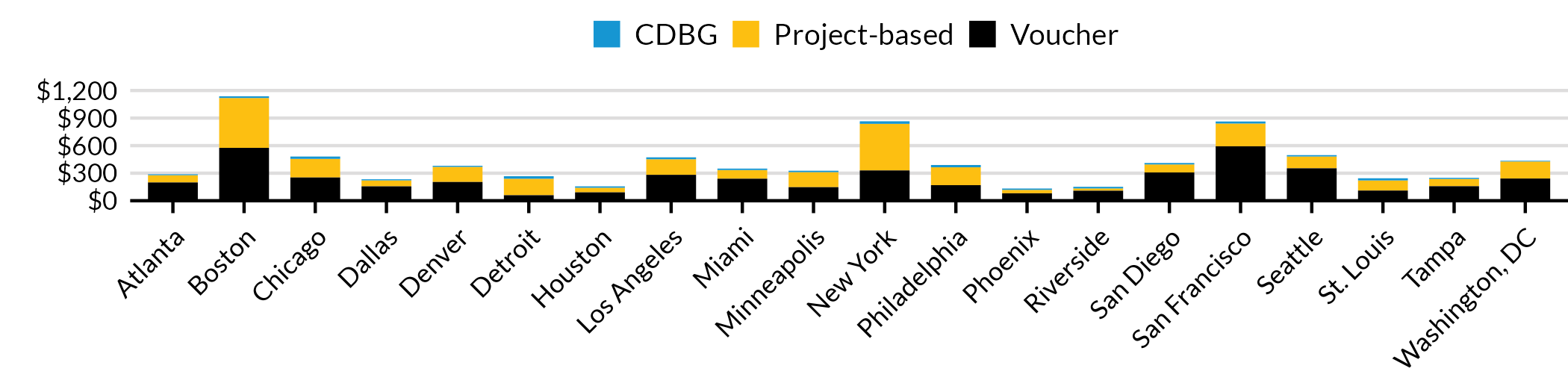
Source: Authors’ analysis of fiscal years 2022 and 2023 federal awards by metropolitan area.
Notes: CDBG = Community Development Block Grants; Project-based = Project-based Section 8, Section 8, and Public Housing programs; Voucher = Housing Choice Voucher program.
How We Did It
We compiled fiscal years 2022 and 2023 data on awards distributed through HUD’s major programs. Our analysis is conducted at the core-based statistical area (CBSA) geographical level, which is comprised of counties. We summed the total funding allocated to counties within each CBSA, excluding data for funding that was distributed outside of CBSAs. We collected demographic and housing-specific need-based indicators from the US Census Bureau 2016–20 five-year American Community Survey, the 2020 HUD Point-in-Time Count, and the 2022 HUD Picture of Subsidized Households. We detail our analysis in greater detail in our methods appendix.
We conducted similar analyses of fiscal years 2022 and 2023 funding for broadband, energy grid, climate resilience, and transportation programs. These findings are part of a larger effort to track the distribution of federal infrastructure investments (including housing).
