
The United States is approaching a historic demographic milestone. Within the next decade, older adults will outnumber children for the first time in American history. Montgomery County is aging even faster than the nation as a whole. Between 2011 and 2024, the share of county households headed by someone age 65 or older climbed from 21.1 percent to 28.2 percent, and the share is still rising. Yet the housing market is failing to keep pace.
Why This Matters
Housing costs are rising faster than fixed incomes can absorb, most homes were never built to accommodate physical decline, and the supply of affordable, care-supportive senior housing has not kept pace with demand. Without action, growing numbers of older adults risk being trapped in homes they cannot afford to maintain, being forced to live in unsafe conditions, or being pushed into homelessness. The decisions Montgomery County makes this decade will determine whether older residents can not only age in place but age well in place.
This report examines older adult housing stability through three interlocking dimensions, or the three A’s. A gap in any one of them can undermine an older adult’s ability to remain safely and stably housed, which is why Montgomery County needs to act on all three at once. Affordability is whether older adults can cover housing costs—rent, mortgage, taxes, utilities, and upkeep—on incomes that are often fixed or shrinking. Accessibility is whether a home and community can physically and socially accommodate aging in place, from grab bars and no-step entries to language access and social connection. Availability is whether enough of the right housing—from independent living to assisted living to nursing care—exists at a price older adults can afford, in the places they already live.
The Three A’s Framework for Housing Stability in Later Life
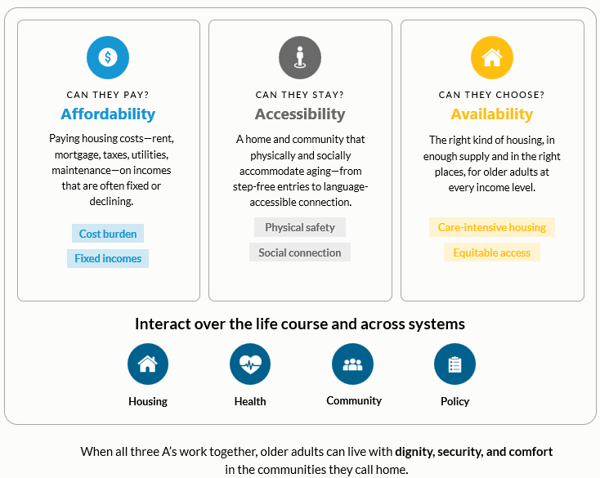
These dimensions are interdependent. A home can be affordable but physically unsafe, accessible but unavailable in a resident’s community, or available but priced out of reach. Montgomery County has real strengths across all three but also real, measurable gaps, detailed below.
What We Found
- Montgomery County is growing older and has one of the largest shares of older adults in the DC area. These older adults cluster in distinct pockets shaped by housing development and income. Incomes generally decrease with age—with more than half of households ages 75 and older having low and moderate incomes—and most older adults age in place as homeowners, but many carry mortgage debt into retirement. More older adults live alone as they age, raising the stakes for social support and accessible housing, and disabilities become increasingly common as people age. The county's older population is also more racially and ethnically diverse than the nation and most neighboring counties, and a meaningful share of older households are linguistically isolated.
- Older adults struggle with affordability. Older LMI renters are most severely cost burdened, with rising rents, fixed incomes, and growing housing instability. Cost-burdened older homeowners are squeezed by rising taxes, utilities, and fees or are stuck in too-large homes. Asset-rich and cash-poor households have trouble navigating the long-term care gap, and senior homelessness is rising, unseen, and underserved.
- Older adults also face accessibility challenges. The housing stock was not built for aging populations. Renters face inaccessible conditions they cannot fix, and home modifications are reactive, expensive, and out of reach for most homeowners. Social isolation compounds these physical barriers, raising the risk of dementia and broader health decline, and language barriers make it harder still for immigrant and non-English-speaking older adults to get help.
- Availability is another issue. The right housing for every stage of life is not always within reach. Care-intensive senior housing concentrates in high-income, majority-white neighborhoods. And there is an affordability paradox. Even when affordable senior housing gets built, affordability remains elusive for many residents (a paradox rooted in the fact that senior housing bundles rent with care services), and “affordable” typically refers only to the rent portion of that bundle.
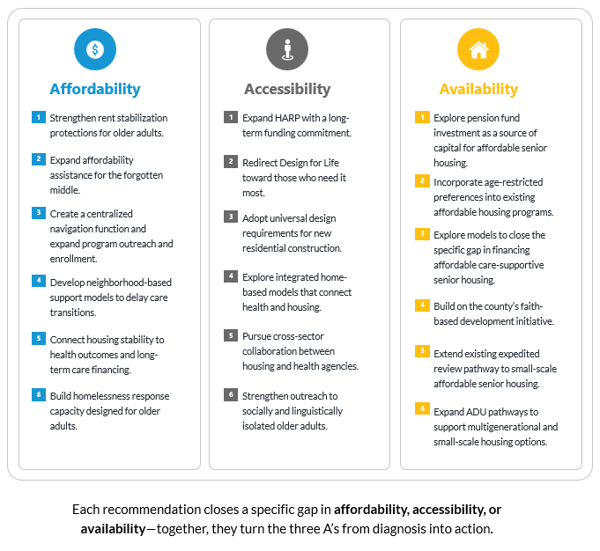
- There is no one-size-fits-all solution. Housing stability in later life requires action across affordability, accessibility, and availability at once and collaboration at every level, from federal financing and state regulation to county investment and the housing-health partnerships the most effective interventions depend on. This report translates evidence into action, organized around the same three A’s. For each dimension, it summarizes the county’s existing policy landscape, identifies the most pressing gaps, and proposes targeted recommendations, drawing on peer-jurisdiction models where relevant. The playbook below previews them.
The Policy Playbook for Housing Stability in Later Life
How We Did It
This report pairs data analysis with direct community engagement. On the data side, we drew on the 2024 American Community Survey, the 2023 American Housing Survey, the 2022 Survey of Consumer Finances, and county property records on age-restricted housing facilities to build an up-to-date picture of who Montgomery County's older residents are, where they live, and what housing challenges they face today.
To ground that analysis in lived experience, we worked with a seven-member advisory group drawn from four county partners—the Department of Housing and Community Affairs, the Planning Department, the Commission on Aging, and the Department of Health and Human Services' Aging and Disability Services Unit. With their guidance, we designed and facilitated five community engagement sessions: four virtual listening sessions with older residents, service providers, housing developers, and policy stakeholders, and one in-person focus group with state and county policymakers. Direct quotes from these sessions appear throughout the report alongside the data, capturing what the numbers alone cannot.
