
Why This Matters
Most US communities do not have enough housing, especially for families with low and moderate incomes. This shortage drives up housing costs and makes it harder for people to live near jobs, high-quality schools, and services. As a result, many households are forced to spend a growing share of their income on housing or endure long commutes, overcrowded conditions, or housing instability.
To help address this issue, many states and regions are increasingly playing a catalytic role in solving housing shortfalls. One way they are doing so is by creating housing production targets coupled with incentives and tools to encourage localities to increase housing production. These targets give communities a clear goal for how much housing they need to build and encourage local governments to update their plans and policies to work toward those goals.
When designed well, housing targets can help align local decisions with broader state or regional needs, making it easier to get housing built in the places that need it most. This brief provides an initial overview of how states and regions are setting housing production targets and introduces a framework for understanding the design choices involved.
Key Takeaways
Housing target strategies can be broken into three major steps: setting goals, selecting methodology, and implementing targets. Each of these steps comes with key decision points that have trade-offs.
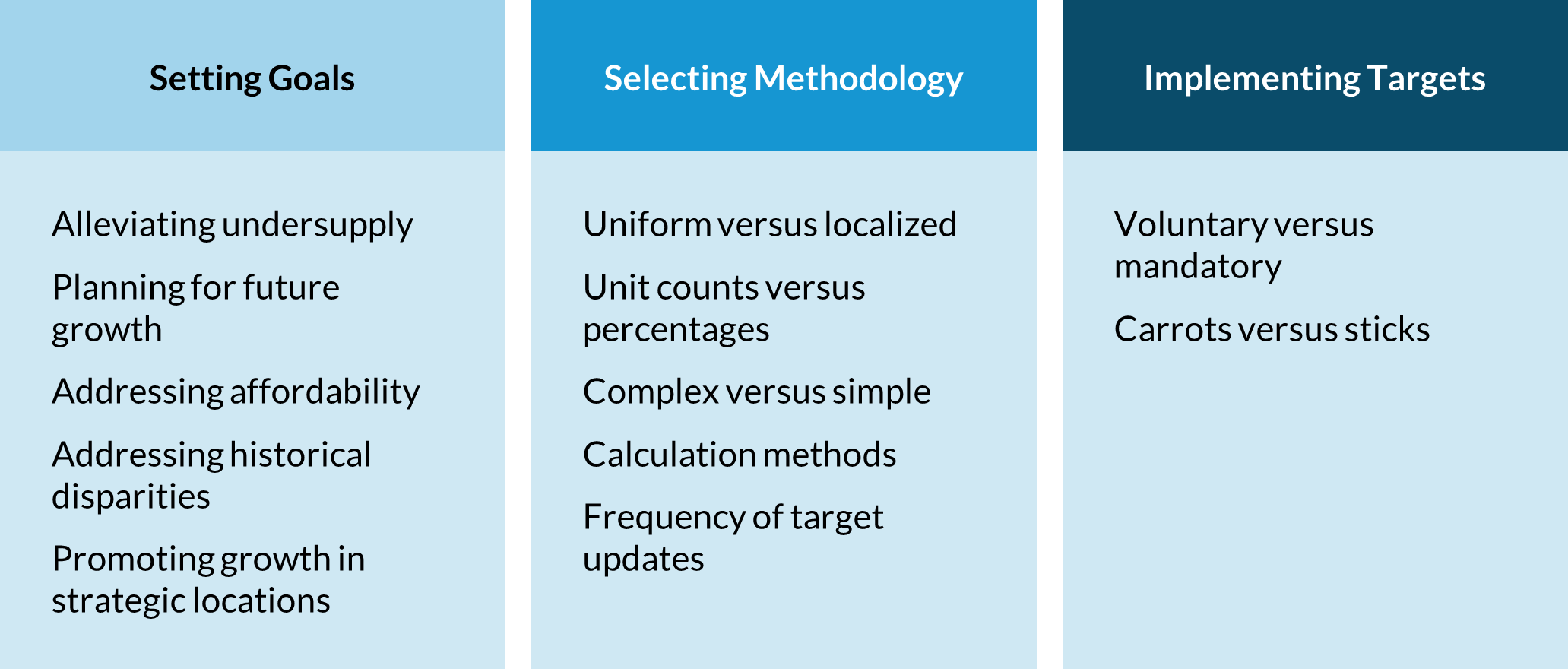
Source: Authors’ analysis of case study programs.
From interviews with leaders in our four case study areas, we identified the following considerations for state leaders looking to create housing target-setting programs:
- Clearly define the program’s goals before setting housing targets. Is the goal to address shortages overall? Improve affordability? Enable growth in strategic areas, such as job centers?
- Design targets to address both immediate housing needs and anticipated future demand, as addressing only one dimension can overlook critical pressures and hinder long-term progress.
- Set housing production targets that are ambitious yet grounded in realistic assessments of local capacity, recognizing that external factors beyond local control—such as interest rates, construction costs, and labor availability—may affect outcomes.
- Establish a regular update cycle for targets that balances timeliness with administrative feasibility.
- Apply transparent, data-informed methods that can be updated as better tools or information become available.
- Avoid basing targets solely on past housing production and instead account for regional equity and unmet needs.
- Use a mix of incentives and disincentives that align with the state or region’s legal framework, political context, and institutional capacity to encourage local compliance with housing targets.
- Provide technical support and public tracking systems to help jurisdictions meet goals and remain accountable.
How We Did It
We conducted case studies from four states and regions—Massachusetts, New Jersey, Oregon, and the Washington, DC, region—and conducted a landscape literature and policy review on housing target programs more broadly. We also interviewed key administrators and experts in our four case study areas.
