
Medicaid is a critical support for women of reproductive age across the US, providing access to general preventive and curative care and family planning services that allow women to choose whether and when to become pregnant. It also promotes the health of women and infants by ensuring access to preconception, prenatal, and maternity care. Congress is considering cuts to Medicaid that could cause many states to drop their Affordable Care Act Medicaid expansions. Prior research using the Urban Institute’s Health Insurance Policy Simulation Model found this would leave 15.9 million people in 40 expansion states and DC without Medicaid coverage in 2026 (Buettgens 2025). This new extension of that research finds that women of reproductive age (18–49) would comprise over one-third of those losing Medicaid coverage. The Medicaid expansion has been shown to decrease uninsurance among low-income women of reproductive age (Johnston et al. 2018). Rolling back the expansion could reverse that progress, increasing uninsurance among millions of women across the US.
Eliminating Medicaid Expansion Would Leave an Estimated 5.7 Million Women Without Medicaid
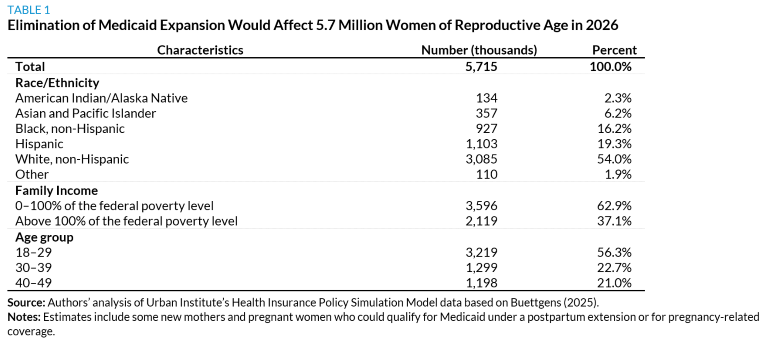
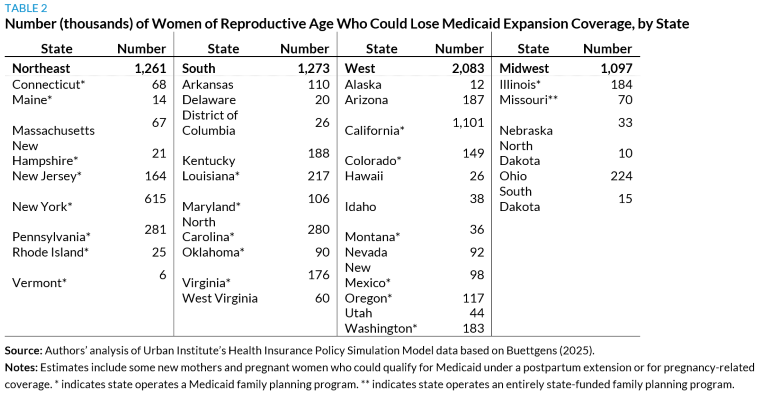
We estimate that 5.7 million women of reproductive age would have expansion coverage in 2026 and be at risk of losing Medicaid if the expansion were eliminated (table 1). White women of reproductive age constitute the single largest racial/ethnic group at risk of losing Medicaid expansion coverage (54 percent or 3.1 million), while 1.1 million women who are Hispanic, 927,000 who are Black, and 601,000 of other races/ethnicities are also at risk. Close to 3.6 million of the women with Medicaid expansion coverage (62.9 percent) have incomes below the federal poverty level, and more than half (56.3 percent) are between the ages of 18 and 29. We estimate that at least 100,000 women of reproductive age would have Medicaid expansion coverage in 2026 in Arizona, Arkansas, California, Colorado, Illinois, Indiana, Kentucky, Louisiana, Maryland, Michigan, New Jersey, New York, North Carolina, Ohio, Oregon, Pennsylvania, Virginia, and Washington (table 2).
Eliminating Medicaid Expansion Would Impede Women’s Access to Reproductive Health Care
Medicaid expansions improved women’s access to and utilization of health care, increased use of effective contraceptive methods, reduced infant mortality, and improved postpartum health (Guth and Diep 2023; Johnston et al. 2018; Margerison et al. 2020). Rolling back the Medicaid expansion would put 5.7 million women of reproductive age at risk of losing comprehensive, affordable coverage. Most would become uninsured, but some would be eligible for up to a year of Medicaid coverage through postpartum extensions, while others would transition to private coverage but face higher cost-sharing. Those who become uninsured may be eligible for a Medicaid family planning program, available in 22 expansion states. Some may have access to federally funded Title X services such as cancer screening, contraceptive care, sexually transmitted infection testing, and pregnancy testing. However, neither Medicaid family planning programs nor Title X provides the full scope of health insurance offered by Medicaid coverage, and ongoing access to these programs is not guaranteed.
