Evaluation is essential for understanding the effects of guaranteed income programs. Although research on pilots outside the US are extensive, research on US initiatives only gained traction after 2018. Now, there are more than 150 US guaranteed income pilots and nearly all of them conduct external evaluations.
Coordinated evaluation efforts can strengthen the case for guaranteed income by producing unified, evidence-based insights that individual programs couldn’t achieve alone.
Create a Learning Agenda and Shared Theory of Change
To support joint learning across diverse programs, create a shared learning agenda. Focus on building a theory of change for the target area, presenting data, and identifying common indicators and results.
A theory of change is a simple, often visual, representation of what a group or entity wishes to change and why its approach will produce that change. A group’s mission statement and work plans may say what it does, but the theory of change expresses why the group is doing it.
The LA GICC engaged Westat and the Urban Institute to visualize each member’s theory of change and then to combine those theories into a single theory of change for the entire coalition, with various paths for certain populations and places.
This approach helps programs learn from each other and connect their work to broader policy goals.
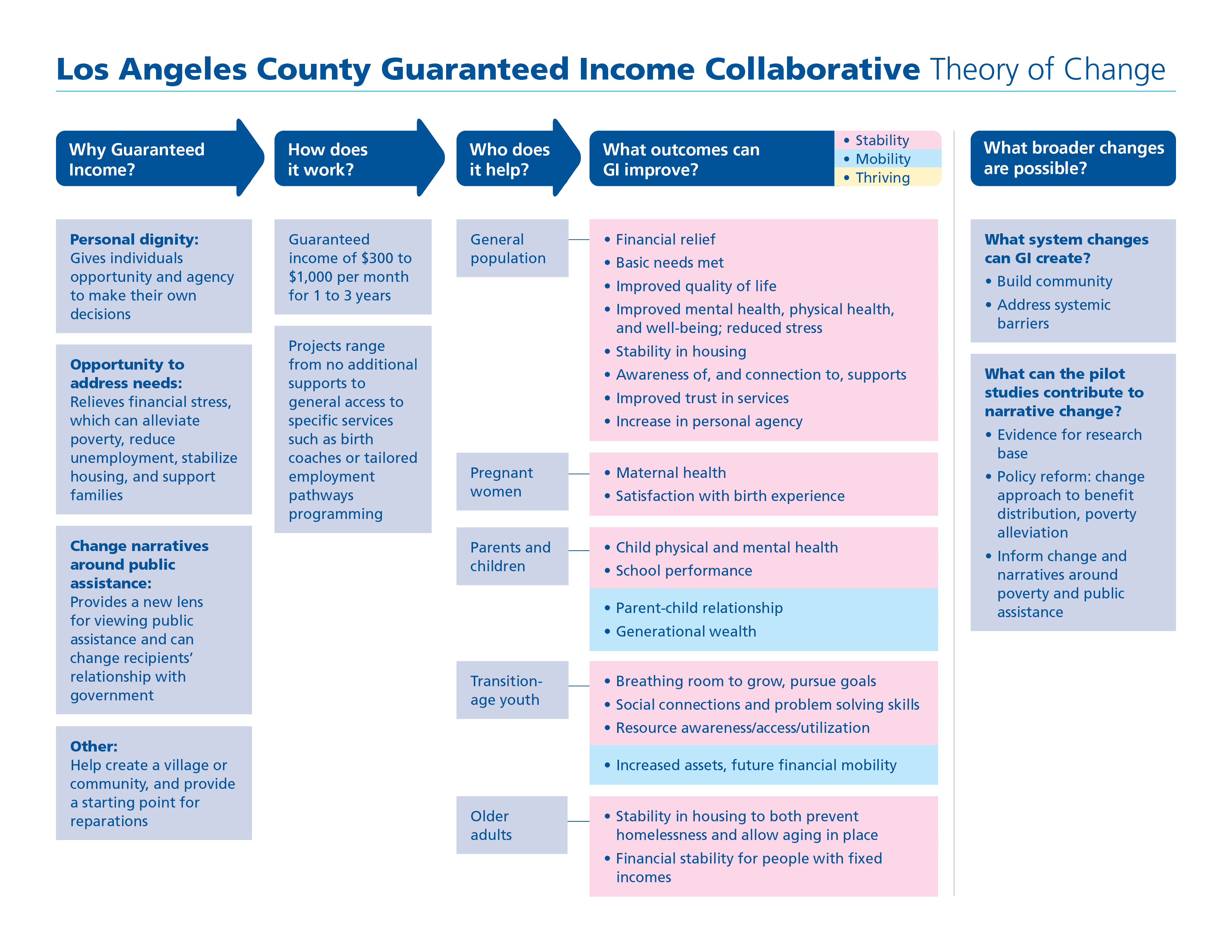
Source: Westat. Reprinted with permission.
Help Programs Conduct Evaluations
Coalitions can support programs by offering technical assistance for different evaluation methods. The LA GICC helped members develop theories of change, refine program models, design research, and select samples via partnerships with Westat and the Urban Institute.
Set up a Data Dashboard
Coalitions can help member programs set up data dashboards to serve as a key communication tools. These dashboards can display participant demographics and show how guaranteed income programs change lives, making the effects of guaranteed income programs more visible and accessible to stakeholders.
For example, LA GICC members Breathe, BIG:LEAP and the West Hollywood Pilot for Guaranteed Income are featured on the Guaranteed Income Pilots Dashboard, which visualizes data from over 30 pilots from across the United States.
Help Programs Communicate Their Findings
Direct cash coalitions can help their members present evaluation findings from their own programs more convincingly by placing them within the context of fieldwide findings. If the findings from an individual program differ from what has been found in other studies, coalitions should help their members explain what unique factors may be driving that difference.
Learn more about how to use data to tell compelling change narratives.
Synthesize Data across the Coalition
To scale guaranteed income programs, coalitions can analyze combined results across programs. This can help reveal trends and shared challenges that could inform future policy.
Use synthesized data to highlight broad outcomes, like financial stability, mental health, and child outcomes.
Working with partner evaluator Westat, LA GICC compiled pilot data and built a strong evidence-based case for guaranteed income. Westat is synthesizing demographic data and results from third-party evaluations of LA GICC pilots and hopes to release the findings in 2026.
LA GICC exemplifies coordinated evaluation, partnering with Westat and the Urban Institute to build a learning agenda and measure collective impact. This collaboration strengthens the case for guaranteed income by producing unified, evidence-based insights that individual pilots alone cannot achieve.